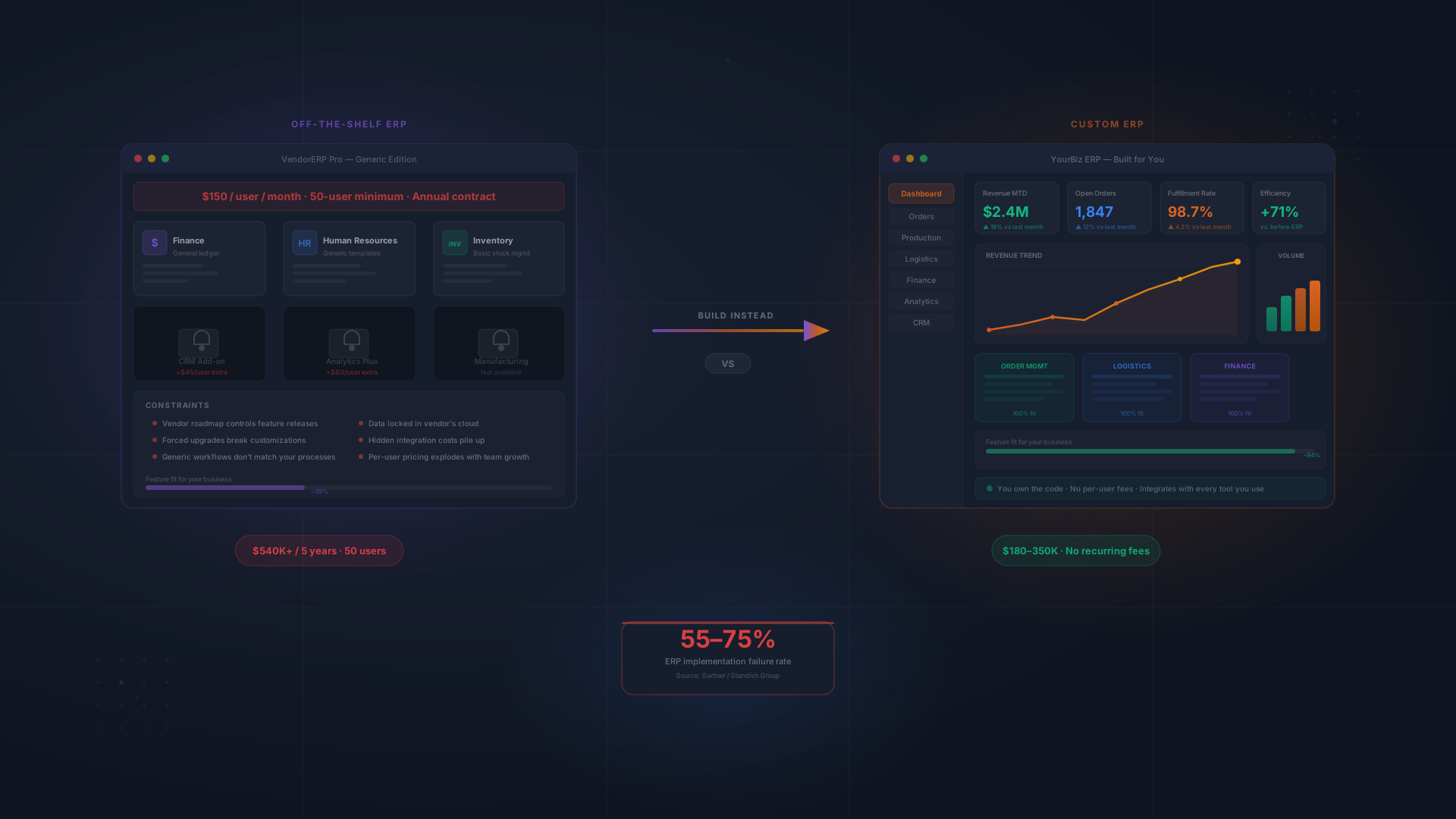
Between 55% and 75% of ERP implementations fail to meet their objectives. The average project runs 189% over budget. Only 25% are completed on time and within the original scope. For a growing company, choosing the wrong ERP path is not just expensive: it can set operations back years.
And yet the ERP market is worth $78–83 billion in 2026 and growing at 10% annually. Companies are not struggling to find an ERP. They are struggling to find one that actually works for their specific operations. Nearly 45% of firms end up switching ERP systems specifically because of off-the-shelf feature limitations.
This guide provides an honest, data-backed comparison of custom ERP vs off-the-shelf ERP for companies with 20–500 employees. You will find real vendor pricing (SAP, Odoo, NetSuite, Dynamics 365), a genuine 5-year total cost of ownership breakdown, a clear decision framework, and an honest view of when not to build custom.
Why Growing Companies Face a Different ERP Decision
The 20–500 employee range is a specific and difficult zone. You have outgrown spreadsheets and point solutions. But you are also too operationally specific for a generic, one-size-fits-all ERP module. Your supply chain, production workflows, client management, or fulfilment processes likely have characteristics that no standard template anticipates.
92% of midsize enterprises have either implemented or planned to implement ERP software. At this stage, the ERP decision touches every department: finance, operations, inventory, HR, sales. It is not a tool purchase. It is an infrastructure decision. Get it wrong and the wrong system compounds every inefficiency it was supposed to solve.
Off-the-shelf ERP has a structural ceiling. As companies grow, they discover that packaged platforms were built for an average business, and their business is not average. The average SMB uses only 40–60% of available features in a standard ERP package, while paying for all of them.
The response is almost always more configuration. Administrators add custom fields, purchase add-ons, and hire consultants to bend the system toward their processes. This work is expensive and takes months, and it can break when the vendor pushes an update. At the end of it, you still own nothing.
Custom ERP is often dismissed with a reflexive "too expensive, too slow." In 2026, that objection is increasingly outdated. AI-assisted development and modern frameworks have compressed timelines significantly. Central European development teams, including Czech, Slovak, and Polish firms, deliver at $40–80 per hour with the technical quality of Western European teams. A focused custom ERP MVP can be in production within 3–5 months.
The Real Cost of Off-the-Shelf ERP: Named Vendors, 2026 Pricing
Most comparisons of custom vs off-the-shelf ERP are vague about actual costs. Here is what the major packaged ERP platforms actually charge a 50-person company in 2026, before any customization, add-ons, or consulting:
ERP Platform | License per user/month | Annual license (50 users) | Implementation cost |
|---|---|---|---|
SAP Business One | $91–$219 | $54,600–$131,400 | $50,000–$150,000 |
Odoo Enterprise | $47 | $28,200 | $25,000–$75,000 |
Oracle NetSuite | $99–$149 + $999 base | $72,000–$107,400 | $75,000–$250,000 |
Dynamics 365 Business Central | $80–$110 | $48,000–$66,000 | $40,000–$100,000 |
These are base prices. The hidden costs are where the real numbers emerge. Third-party add-ons add 50–200% to base ERP price. Customizing a packaged ERP to fit non-standard processes costs $50,000–$500,000, and that customization can break with vendor updates. Data migration alone runs $12,000–$75,000 depending on legacy system complexity. Training is typically 15–20% of total project budget. Consulting fees run $150–350 per hour, with complex deployments exceeding 700 hours.
Most companies underestimate ERP implementation costs by 30–50%. That is not a coincidence: it is what happens when vendor quotes exclude the work that actually makes the system functional for your business.
What Custom ERP Development Costs
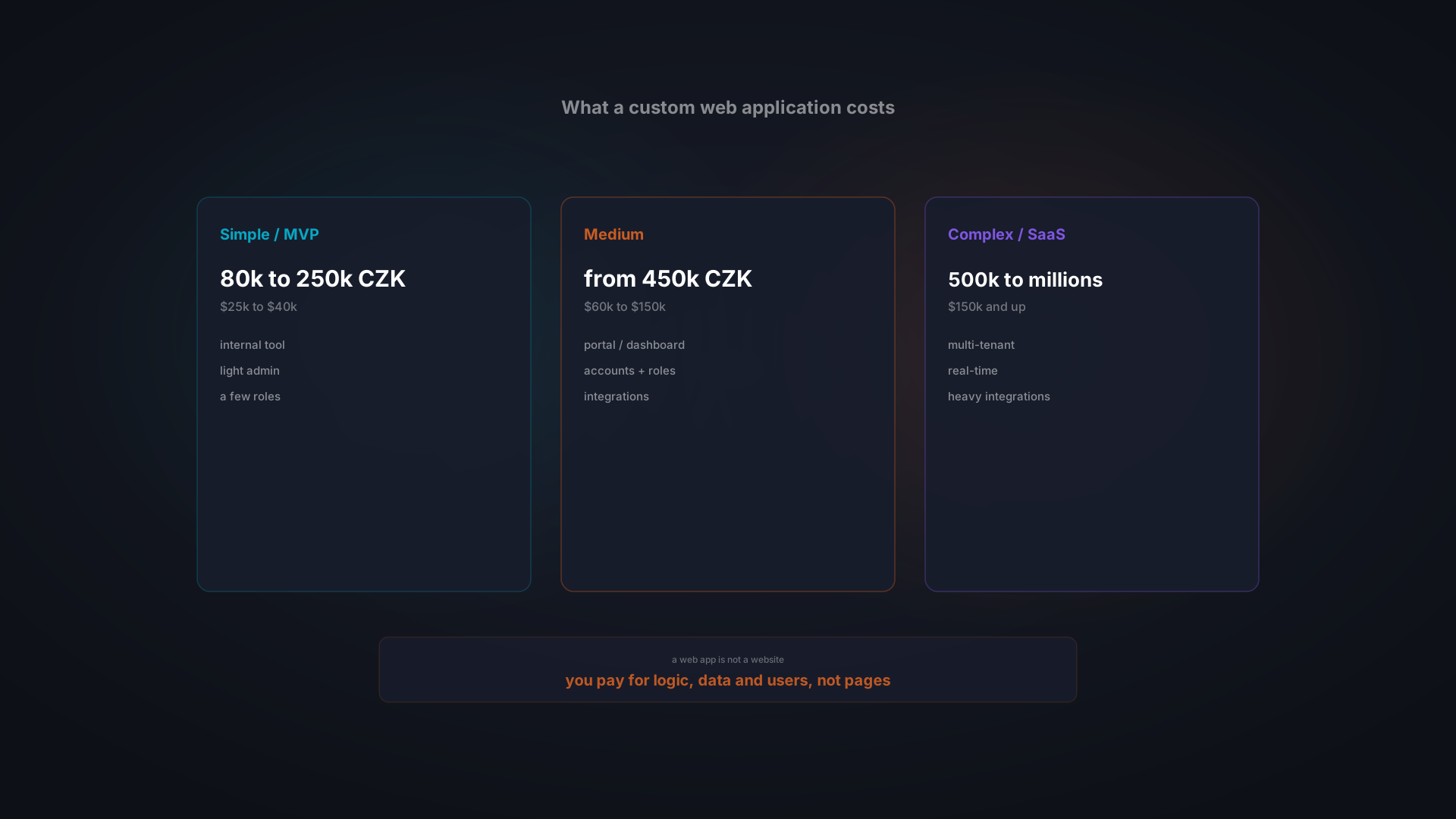
Custom ERP development follows three broad tiers based on scope and team size:
- Focused MVP ($40,000–$80,000, 3–5 months): Core operations modules for 20–50 users. Covers the primary workflow bottlenecks: order management, inventory, invoicing, or basic finance. Sufficient for most early-stage ERP replacements.
- Mid-Range with Integrations ($80,000–$200,000, 5–9 months): Multi-department coverage for 50–150 users. Includes API integrations with existing tools, custom reporting, and role-based access. The most common tier for growing mid-market companies.
- Enterprise-Grade ($200,000–$400,000+, 9–18 months): Full operations platform for 150–500 users. Multi-site support, advanced analytics, custom AI integration, and complex supply chain or production modules.
After launch, annual maintenance runs 15–20% of the initial development cost. There are no per-user licensing fees. Adding 50 or 500 users costs infrastructure, not licensing. Central European development rates ($40–80 per hour) make these figures achievable without the quality compromises of offshore development.
5-Year Total Cost of Ownership: The Real Picture
The meaningful comparison is not upfront cost: it is total cost of ownership over the period you plan to use the system. Here is a realistic 5-year TCO comparison for a 50-person company, using mid-range estimates:
Year 1 cost | Annual cost (yr 2–5) | 5-year total | |
|---|---|---|---|
SAP Business One | ~$155,000 | $63,000–$77,100 | ~$434,600 |
Odoo Enterprise | ~$78,000 | $33,000–$39,500 | ~$222,500 |
Custom ERP (mid-range) | ~$120,000 | $20,000–$25,000 | ~$210,000 |
Custom ERP reaches break-even with SAP Business One by month 18–24. It reaches cost parity with Odoo by year 3, then pulls ahead as headcount grows, because adding users has zero incremental licensing cost.
These figures exclude the hidden costs of off-the-shelf customization ($50K–$500K) and integration workarounds that accumulate over time. Factor those in and the custom ERP advantage is substantially larger.
For context: custom software delivers approximately 243% ROI within 3 years according to industry studies. Custom ERP workflows specifically have shown ~90% ROI over five years. SaaS subscription inflation is running at 12.2% annually, 4x faster than general inflation, which means the off-the-shelf cost trajectory only worsens over time.
Where Custom ERP Delivers the Biggest Advantage
Process Fit: Your Operations, Not a Template
Off-the-shelf ERP is built for a hypothetical average business. Growing companies typically have workflows that are not average: proprietary processes that are often the source of their competitive advantage. Forcing those processes into a standard ERP template either breaks the process or breaks the ERP.
66% of organizations report that ERP improved operational efficiency, but only when the system matched their actual processes. Companies with custom digital solutions achieve 20–30% higher operational efficiency overall. The gap between a system built around your operations and a system you have been configured to work around compounds every single day.
Custom ERP eliminates the "workaround culture": the shadow spreadsheets, manual re-entry, and informal processes teams build to work around ERP limitations. That culture is not just inefficient; it makes your data unreliable and your operations opaque. If you recognize it in your organization, that is a strong signal your current system is not working.
Scalability Without Per-Seat Penalties
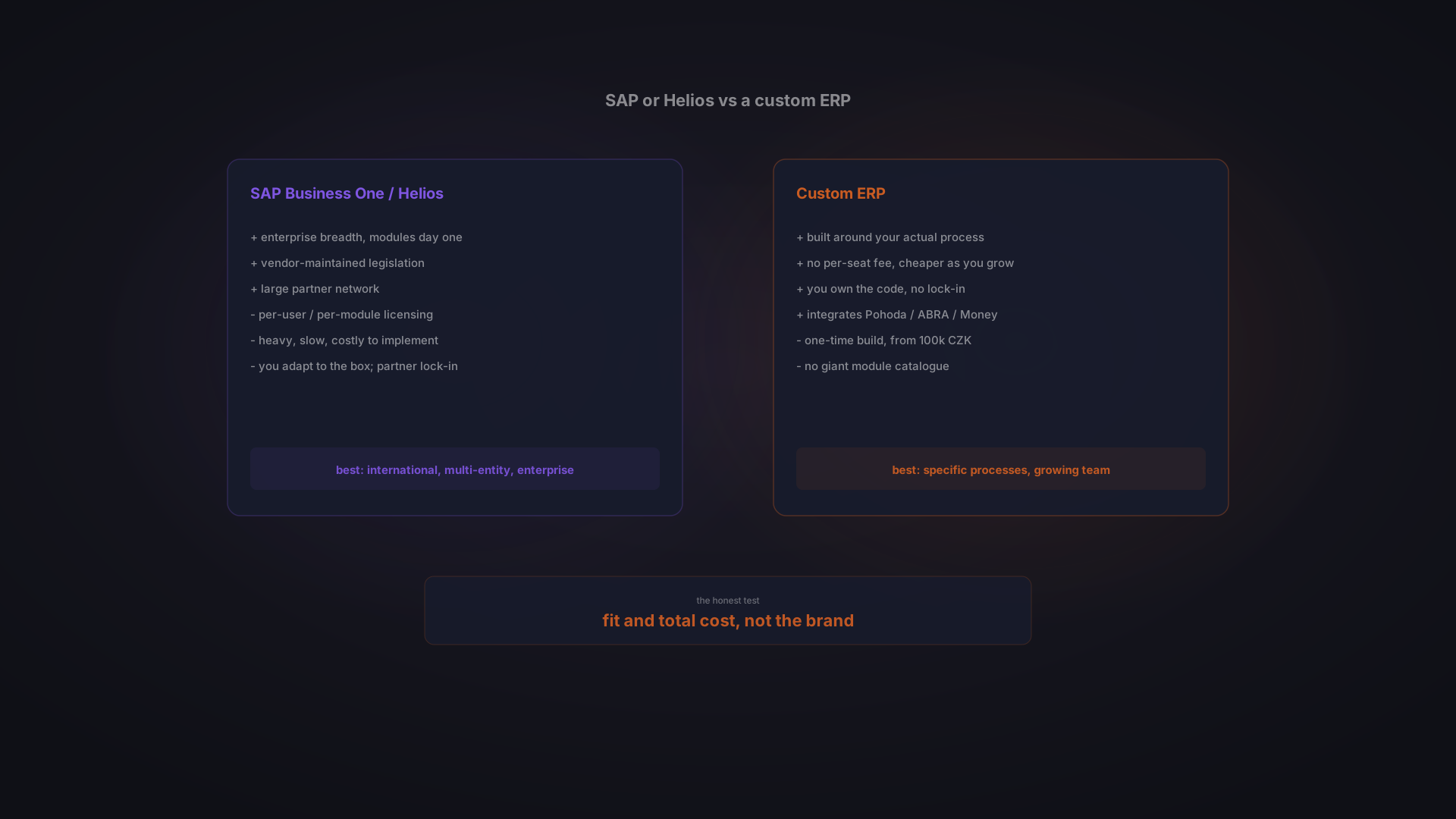
Growing from 50 to 150 users on SAP Business One increases your annual license cost by over $100,000. With a custom system, you pay for infrastructure, not licenses. That asymmetry becomes more significant every year as your headcount grows. We compare that cost curve against SAP and Helios in our SAP and Helios alternative comparison.
Custom ERP can also be architected around your specific growth trajectory. Adding a new department, a second location, or a new product line is a development sprint, not a vendor negotiation, a tier upgrade, or a new contract. The system scales with your decisions, not with the vendor's pricing model.
Data Ownership and GDPR Compliance
For European businesses, data sovereignty is not an optional consideration: it is a legal requirement. The EU Data Act (effective September 2025) extends sovereignty requirements to non-personal and industrial data. The CLOUD Act creates a direct conflict: US-headquartered cloud providers, including those hosting NetSuite and Dynamics 365, can be legally compelled to share European business data with US authorities regardless of where the data is physically stored.
A self-hosted custom ERP built by a European team provides full GDPR compliance with EU data residency by default. There is no ambiguity, no cross-border data transfer risk, and no dependency on a US-headquartered vendor's compliance posture. 47% of enterprises already cite data migration as a significant barrier to switching providers. Custom ERP avoids that lock-in from day one.
AI-Powered Operations Built In
In 2026, custom ERP means custom AI. Purpose-built AI agents can be integrated directly into your operations workflows: demand forecasting calibrated to your specific products and seasonality, inventory optimization tuned to your supplier lead times, invoice processing automation against your document formats, anomaly detection trained on your historical data.
Generic ERP AI features are limited to what the vendor builds for an average customer. Invoice processing automation alone delivers up to 460% ROI with a 6-month payback. That return is only available when the AI is built around your actual documents and processes, not a generic module that approximates them. This is the 2026 differentiator that no packaged ERP can match at the same depth. If you want to explore what custom AI agents for business operations can do in your specific context, the opportunity is significant.
The Off-the-Shelf Reality Check: Failure Rates and Hidden Risks
The failure statistics deserve more attention than they typically receive. 55–75% of ERP implementations fail to meet their stated objectives. 70% of ERP implementations over the next three years are expected to miss their goals, according to Gartner. Average cost overruns are 189% across all industries, with discrete manufacturing hitting 215%.
These failures are not random. The top three causes account for 75% of all ERP project failures: inadequate change management, poor data migration, and inexperienced implementation teams. All three are significantly harder to manage when the software imposes its own logic on your processes. Custom ERP reduces these risks because the system is built around how your teams already work, not the other way around.
Vendor lock-in is the long-term version of the same problem. 74% of ERP buyers now evaluate switching costs before purchasing, up from 47% in 2018. Custom code built with vendor-specific tools cannot run on another platform. Proprietary data formats make migration painful. One US manufacturer spent $2.5 million switching ERP vendors due to incompatible APIs and custom logic. 58% of customers who feel trapped eventually leave despite those costs, and they become active detractors in the market.
When to Choose Custom ERP vs Off-the-Shelf
Build a custom ERP when:
- Your operational workflows are proprietary and central to your competitive advantage
- You have 20+ employees and are growing: per-user licensing costs compound fast
- You need to integrate five or more systems into a unified operations platform
- You are spending $5,000+/month on ERP subscriptions plus workaround tools
- Off-the-shelf ERP would require significant customization (more than 30% of functionality)
- You operate in the EU and need GDPR/EU Data Act compliance with full data residency control
- Your team actively works around the current system with spreadsheets and manual processes
- You want AI capabilities built directly into your operations data and workflows
Stick with off-the-shelf ERP when:
- Your processes are standard and well-served by existing modules (basic accounting, standard inventory management)
- You need a system running within weeks, not months
- Your team is small (fewer than 20 people) with stable, predictable processes
- Your budget cannot accommodate upfront development investment
- You are in a heavily regulated industry where packaged ERP already handles compliance (pharmaceutical lot tracking, for example)
There is also a third path worth naming: the hybrid approach. Use packaged tools for commodity functions: basic accounting (Xero, QuickBooks), email, project management. Build custom for the core differentiating operations: order management, production planning, client workflows, specialized reporting. Connect everything through custom integrations and APIs.
58.5% of companies prefer a phased ERP implementation. Starting with one custom module, the piece of your operation that is most broken or most differentiated, and expanding from there is often the lowest-risk path for a growing business. You validate the approach before committing to full platform replacement.
A 5-Step Framework for Making the ERP Decision
Before engaging any vendor or development firm, work through these five steps:
- Audit your current operations stack. List every tool, spreadsheet, and manual process involved in daily operations. How many systems does data flow through? Where do people re-enter information? Where are the real bottlenecks?
- Calculate your true ERP spending. Add licensing, customization consulting, add-ons, integration costs, and the labor cost of workarounds: the time your team spends working around system limitations. Most companies underestimate their true ERP cost by 30–50%.
- Map your proprietary processes. Which workflows are unique to your business versus industry standard? The more proprietary your core processes, the stronger the case for custom. A standard pick-pack-ship workflow can run on any warehouse ERP. A custom production planning logic that is the reason customers choose you cannot.
- Project 3-year headcount and growth. Calculate how per-user licensing compounds as you grow. At what headcount does the custom break-even arrive? For most companies with growth ambitions, it is earlier than expected.
- Evaluate your data sovereignty needs. Do you operate in the EU? Process customer data subject to GDPR? Require data residency control? Custom gives you full ownership: no vendor terms, no CLOUD Act exposure, no dependency on a third party's compliance posture.
The output of this exercise is usually a clear picture: either packaged ERP is genuinely sufficient and the investment is justified, or the gaps between what you need and what any standard platform offers are large enough that custom is the right path.
What Good Custom ERP Development Looks Like
Not all custom development is equal. A custom ERP built quickly and cheaply, without proper discovery, on a fragile technology stack will create more problems than it solves. Here is what to look for in a development partner:
- Discovery before code. A team that starts building without a structured requirements phase will build the wrong system. Good discovery documents your actual workflows, maps your data model, identifies integration requirements, and produces a specification both sides sign off on before a line of code is written.
- Modern, maintainable technology. Next.js, React, Node.js, TypeScript, PostgreSQL: well-supported, widely-used technologies mean the system can be maintained and extended by any competent developer, not just the original team.
- User acceptance testing. The system should be validated by actual operations users before go-live, not just tested for technical bugs, but confirmed to match how your team actually works.
- Data migration support. Moving your historical data into the new system properly is non-negotiable. Starting with an empty ERP undermines the entire investment.
- Post-launch support. The first weeks after go-live reveal real-world usage patterns that no testing phase fully anticipates. A development partner should be available to address them quickly.
- Documentation. A system without documentation is a liability. You should receive clear documentation of the data model, API structure, and the reasoning behind key design decisions.
The Bottom Line on Custom ERP vs Off-the-Shelf
The ERP failure statistics are not a mystery. 55–75% failure rates are the predictable outcome of selling a generic platform to thousands of businesses with different operations and expecting it to fit. The companies that break out of that pattern are the ones that build for their specific reality rather than configuring their way to something adequate.
For companies in the 20–500 employee range with defined, proprietary operations, the custom ERP vs off-the-shelf comparison usually resolves clearly after a proper TCO analysis. The upfront custom development investment is real and bounded. Off-the-shelf costs have no ceiling, and with SaaS inflation running at 12.2% annually, that ceiling gets higher every year.
Add the GDPR and EU Data Act requirements, the AI integration opportunity, and the compounding efficiency gains from a system built around your actual workflows. For most growing European businesses, the custom path delivers significantly better outcomes over a 3–5 year horizon.
Bitvea builds custom ERP and operations systems for growing businesses across the Czech Republic and Europe. Our work spans custom software development, CRM, e-commerce automation, invoice processing, and AI agents. The same principles and technical approach apply to ERP. If your team is spending significant time working around your current system, let's talk, and we'll assess whether a custom ERP makes sense for your situation and what it would realistically cost.
Part of a topic guide