ANABIX is one of the most affordable CRM options available to Czech businesses. It is Czech-made, very simple to use, and targets micro-businesses and small teams just getting started with CRM. At roughly 200–300 CZK per user per month, it removes the barrier to entry entirely.
For a solo entrepreneur or a five-person team with a straightforward sales process, ANABIX can be perfect. It handles basic contact management, simple deal tracking, task lists, and a bit of email integration. You can start using it within hours.
But ANABIX's strength is also its limit. As your business grows, you hit walls. The feature set is intentionally minimal. Automation is basic. Reporting is sparse. API is weak. And when you need to integrate ANABIX with your invoicing system, accounting software, or anything else, the options are few.
A Bitvea CRM takes a different approach. We have already built a complete, working CRM system. You do not start from scratch. We deploy Bitvea CRM as your starting point, then customize it to match your sales process, integrations, and team structure. You own the code, pay once for setup and customization, and own the data forever.
This article walks through what ANABIX offers, where it breaks down, what Bitvea CRM delivers, and a detailed comparison to help you decide which path is right for your situation. For pricing data across every major CRM (Salesforce, HubSpot, Pipedrive, Raynet, eWay-CRM and more), see our complete CRM pricing guide for 2026.
What ANABIX Is and Who It Serves
ANABIX is a cloud CRM platform built in the Czech Republic for Czech businesses. Its design philosophy is: simplicity and affordability first, features second.
What ANABIX offers:
- Contact and company database, store names, emails, phone numbers, basic company info
- Deal/pipeline management, drag deals through basic stages, see who owns what
- Task tracking, to-do lists tied to contacts and deals
- Basic email integration, limited email sync and tracking
- Activity timeline, a simple log of calls, meetings, emails tied to contacts
- Mobile app, basic mobile access to contacts and deals
- Czech language and support, fully localized for Czech users
- Integrations, Zapier, and native integrations with popular Czech invoicing tools (Pohoda, Invoice, others)
- Very low cost, starts around 200–300 CZK per user per month
ANABIX is good at what it does: providing a simple, no-frills CRM for small teams. It is reliable. It is easy to learn. And it costs almost nothing compared to Salesforce or HubSpot.
ANABIX is right for you if you are:
- A solo entrepreneur or 1–5 person team just learning CRM
- New to business and still figuring out your sales process
- Selling a simple product or service with a straightforward deal cycle
- On a very tight budget and need to get moving quickly
- Currently using spreadsheets and need just enough structure to stay organized
Where ANABIX Hits Its Limits
ANABIX's simplicity is intentional. But when your business outgrows that simplicity, you hit hard walls.
Limited Automation
ANABIX has basic task automation, you can set reminders when a deal is idle for X days. But that is about it. You cannot build multi-step workflows. You cannot trigger actions across multiple tools. You cannot automate complex follow-up sequences based on deal stage, contact behavior, or other conditions.
For a growing sales team, this limitation costs real time. Deals slip because nobody notices they are stalled. Follow-ups are manual. Reminders happen in email, not in the system.
Minimal Reporting and Analytics
ANABIX can show you the pipeline summary and basic deal counts. But there is no custom reporting. You cannot build dashboards. You cannot measure deal velocity, forecast revenue, or analyze what actually closes vs what stalls. Management gets lists, not insights.
Limited Pipeline Customization
ANABIX comes with a few standard pipeline stages. You can change the names, but the structure is fixed. If your sales process is more complex, if deals loop back to earlier stages, if there are approval gates, if different products follow different paths, ANABIX does not bend.
Weak API and Integrations
ANABIX has an API, but it is basic. If you want to sync data with your invoicing system automatically, or push leads from your website into ANABIX, or pull reports into your accounting software, the integration is either limited or requires a lot of manual setup via Zapier.
A real integration, where your CRM and invoicing system stay in sync automatically, where a deal closing triggers an invoice, where you never manually re-enter data, is not practical with ANABIX.
No Advanced Workflow Rules
You cannot define complex rules like "if deal is worth more than 100,000 CZK, require approval before closure" or "if no activity for 30 days, reassign to manager". Advanced business logic is not available.
Limited Mobile Experience
ANABIX has a mobile app, but it is basic. For salespeople who need to work from the field, log calls quickly, or update deal status on the go, the mobile experience is limited.
No Custom Fields Beyond Basics
ANABIX allows some custom fields, but the options are limited. If your business tracks specific data, industry certification, budget cycle, decision-maker count, regulatory requirements, you may not have room to capture it.
No Data Ownership Model
Your data lives in ANABIX's cloud. You cannot export it in a structured way, and you are locked in to their platform for as long as you use it. If they change pricing or shut down, you are stranded.
None of these limitations matter if you are a solo seller. They matter a lot when you are building a sales organization.
What Bitvea CRM Delivers
Bitvea CRM is a complete, proven CRM system. We have already built it. You do not start from a blank canvas. Instead, we deploy Bitvea CRM as your working starting point and customize it to fit your exact sales process, team structure, and integrations.
In practice, this means:
- Already built and working, Bitvea CRM is a complete, tested system deployed in 2–4 months, not built from scratch
- Exact pipeline design, your stages match your actual sales cycle, not a generic template. Deals can loop back if needed. Approval gates are built in.
- Unlimited fields, you capture every piece of data that matters to your business, without limits or workarounds
- Advanced automation, multi-step workflows, conditional logic, integrations that sync automatically. Deals that meet criteria trigger actions. You never manually do the same work twice.
- Custom reporting and dashboards, management gets exactly the view they need. Pipeline forecast. Deal velocity. Win rates by stage. Revenue at risk.
- Deep integrations, your CRM connects directly to your invoicing system (Pohoda, ABRA, Helios), your accounting software, your e-shop, your ERP. Data flows both ways, automatically.
- Mobile-first design, if your team works in the field, the app is built for that. Fast, responsive, works offline.
- Full data ownership, you own the code and the data. You can export, migrate, or customize anything. No vendor lock-in. No SaaS trap.
- Real adoption, when software fits how people work, people use it. Adoption rates rise dramatically.
- Unlimited users, one-time customization cost, no per-seat fees ever
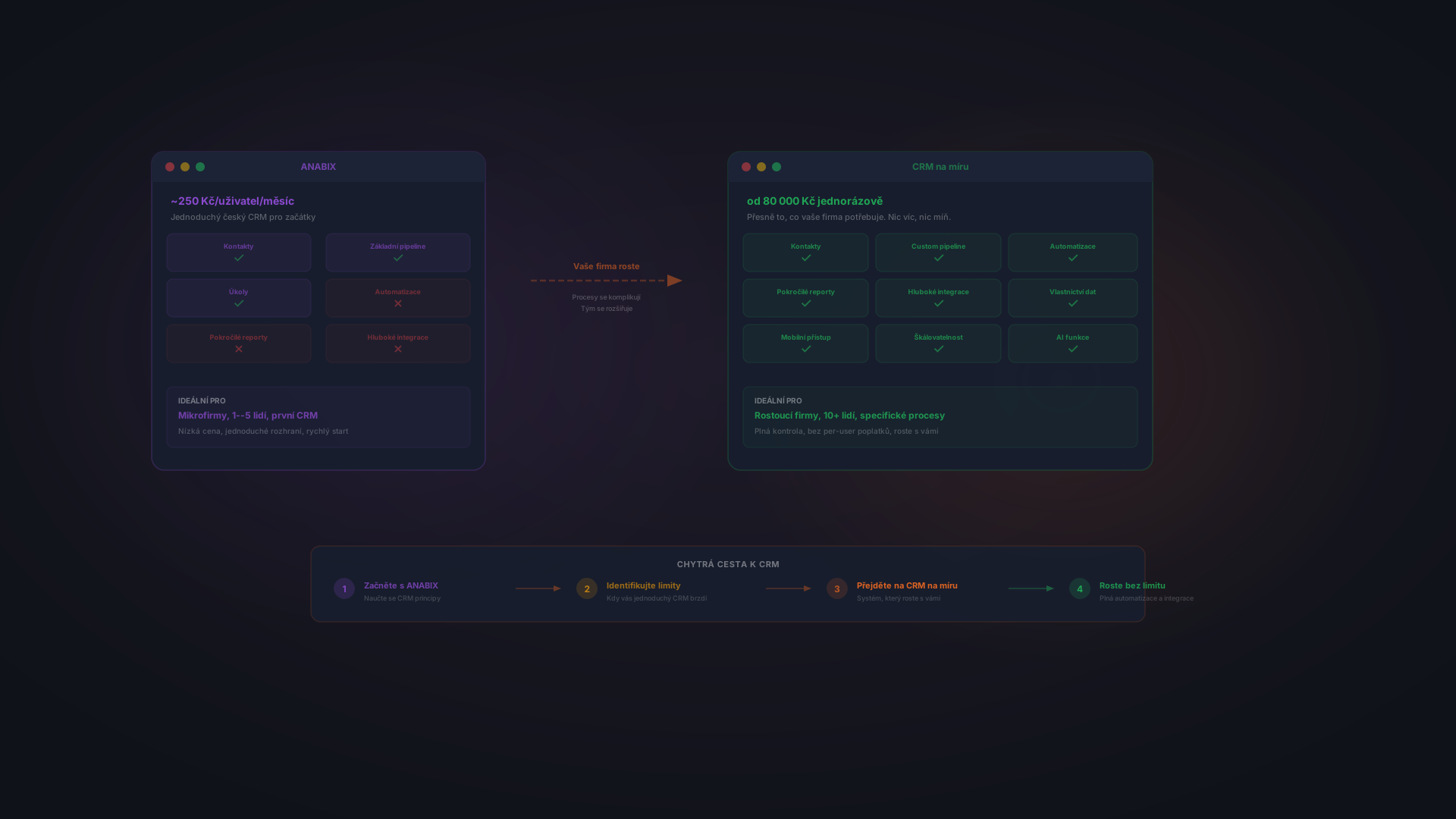
Feature Comparison: ANABIX vs Bitvea CRM
Feature | ANABIX | Bitvea CRM |
|---|---|---|
Basic contact management | Yes | Yes |
Deal/pipeline tracking | Yes, basic | Yes, unlimited |
Custom pipeline stages | Limited (3–5 stages) | Unlimited, designed for you |
Task automation | Very basic | Advanced multi-step workflows |
Custom fields | Limited | Unlimited |
Reporting and dashboards | Summary only | Full custom analytics |
Email integration | Basic | Full sync or advanced |
Invoicing integration | Limited (Zapier) | Native integration |
API access | Basic | Full-featured, documented |
Mobile app | Basic | Fully custom, optimized |
Advanced workflow rules | No | Yes |
Data ownership | Cloud-only, vendor lock-in | Full ownership, yours to keep |
Per-user cost | 200–300 CZK/month | No per-seat fees, unlimited users |
Setup cost | None (included) | Starts at 80,000 CZK (one-time customization) |
Annual hosting/support | Included | Around 10,000 CZK/year |
5-year total cost (10 users) | ~120,000–180,000 CZK | ~130,000–170,000 CZK (includes custom build and hosting) |
Cost Comparison: Monthly Subscription vs Total Ownership
ANABIX looks cheaper at first glance. 300 CZK per user per month is hard to beat. For a 10-person team, that is 3,000 CZK per month, or 36,000 CZK per year.
But monthly cost is not the right comparison. Total cost of ownership over the time you will use the system is.
ANABIX Cost Over Time
- Year 1 (10 users): 3,000 CZK × 12 = 36,000 CZK
- Year 2: 36,000 CZK (prices may increase)
- Year 3: 36,000 CZK+
- Year 4: 36,000 CZK+
- Year 5: 36,000 CZK+
- 5-year total: ~180,000 CZK
- Plus: custom development to work around ANABIX limits (~20,000–40,000 CZK via Zapier or custom scripts)
- Adjusted 5-year total: ~220,000 CZK
- And you never own your data. If you leave, you cannot take it with you.
Bitvea CRM Cost Over Time
- Year 1: Customization (80,000–120,000 CZK) + hosting and support (~10,000 CZK) = ~90,000–130,000 CZK
- Year 2–5: Hosting and support (~10,000 CZK/year) × 4 = ~40,000 CZK
- 5-year total: ~130,000–170,000 CZK
- Includes: full data ownership, unlimited customization, unlimited users, feature additions, complete independence
For a 10-person team with a 5-year horizon, Bitvea CRM is actually cheaper than ANABIX when you account for recurring per-user costs, workarounds, and the fact that you own everything.
And that is before you measure the productivity gain. A team using a system built for their process is faster, more organized, and more likely to close deals.
The Bitvea CRM Difference: Already Built, Ready to Deploy
The key difference: Bitvea CRM is not a blank canvas. It is a complete, tested, working system. We have already built the core: the database, the pipeline logic, the API, the reporting engine, the mobile foundation.
What you pay for is customization, not scaffolding. We take the proven base, adapt it to your sales process and integrations, and deploy it in 2–4 months. You own the code, you own the data, and you own the future.
This is the middle path between a rigid SaaS platform and a 6-month custom build. It combines the speed of a ready-made solution with the fit of custom software.
Pricing: Bitvea CRM starts at 80,000 CZK for customization, plus around 10,000 CZK per year for hosting and support. Unlimited users. No per-seat fees.
We have limited capacity (3–4 projects per quarter) to ensure every client gets the attention they deserve. A free tier is launching soon for teams exploring the system.
When ANABIX Is the Right Choice
ANABIX is the right choice in specific situations:
- You are a solo entrepreneur or micro-business (1–5 people). You need CRM basics, not a complex system.
- Your sales process is very simple. One product, straightforward deal cycle, no special integrations needed.
- You are learning CRM for the first time. ANABIX is a good place to start and understand what CRM can do.
- Your budget is minimal right now. You cannot justify any upfront investment.
- You need to get moving fast. You want to be operational in days, not weeks.
- You are geographically concentrated in Czech Republic and want local support. ANABIX is Czech-first.
If most of these apply to you, ANABIX is a sensible choice. It will serve you well for a while.
When Bitvea CRM Wins
Bitvea CRM makes sense when:
- Your team is 10+ people. ANABIX cost adds up fast with per-user pricing.
- Your sales process is complex. Multiple product lines, approval gates, long cycles, or special data requirements.
- You need tight integrations with other systems. Invoicing, accounting, ERP, e-shop, data needs to sync automatically.
- You want automation to drive productivity. Complex workflows, conditional logic, multi-step follow-ups.
- You need real reporting and visibility. Management needs dashboards, forecasts, and analytics ANABIX cannot provide.
- You plan to use CRM for 3+ years. At that horizon, Bitvea CRM is cheaper and more valuable.
- You want competitive advantage through process. A system built for your unique sales motion is hard for competitors to replicate.
- You want data ownership. You should own your pipeline data, not be a tenant of a platform.
If your business ticks 3 or more of these boxes, Bitvea CRM likely delivers better ROI than staying with ANABIX.
The Graduation Path: Start with ANABIX, Graduate to Bitvea CRM
One smart strategy is to start with ANABIX and graduate as you grow.
You begin with ANABIX because you are small, budget is tight, and you need to learn what CRM actually means for your business. You gain 12–24 months of real experience: what data matters, how deals actually move, where your team struggles.
As you scale to 10–15 people, as your sales cycle becomes more complex, as you find yourself fighting ANABIX limits, you are ready for Bitvea CRM. And now you know exactly what to build because you lived with ANABIX first.
This is a valid and often smart strategy. It is not a waste. Your ANABIX months clarify requirements and reduce risk for the build.
The migration from ANABIX to Bitvea CRM is straightforward: export your data, map it to the new system, and go live. You lose nothing.
How Long Does Bitvea CRM Take?
A realistic timeline for Bitvea CRM deployment is:
- Discovery and requirements (2–3 weeks), understand your sales process, define customizations, agree on scope
- Customization and integration (4–8 weeks), adapt Bitvea CRM base to your process, connect your systems
- Testing and deployment (2–3 weeks), user testing, data migration, go-live
- Total: 8–14 weeks, or 2–4 months
Much faster than a build from scratch because we start with a working system. After launch, you will iterate and add features. That is normal and included in your ownership model.
Technology Stack: What Bitvea CRM Is Built On
Bitvea CRM is built on modern, well-supported, mainstream technology:
- Frontend: Next.js and React, the most popular and stable modern JavaScript stack
- Backend: Node.js or similar modern server platforms
- Database: PostgreSQL, a rock-solid relational database ideal for CRM data
- ORM: Prisma, to keep code clean and secure
- Hosting: Cloud platforms (AWS, Vercel, DigitalOcean) with excellent uptime and scaling
- CI/CD: Automated testing and deployment for safe, reliable changes
Why this matters: you own a system built on solid, mainstream technology. Any competent developer can maintain it. You are never locked into one person or one agency.
FAQs: ANABIX vs Bitvea CRM
Q: Can I use ANABIX and build custom integrations on top?
A: Yes, partially. ANABIX has an API and supports Zapier. But custom integrations are limited by ANABIX's API capabilities. You cannot easily sync data bidirectionally or automate complex workflows. At some point, you hit ANABIX's limits.
Q: What if my team loves ANABIX but it is not scaling?
A: ANABIX is easy to use, and that is valuable. When you graduate to Bitvea CRM, you have the chance to preserve what users love (simplicity, speed) while adding power. A well-designed custom CRM is actually easier to use than a bloated platform.
Q: Is Bitvea CRM more expensive?
A: Not over time. The upfront cost is higher, but over 5 years, Bitvea CRM is cheaper than ANABIX when you factor in growing team size, per-user fees, and workarounds. For a team of 10–20 people, Bitvea CRM breaks even in 18–24 months.
Q: Can I export my ANABIX data and migrate to Bitvea CRM?
A: Yes. ANABIX allows data export. Our team can map that data into Bitvea CRM. The migration is typically smooth and can happen over a weekend.
Q: What if the customization goes wrong?
A: Good due diligence on our team reduces risk. We start with clear discovery and requirements, a fixed-price MVP scope, user testing before go-live, and fully documented code. We avoid surprises.
Q: Can I hire someone to maintain Bitvea CRM later?
A: Yes. Bitvea CRM is built on mainstream technology (Next.js, React, Node.js, PostgreSQL). Any developer skilled in these tools can maintain the system. You own the code and are never locked in.
Real Example: When a Team Graduated from ANABIX
A Czech B2B software sales team of 8 people started with ANABIX two years ago. It was a good fit: low cost, easy to learn, got them off spreadsheets.
By year two, the team had grown to 15 people and the process was more complex. They needed:
- Deeper integration with their invoicing system (Pohoda), currently manual and error-prone
- Automated follow-ups based on deal stage and inactivity, ANABIX could not do this
- Revenue forecasting and pipeline health dashboards, ANABIX had no custom reporting
- Mobile app for field salespeople to log calls and updates quickly
They deployed Bitvea CRM. Implementation took 12 weeks. Cost: 110,000 CZK. The team now has:
- 100% Pohoda integration, deals and invoices stay in perfect sync
- Automated follow-ups, deals idle more than 5 days trigger reminders automatically
- Custom dashboard, management sees pipeline forecast, deal velocity, and risk at a glance
- Responsive mobile app, salespeople log calls in 30 seconds from the field
They saved the ANABIX cost: 36,000 CZK/year × 15 users = 540,000 CZK saved annually (at scale, and increasing with team size). But more important, the team is faster and deals are more reliable.
The system paid for itself in under 3 months.
The Bottom Line
ANABIX is good at what it is designed to do: provide an affordable, simple CRM for micro-businesses and small teams. If that is you, use it. Do not over-engineer.
But if your business is growing, if your sales process is complex, or if you spend more time working around ANABIX than working in ANABIX, it is time to graduate.
Bitvea CRM is not expensive for the right business. And it is not a distant future. We can deploy a customized system in 2–4 months.
The decision is not ANABIX or Bitvea CRM. It is: use ANABIX now, and Bitvea CRM when you grow? Or build custom now and own your process from the start?
Both are valid paths. If you are outgrowing ANABIX or considering a custom build from the start, let's talk. We will assess what makes sense for your business.