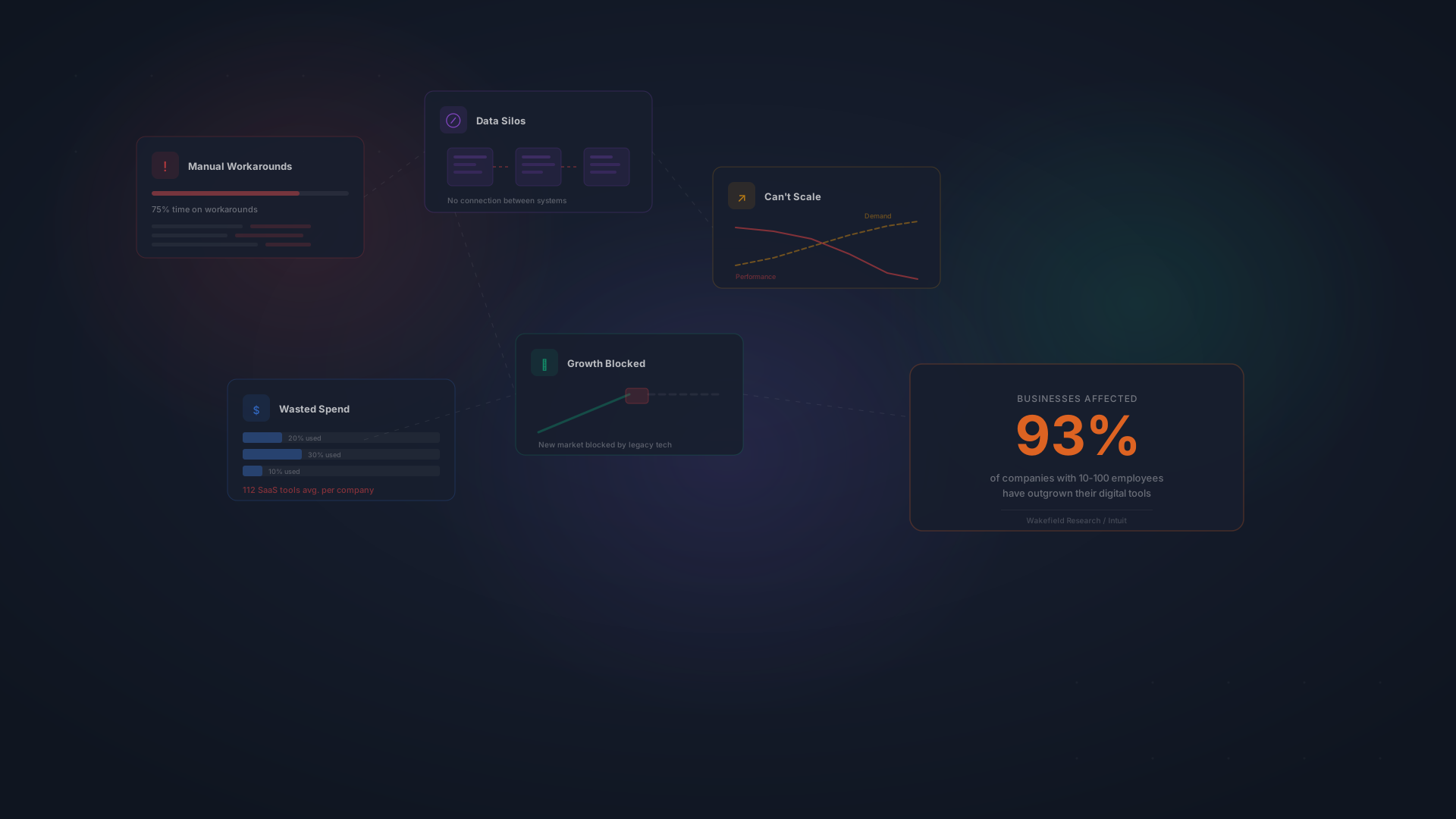
Research by Wakefield and Intuit found that 93% of businesses with 10–100 employees have outgrown at least some of their digital tools. Not a minority. Not the outliers. Almost every growing company hits the same wall. The tools that were perfect at ten employees start showing cracks at fifty. The systems that supported your early growth quietly become the reason you can't grow further.
There's a particular cruelty to this pattern. The signs rarely arrive as a sudden system failure. They accumulate slowly: a manual workaround here, a data discrepancy there, a growth initiative that takes six months longer than it should because your software isn't ready. By the time most businesses recognise they've outgrown their tech stack, they've already been paying the cost for 12 to 18 months.
This is especially relevant for Czech and European SMBs navigating today's digital landscape. According to EU Digital Decade 2025 data, 71.1% of Czech SMEs report at least basic digital transformation — but only 49.3% have adequate digital intensity to remain competitive. The gap between "we have some digital tools" and "our technology actively supports our growth" is where most businesses are stuck.
Here are five clear signals that your business has outgrown its current tools — and what to do about each one.
Why Growing Businesses Outgrow Their Tech Stack
Every business starts with tools that fit its size. A five-person team can coordinate in a shared spreadsheet. A ten-person team can manage customer relationships in a basic CRM. A fifteen-person team can handle orders through a simple e-commerce backend. These tools work — until the business grows past the assumptions baked into them.
The problem is not that the tools are bad. It's that they were designed for a version of your business that no longer exists. What worked for five people breaks at fifty. What handled 50 orders a day struggles with 500. What served one market requires a complete rebuild to support three.
The financial cost of staying with legacy systems compounds over time. Industry analysis consistently finds that organisations spend 60–80% of their IT budgets maintaining legacy infrastructure — leaving only 20–40% for innovation and growth. IT teams spend 5–25 hours per week patching systems that should have been replaced or upgraded. Meanwhile, 70% of organisations say technical debt significantly impacts their ability to innovate (industry surveys, 2025). The longer you stay with a stack you've outgrown, the more expensive the eventual transition becomes.
The good news is that the signs are recognisable — if you know what to look for.
Sign 1: Your Team Spends More Time on Workarounds Than Actual Work
What This Looks Like
The most visible sign of an outgrown tech stack is not a system crash — it's the quiet accumulation of manual tasks your team has accepted as normal. Someone copies data from one platform into another every morning. A manager exports a spreadsheet, adjusts the columns, and emails it to three people because the reporting tool can't filter the way they need. Orders that arrive through one channel get manually re-entered into another system before anyone can act on them.
- Employees maintaining parallel spreadsheets alongside "official" systems
- Copy-pasting data between applications that don't talk to each other
- IT staff spending 5–25 hours per week patching legacy systems
- Teams abandoning official tools in favour of shadow IT or personal workarounds
The Real Cost
Consider a 30-person Czech e-commerce company. Their warehouse team manually updates inventory across three separate systems every morning because their order management platform, their marketplace listings, and their accounting software don't sync. Each update takes roughly 45 minutes. Across a team of four warehouse staff, that's three hours of productive capacity evaporating into redundant data entry — every single day.
70% of organisations say technical debt significantly impacts their ability to innovate. The workarounds don't just cost time in the moment — they create drag that compounds every quarter. Your team adapts to the system's limitations, develops unofficial processes, and eventually stops questioning why things work the way they do. The inefficiency becomes invisible because it has been normalised.
What To Do About It
Map every recurring manual task your team performs. If a task exists because two systems don't connect, that's a process that can be automated. The question is whether to integrate your existing tools with API connectors, replace them entirely, or consolidate onto a purpose-built custom software solution. In most cases, targeted integration solves 70% of the problem at 20% of the cost of a full replacement.
Sign 2: Your Data Lives in Silos and You Can't See the Full Picture
What This Looks Like
Your sales data lives in one system. Financial data lives in another. Customer data lives in a third. Inventory is somewhere else entirely. Each tool was adopted at a different time by a different team to solve a different problem — and none of them were designed to work together.
- No single source of truth for business decisions
- Monthly reporting takes days instead of minutes
- Different departments report different numbers for the same metrics
- A complete profitability picture requires manual consolidation across three or more systems
The Real Cost
Consider a growing Czech manufacturing firm. The CEO needs three days to get a complete view of profitability per product line because the data is scattered across accounting software, production spreadsheets, and a basic CRM that was never designed to track manufacturing costs. Strategic decisions that should take an afternoon take a week — and they're made on data that's already outdated by the time it's assembled.
Poor data quality is the leading cause of digital project failure — responsible for 43% of failed initiatives according to CDO Insights 2025. Data silos don't just create inconvenience. They create a fundamental visibility problem that causes businesses to misallocate resources, miss opportunities, and make strategic bets on incomplete information. Average ERP ROI reaches 52% with payback in 12–24 months precisely because unified data transforms decision-making speed and quality.
What To Do About It
Identify the three questions your leadership team asks most frequently that require data from more than one system to answer. Those are your integration priorities. A unified data layer — whether through a custom dashboard, a proper ERP system, or API integrations between your core platforms — eliminates the reconciliation work and gives you a single reliable source of truth for decisions that used to take days.
Sign 3: Your Systems Can't Keep Up With Transaction Volume or User Growth
What This Looks Like
Some tools are built for scale. Most are not. When a platform was designed for a team of five, it may technically run for a team of fifty — but the experience degrades in ways that have a direct operational cost.
- System slowdowns during peak hours as concurrent users increase
- Checkout failures on your e-commerce platform during promotions or seasonal peaks
- Application crashes when too many users log in simultaneously
- Storage limits reached, requiring you to archive data just to keep the system running
- Reports that used to take seconds now taking ten or twenty minutes
The Real Cost
A Czech online retailer with a growing customer base sees their e-commerce platform perform well during normal trading. But during Black Friday and seasonal peaks, the system struggles with concurrent checkout sessions, causing abandoned carts and lost revenue. Every additional second of page load time reduces conversion rates. The performance issue that seemed manageable at normal volume becomes a direct revenue leak at scale.
Performance degradation is particularly insidious because it arrives gradually. Nobody schedules a meeting to announce that the system is 15% slower than last year. People adapt — they run reports at off-peak hours, stop using features that time out, and quietly accept that the tool is less useful than it was. The limitation becomes normalised, and the business stops measuring what it's losing.
What To Do About It
Run a capacity audit on your core systems. What are the limits — in terms of records, users, transactions per day, and API calls — of the platforms you depend on most? If you're above 60–70% of capacity on a critical system, you have less runway than you think. Scalable architectures built around your actual growth trajectory are significantly cheaper to implement proactively than to migrate to reactively after a crisis.
Sign 4: You're Paying for Features You Don't Use — and Missing the Ones You Need
What This Looks Like
SaaS vendors compete on feature count. Every quarter brings new functionality designed to justify price increases and win enterprise deals. The result is that the tool you originally bought for one clear purpose now has seventeen tabs, a marketplace of add-ons, and a monthly "What's New" announcement that nobody on your team reads.
- Paying enterprise-level SaaS fees but using only 10–15% of available features
- Cobbling together five or more SaaS tools to replicate what one integrated solution could do
- Needing a specific capability that "isn't on the vendor's roadmap"
- Your team adapting how it works to fit the software, rather than the other way around
The Real Cost
Research consistently finds that 85–90% of features in off-the-shelf software go unused. Meanwhile, 79% of businesses say their digital tools are either "too small or too large" for their actual needs (Wakefield Research / Intuit). The fit problem is the norm, not the exception.
Consider a Czech services company paying for six different SaaS subscriptions — project management, invoicing, CRM, team communication, time tracking, and reporting — at a combined monthly cost that exceeds what a single integrated custom solution would cost to build and maintain. Beyond the financial waste, the fragmentation means data doesn't flow between tools, onboarding new staff requires training across six platforms, and every workflow crosses system boundaries that introduce friction and errors.
The payoff from fixing this is measurable. Companies that adopt purpose-built custom solutions see an average 35% boost in operational efficiency within the first year of deployment. That figure reflects both the removal of features nobody uses and the addition of capabilities that were missing entirely.
What To Do About It
Do a features audit on your top five tools. Which features does your team actually use? Which are you paying for that deliver zero value? More importantly: what workflow or capability do you wish existed that none of your current tools provide? That gap — the thing your team compensates for with a spreadsheet or a workaround — is often the most expensive thing you're not paying attention to. Custom software development built around your actual workflows eliminates both the bloat and the gaps simultaneously.
Sign 5: Your Technology Is Blocking Your Next Growth Move
What This Looks Like
The first four signs are operational. This one is strategic — and it's the one that determines whether you capture or miss your biggest opportunities.
- Unable to expand to new markets because systems don't support multi-currency or multi-language operations
- Can't automate repetitive processes that are consuming staff time because integration layers don't exist
- Your online presence isn't generating leads because the technology behind it is outdated
- Competitors with modern stacks are executing initiatives that your current infrastructure simply can't support
The Real Cost
The Czech ICT market is projected to grow from USD 22.5 billion in 2025 to USD 32.4 billion by 2030 (Mordor Intelligence) — a 44% expansion in five years. Czech SMBs are projected to grow IT spending at 8.7% CAGR through the same period. Businesses that don't modernise will not simply grow more slowly. They will find themselves structurally unable to compete for the customers, talent, and partnerships that will define the next phase of market growth.
Consider a Czech manufacturer ready to expand into the DACH market. Their ERP handles Czech VAT, Czech-language invoicing, and domestic carriers. Supporting German customers requires German-language documents, cross-border EU VAT compliance, and integration with German logistics providers. The ERP vendor quotes a six-month implementation at a cost that exceeds projected first-year revenue from Germany. The outgrown tech stack hasn't just slowed down a growth initiative. It has made it economically unviable before it even started.
AI amplifies this pattern. Businesses deploying AI agents for customer support automation, intelligent demand forecasting, or automated reporting need clean, accessible, structured data as the prerequisite. One company that built the right data infrastructure first was able to deploy an AI customer support agent that resolved 60% of support tickets without human involvement. For businesses running fragmented, unintegrated stacks, that kind of deployment isn't possible — not because the technology doesn't exist, but because the data foundation isn't there. The modernisation ROI from addressing these issues runs at 200–400% within three to five years according to industry analysis.
What To Do About It
Look twelve months ahead. What is the most important growth initiative your business is planning? Now ask honestly: does your current technology stack support that initiative out of the box, or does it require significant workaround, integration work, or vendor negotiation before you can even begin? If the answer is the latter, the tech stack conversation is no longer a back-office IT question — it is a strategic priority that belongs in your next leadership meeting.
What to Do When You Recognise These Signs: A Four-Step Framework
Recognising the signs is the first step. The second is moving from diagnosis to a plan that delivers results without disrupting your operations. Here is the framework that works for most growing businesses.
Step 1: Audit Your Current Stack
Before you buy, build, or replace anything, map what you actually have. List every tool your business uses — who owns it, what it costs, what it integrates with, and critically, what it doesn't do that someone has compensated for with a spreadsheet or a manual process. Most businesses discover they are running 20–30% more tools than anyone in leadership is aware of, with significant overlap in functionality and real gaps in coverage. This audit typically takes one week and consistently surfaces immediate wins: tools that can be consolidated, integrations that can be activated with no new spend, and redundant subscriptions that can be cancelled. The 30–40% IT maintenance cost reduction that businesses typically achieve after modernisation almost always starts here, with this clarity.
Step 2: Define Your Growth Requirements
Where do you need to be in two to three years? What markets, products, customer segments, or operational capabilities does your technology need to support to get there? Define these requirements explicitly before evaluating solutions. Most businesses make the mistake of replacing one inadequate tool with another tool that is adequate today but will face the same growth ceiling in 18 months. Designing for your two-year state, not your current state, is the difference between a technology investment that pays off and one that just defers the problem.
Step 3: Explore Custom Solutions Before Adding Another SaaS Tool
The instinctive response to a gap in your current tools is to search for another SaaS product that fills it. Sometimes that's the right answer — for commodity functions like email, basic HR, and standard accounting, buying off-the-shelf is nearly always cheaper. But for the processes that are unique to how your business operates — the workflows, approval chains, reporting requirements, and integration patterns that no generic product was designed to handle — custom software development almost always delivers better outcomes within 18–24 months. The Bitvea approach starts with a free consultation and deep analysis before any development begins, because understanding the problem fully is what makes the solution right.
Step 4: Plan a Phased Migration
You do not have to replace everything at once — and attempting to do so is one of the most common reasons technology transformation projects fail. Start with the single system that is costing you the most, whether in wasted hours, missed revenue, or blocked strategic initiatives. A focused project that delivers measurable results in 90 days builds more organisational momentum than a twelve-month overhaul that is still three months from go-live. The quick win creates the internal credibility to fund and execute the more significant moves that follow.
The Cost of Waiting vs. the Return on Acting
The five signs above are not abstract warnings. They are measurable drains on revenue, margin, and competitive position. Technical debt, data silos, scaling failures, feature mismatch, and strategic blockages each carry a quantifiable cost — in wasted staff hours, in missed opportunities, in revenue that went to a competitor whose technology could handle what yours couldn't.
The Czech SMB Support Strategy 2021–2027 has accelerated digital transformation investment across the region. Businesses that act on these signals now are positioning themselves to capture the growth that modernisation makes possible. Businesses that wait are funding their competitors' advantages one month at a time.
If you recognised your business in any of the five signs above — the workarounds, the silos, the performance ceiling, the feature mismatch, or the strategic blockage — the right next step is an honest audit of where your technology is costing you the most. The legacy tech upgrade that the average business delays costs $2.9 million (CIO Dive) in lost productivity and technical debt accumulation before a crisis finally forces the issue.
Bitvea builds custom software, ERP systems, e-commerce platforms, and AI agents for growing Czech and European businesses. If you've outgrown your tech stack and want to understand your options, let's talk — a diagnostic conversation costs nothing and usually surfaces opportunities that more than pay for themselves.