72% of small and medium enterprises now use mobile workforce management tools. Yet nearly 50% of field technicians say their tools are difficult to use. Those two facts, sitting next to each other, tell you something important: companies are not struggling to adopt technology. They are struggling to adopt technology that actually fits how their teams work.
The field service management market is projected to grow from $6.2 billion in 2026 to $23.6 billion by 2035. More money is flowing into field software every year. But growth in spending has not translated into growth in satisfaction. Field teams are buying more tools while getting less value from them.
The reason is straightforward: off-the-shelf field service apps are designed for the average company. But field operations are never average. Construction, logistics, maintenance, and field sales teams each have workflows, environments, and constraints that generic software cannot accommodate. This article explains exactly where that gap shows up, what a custom mobile app built for your specific operations actually delivers, and how to assess whether your current tools are costing you more than you realize.
The Hidden Cost of "Good Enough" Field Service Tools
Your Team Is Working Around the Software, Not With It
Generic field service management tools are built around a standard model: jobs come in, technicians are dispatched, work orders are completed, invoices are sent. That model works for some businesses. For many others (companies with specialized inspection protocols, equipment-specific workflows, multi-step approval chains, or tight integration requirements), the platform becomes something to work around rather than work with.
The evidence shows up in the shadows: paper notes that get transcribed at the end of the day, WhatsApp groups used to pass job updates, personal spreadsheets that hold the data the official system cannot capture. According to Capterra, 37% of software purchasers discover compatibility issues with their existing systems only after they have already bought the software.
Every workaround has a cost. For a 30-person field team, even 30 minutes per day per person of duplicate data entry, manual transfers, and system navigation translates to roughly 375 hours per month of productive capacity lost. That is the equivalent of more than two full-time employees doing nothing but compensating for software that does not fit.
Disconnected Data Means Disconnected Decisions
When field data does not flow in real time to the people who need to act on it, operational decisions suffer. Dispatchers work with stale information. Managers cannot see which jobs are at risk. Customers do not get accurate ETAs. Inventory decisions get made on yesterday's stock counts.
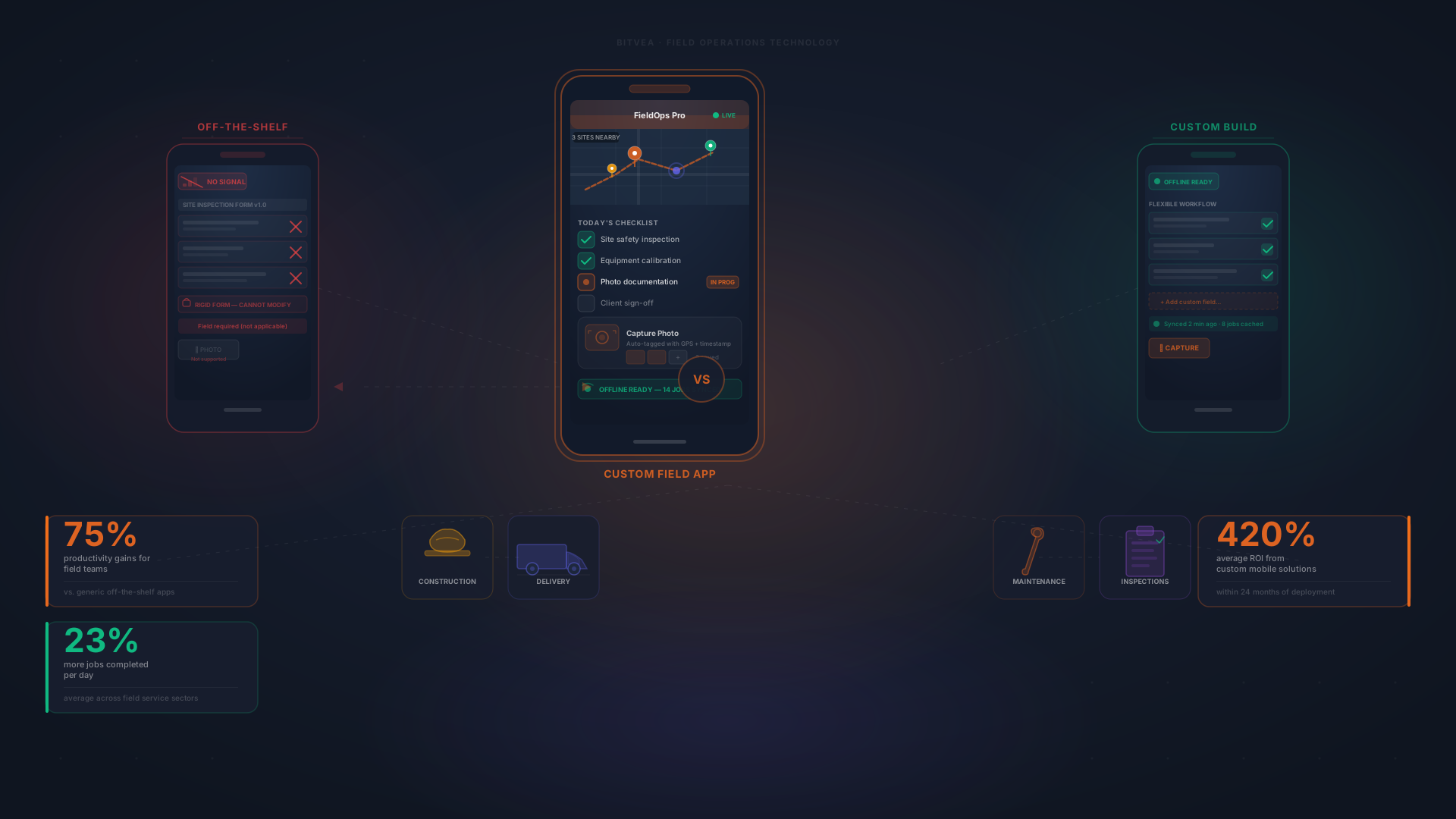
The contrast with a well-integrated system is stark: companies using mobile-first field service solutions report technicians completing 23% more jobs per day. That gap comes from real-time data flow: knowing where every technician is, what they have completed, what they need next, and what is going wrong before it escalates into a missed service level agreement.
The Per-User Pricing Trap
Off-the-shelf field service tools charge $30–$150+ per user per month. For a 50-person field team, that is $18,000–$90,000 per year in licenses alone, before add-ons, integrations, or the consulting fees that most enterprise platforms require for initial setup.
SaaS pricing is not static. According to the Vertice SaaS Inflation Index 2026, software costs are rising at 12.2% annually, four times faster than general inflation. Vendors are hiking prices 9–25% while corporate IT budgets grow at just 2.8%. Add seasonal workers, subcontractors, or temporary hires, and every new user pays full license price. Over five years, the licensing bill for a mid-size field team frequently exceeds the total cost of a custom-built alternative.
Five Ways Off-the-Shelf Apps Fail Field Teams
1. Offline Support Is an Afterthought
Field teams work on construction sites, in building basements, in rural service areas, on motorways, and in warehouses with unreliable Wi-Fi. Connectivity is not guaranteed. Most off-the-shelf apps offer "offline mode" as a limited feature: read-only access, no form submission, occasional data loss on reconnect.
A properly built offline-first app is architecturally different. Data is stored locally on the device. Actions are queued and execute in order when connectivity returns. Conflict resolution handles cases where the same record is updated in the field and the office simultaneously. Background sync means the technician never has to think about connectivity at all. The practical difference is significant: your team either loses work or does not. Generic apps do the former. Properly built field apps do not.
2. Rigid Forms and Checklists That Do Not Match Your Process
Every industry has unique inspection forms, work orders, checklists, and sign-off requirements. Off-the-shelf tools offer configurable forms, but configuration has hard limits. When a maintenance company needs to capture vibration readings from specific equipment, cross-reference against maintenance history, and trigger different follow-up actions based on whether readings exceed operational thresholds, no generic form builder handles that cleanly.
The consequences are predictable. Technicians skip fields that do not apply to their actual work. They enter placeholder data to satisfy mandatory fields. They photograph the paper checklist they completed separately and attach it to the digital form. The system collects structured-looking data that is not actually reliable. According to Skyllful, 55% of field workers received no formal training on their technology tools. When a tool does not match their mental model of the job, adoption collapses.
3. Integration Gaps With Your Existing Systems
Field data needs to flow to your CRM, ERP, accounting system, inventory management, and dispatch software. Off-the-shelf FSM tools integrate with popular platforms, but rarely with custom, industry-specific, or legacy systems. The result is middleware, Zapier connections, CSV exports, and manual data transfers.
Every integration gap is a point where data gets delayed, duplicated, or simply lost. When a field sales rep closes a deal and it does not appear in the CRM for three hours because of a sync delay, that is a pipeline visibility problem. When a parts request submitted in the field does not reach the warehouse system until someone manually processes a CSV export, that is an operational bottleneck. Integration gaps are not inconveniences. They are compounding inefficiencies.
4. One-Size-Fits-No-One User Experience
A tool designed for residential HVAC service is not designed for construction site inspections. A tool designed for plumbing dispatch is not designed for industrial logistics. Field technicians using apps that do not match their work context waste time navigating irrelevant screens, working around features that do not apply to them, and hunting for the fields they actually need.
Poor usability and poor tool fit are not separate problems. They reinforce each other. When the app is confusing for the specific job, technicians stop using it. When technicians stop using it, management loses visibility. When management loses visibility, decisions degrade. The root cause is always the same: a generic tool forced onto a specific operation.
5. You Do Not Own the Data or the Roadmap
Your operational field data, including GPS tracks, job photos, customer signatures, equipment readings, and inspection records, lives on your vendor's servers, governed by their terms of service. According to Flexera, 47% of enterprises cite data migration as a significant barrier to switching providers. Vendor lock-in is structural, not accidental.
Feature requests go into a backlog prioritized by the vendor's largest customers. When the vendor discontinues a feature you depend on, changes pricing, or gets acquired, you absorb the disruption. For European operations, this compounds: the EU Data Act (effective September 2025) and GDPR create specific obligations around field data: GPS tracking of employees, photos of customer premises, digital signatures. Your data architecture needs to support compliance by design, not rely on a vendor's interpretation of their obligations.
What a Custom Field Operations App Actually Looks Like
A custom mobile app for field teams is not a repackaged off-the-shelf tool. Every screen, form, and action flow is designed around how your team actually works, not around a generic model that approximates it.
The difference is visible in specific industry scenarios:
- Construction: Site inspection checklists with conditional logic, photo evidence tied to specific locations via GPS stamps, safety sign-offs with digital signatures, progress reports synced to project management in real time
- Logistics: Route optimization based on live traffic and delivery constraints, delivery confirmation with photo proof and customer signature, real-time tracking visible to dispatchers and customers, automatic ETA updates
- Maintenance: Equipment history lookup from the field, parts ordering linked to inventory, work order completion with multi-step sign-off, threshold-based alerts that trigger follow-up actions automatically
- Field sales: Full product catalog with real-time pricing, on-the-spot quoting and order submission, CRM data access and updates from the field, integration with back-office approval workflows
In each case, the app supports the real process instead of requiring the team to adapt their work to the software's constraints.
Offline-First Architecture That Actually Works
Bitvea builds offline-first mobile apps with React Native, designed specifically for field environments where connectivity is unreliable. The architecture stores data locally on the device, queues all actions (form submissions, photo uploads, status changes), handles conflict resolution automatically when the same record is updated from multiple sources, and syncs in the background without the technician needing to trigger it.
This is an architecture decision, not a feature toggle. Most off-the-shelf apps are built connectivity-first and retrofit offline support as a secondary mode. The result is fragile: data loss on reconnect, read-only offline states, sync errors that require manual resolution. A properly offline-first app is built the other way around: local state is the source of truth, and the server is the sync target.
Direct Integration With Every System That Matters
A custom field app is built with direct API integrations into your CRM, ERP, inventory system, and accounting software. Bidirectional data flow means field updates appear in the office instantly, and office changes (new assignments, pricing updates, customer information) reach the field in real time. No middleware layer, no Zapier, no CSV exports, no manual transfers.
Bitvea's mobile app development includes backend infrastructure and API development as a core part of every project. The field app is not a standalone product that integrates with your systems as an afterthought. It is built as part of your system architecture from day one.
Full Ownership: No Licensing Fees, No Vendor Dependency
With a custom field app, you own the source code, the backend infrastructure, and all the data. There are no per-user license fees. Add 10 or 100 new field workers at zero marginal cost. Host on your own infrastructure or in a European cloud provider for GDPR and EU Data Act compliance. If you want to change development partners, bring development in-house, or extend the app with new capabilities, you can do all of that without negotiating with a vendor.
Full code ownership is a core principle of every Bitvea project. You are not renting software. You are building an asset your business owns outright.
The ROI of Getting It Right
Productivity Gains Backed by Data
Companies with mobile-first field service solutions report 75% productivity gains (FieldCamp). Mobile-first technicians complete 23% more jobs per day. According to research cited by Programming Insider, firms adopting bespoke digital platforms report a 30% reduction in operational delays and a 22% increase in client satisfaction within the first year.
The ROI potential is substantial. Properly developed custom apps have demonstrated up to 420% ROI from operational efficiency gains. A fleet operator case study showed $7,450 per month in savings on fuel and payroll within four months of deployment. A manufacturing custom app delivered a 63% reduction in inventory discrepancies and a 46% decrease in administrative errors, saving 90 minutes per shift.
Five-Year Cost Comparison
The economics of custom development become clear over a realistic time horizon. For a 50-person field team:
- Off-the-shelf FSM (5 years): $50/user/month × 50 users × 60 months = $150,000 in licenses alone, before add-ons, integrations, implementation consulting, and annual price increases averaging 12%
- Custom field app (5 years): $50,000–$120,000 development investment (depending on complexity) + $500–$2,000/month ongoing maintenance = $80,000–$240,000 total over 5 years, with no per-user fees and full ownership
- Break-even point: Typically 18–30 months for teams of 20+ users
- After break-even: Every additional user and every additional year is pure savings: the off-the-shelf bill keeps growing while the custom app maintenance cost stays flat
Bitvea's custom mobile app projects start from 120,000 CZK, with most field operations apps in the €15,000–€40,000 range. The right comparison is not upfront cost versus monthly subscription. It is total cost of ownership over the period you plan to use the system.
Eliminating the Workaround Tax
The most significant hidden cost of a poorly fitted field tool is not the license fee. It is the productive capacity consumed by working around it. For a 30-person field team at 30 minutes of workaround time per person per day, that is 375 hours per month of lost capacity, equivalent to more than two full-time employees doing nothing but compensating for software gaps.
A custom app that eliminates 80% of that workaround time recovers 300 hours per month. At an average field technician cost of €35–€60 per hour, that recovery has a monthly value of €10,500–€18,000. The ROI calculation is not theoretical. It is the difference between productive field time and time spent fighting the tool.
Is a Custom Field App Right for Your Team?
A custom field app is not the right solution for every operation. Use this assessment to evaluate your situation honestly.
Strong signals that a custom field app makes sense:
- Your field team has 15+ people and standard tools are not fitting their workflow
- Offline reliability is critical: your team works on construction sites, in rural areas, in warehouses, or anywhere connectivity is unreliable
- Your technicians have specific data capture needs that generic form builders cannot handle: equipment readings, conditional inspection logic, GPS-stamped evidence, signature workflows
- You need integration with a CRM, ERP, or back-office system that your field tool does not connect to natively
- You are spending €2,000+ per month on field service licenses
- Your team has developed workarounds (paper, WhatsApp groups, personal spreadsheets) to compensate for what the official tool cannot do
- Data compliance matters: GDPR, EU Data Act, or industry-specific regulations govern the data your field team collects
Signals that off-the-shelf is likely sufficient:
- Your team is small (fewer than 10 field workers) with simple, standard workflows
- Your industry is well-served by a specific vertical FSM tool and your team is genuinely using it
- You need a solution deployed within two weeks, not two months
- Your current tool is meeting 80%+ of your operational needs without significant workarounds
The Retool 2026 Build vs Buy Report found that 35% of enterprises have already replaced at least one SaaS tool with custom software. The trend reflects a broader recognition: for operations with specific requirements, the total cost of a generic tool (licensing, workarounds, inefficiency, and lost data quality) often exceeds the investment in a purpose-built alternative.
The Bottom Line
Off-the-shelf field service apps are designed for the average company. For small teams with standard workflows, they work well. But as your field team grows, your workflows become more specialized, and your integration needs become more demanding, generic tools start costing more than they save.
The data is consistent: mobile-first custom solutions deliver measurable productivity gains, lower long-term costs, higher adoption rates, and better data quality. Companies that invest in a custom field app built for their specific operations gain an operational advantage that off-the-shelf-dependent competitors cannot replicate, because the advantage is built into the tool itself.
Bitvea builds custom mobile apps for field teams across construction, logistics, maintenance, and field sales, including offline-first architecture, backend integration, and full code ownership. If your field team is working around its current tools rather than with them, let's talk. We will assess your situation and tell you honestly whether a custom build makes sense.