The gap between AI hype and AI reality for small businesses is closing fast. Not long ago, deploying intelligent automation required enterprise budgets and dedicated data science teams. Today, AI agents for small business are delivering measurable results in weeks — not years. According to a 2025 QuickBooks survey, 68% of small businesses now use AI regularly, up 42% year-over-year. And among those that have adopted AI, 91% report measurable revenue growth. The question has shifted from "can small businesses afford AI?" to "can they afford to wait?"
This article covers what AI agents actually are, where they deliver the strongest ROI for small and mid-sized businesses, two real case studies with specific metrics, and a practical framework for getting started — without overcommitting budget or headcount.
What Are AI Agents (and Why Should Small Businesses Care)?
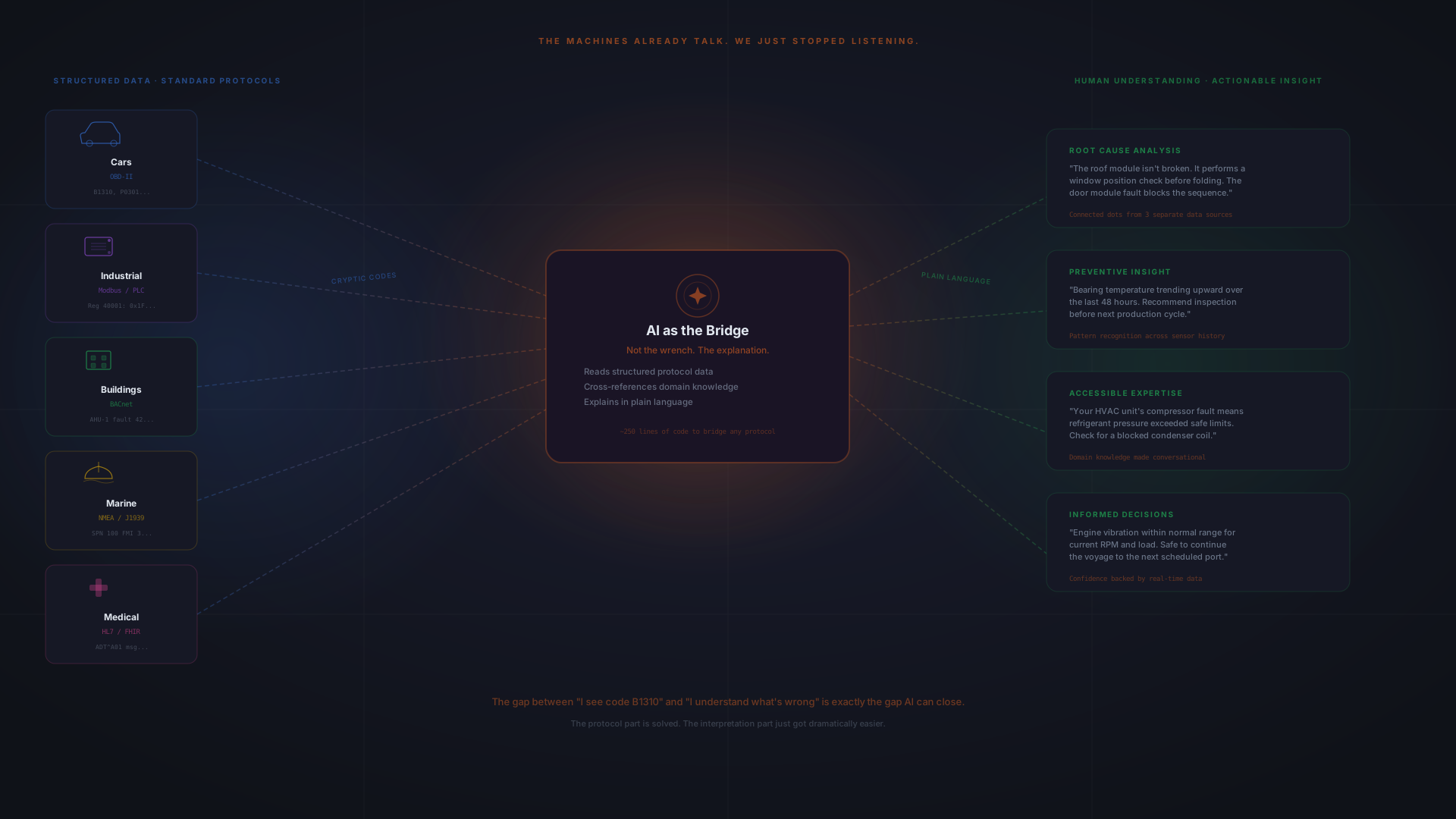
An AI agent is software that perceives its environment, makes decisions, and takes autonomous action to achieve a defined goal — without a human directing every step. This is the key distinction from earlier AI tools. A traditional chatbot pattern-matches keywords to pre-written responses. An AI agent reasons through a problem, calls external tools (databases, APIs, email systems), adapts based on what it learns, and hands off to a human only when genuinely needed.
Think of it as the difference between a vending machine and a shop assistant. A chatbot dispenses pre-programmed answers. An AI agent listens, thinks, looks things up, acts — and learns from the outcome.
For small businesses, this distinction matters enormously. Agentic AI means you can automate multi-step workflows — not just single-question interactions. A support ticket that requires checking a customer account, consulting product documentation, and drafting a personalised response can be handled end-to-end by an agent, with no human in the loop unless the confidence threshold is not met.
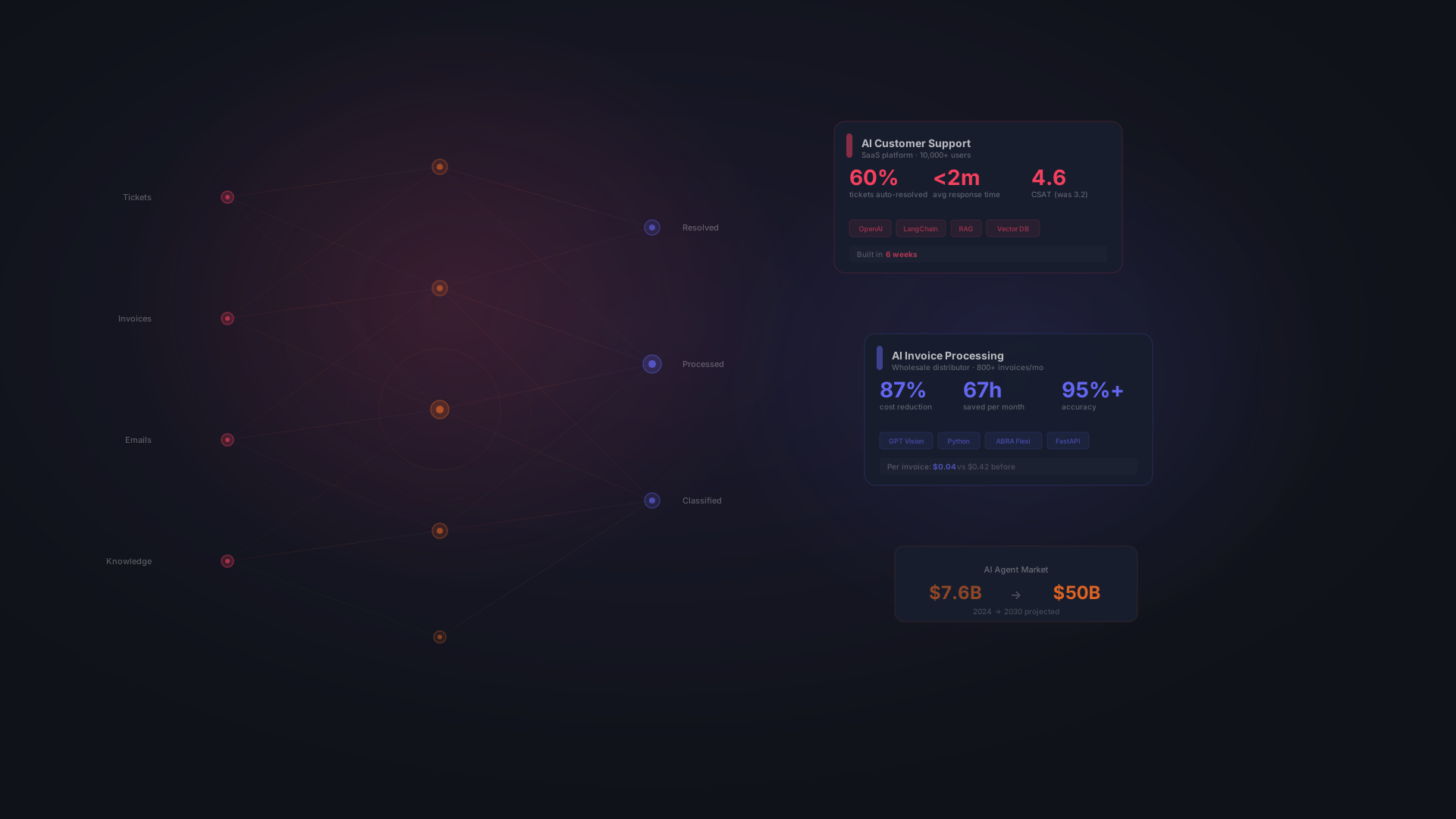
The market is validating this shift at speed. The AI agent market crossed $7.6 billion in 2025 and is projected to exceed $50 billion by 2030, growing at a 46.3% compound annual rate. This growth is not driven by enterprises alone — it is being powered by the falling cost and rising accessibility of the underlying technology.
The State of AI Adoption Among Small Businesses
The adoption data paints a clear picture. Beyond the 68% usage rate, AI adoption among small businesses surged 41% in 2025 according to the Thryv survey. 90% of AI-adopting SMBs report operational improvements alongside that 91% revenue growth figure. Marketing leads all business functions in AI adoption at 42%, followed by customer service and administrative tasks.
Yet meaningful barriers remain. The top three obstacles cited by small business owners are data privacy and security concerns (38%), lack of time or resources to explore AI tools (37%), and unclear return on investment (34%). Perhaps most striking: 77% of small businesses using AI have no written AI policy. They are adopting the tools without the governance frameworks to use them safely.
Analyst projections add urgency to the picture. Gartner predicts that 40% of enterprise applications will feature task-specific AI agents by 2026 — up from less than 5% in 2025. By 2028, 90% of B2B buying will be AI agent-intermediated. These are not niche scenarios. They describe the baseline expectation customers will carry into every business interaction, regardless of the size of the company they are dealing with.
By 2029, 80% of customer service interactions will be resolved autonomously without human intervention. — Gartner
5 Ways AI Agents Are Transforming Small Business Operations
Not every use case is created equal. The highest-ROI applications for small businesses share a common profile: high volume, rules-based, repetitive, and time-consuming. Here are the five areas where we consistently see the strongest return — illustrated with real outcomes.
1. Customer Support That Never Sleeps
Small businesses cannot afford 24/7 support teams. A customer submitting a query at 11pm on a Friday used to face a wait until Monday morning. An AI customer support agent changes that calculus entirely — handling ticket triage, answering common questions, and escalating only the cases that require human judgment.
Bitvea built an AI support agent for a SaaS platform serving over 10,000 users. The system used OpenAI's API, LangChain for orchestration, and a RAG (Retrieval-Augmented Generation) architecture that gave the agent access to the full knowledge base — updated automatically whenever documentation changed.
The results after six weeks in production:
- 60% of support tickets resolved automatically — no human involvement required
- Response time reduced from 4 hours to under 2 minutes across all ticket categories
- CSAT improved from 3.2 to 4.6 out of 5 — faster responses, more consistent answers
- Three support agents reassigned to complex technical cases and proactive customer success work
The customer experience transformation was immediate. A ticket submitted at 11pm on a Friday now receives a complete, accurate answer within two minutes — indistinguishable in quality from the most knowledgeable person on the team. The human agents, no longer grinding through repetitive queries, shifted to cases that actually demanded their expertise. The AI customer service market is projected to reach $47.82 billion by 2030, and Gartner predicts agentic AI will autonomously resolve 80% of common customer service issues by 2029.
2. Financial Operations and Invoice Processing
Manual invoice processing costs between $12 and $16 per invoice when you factor in staff time, error correction, and the risk of duplicate or missed payments. It is one of the most expensive low-value tasks in a small business back office.
Bitvea built an AI invoice processing pipeline for a Czech wholesale distributor handling over 800 invoices per month. Using GPT-4 Vision, the system reads incoming invoices in any format, extracts line items, VAT details, supplier information, and due dates, validates the supplier against ARES and VIES registries, and pushes structured data directly into ABRA Flexi — all without manual re-keying.
The outcome:
- 87% cost reduction — from $0.21–$0.42 per invoice to approximately $0.04
- 95%+ accuracy rate on data extraction, consistently outperforming manual entry
- 67 hours of staff time recovered every month
- Payback period under one quarter — the system paid for itself before the end of Q1
- Built and deployed in six weeks
Industry benchmarks confirm this is not an outlier result. Automated invoice processing broadly reduces cost to $2–$4 per invoice — an 80%+ reduction. Processing time drops from an industry average of 20.8 days to 7.9 days. Businesses processing 1,000+ invoices monthly typically achieve 300–500% ROI in the first year, with payback within six to nine months.
3. Sales and Lead Management
AI agents can monitor inboxes, qualify inbound leads against predefined criteria, update CRM records automatically, and schedule follow-up tasks without a salesperson logging in. Qualified leads get a faster response; unqualified leads get appropriate nurturing. The sales team focuses its time on closing.
Early adopters of AI-assisted sales workflows report 20–30% faster workflow cycles. When your pipeline management runs itself, your people run at higher capacity. For businesses with a high volume of inbound enquiries, the ROI case is similar to customer support: the agent handles the volume, the humans handle the complexity.
4. Marketing and Content Operations
Marketing leads all business functions in AI adoption at 42%, and for good reason. AI agents can manage social posting schedules, draft outreach sequences, generate personalised content variations, and monitor campaign performance — all without additional headcount. For small businesses competing against larger players with bigger marketing teams, this levels a significant part of the playing field.
The key unlock is personalisation at scale. An AI agent can tailor a follow-up email to each contact based on their behaviour — a task that would take a human hours to do for a list of 500 — in seconds. Done well, this is not mass email; it is attentive, timely communication that previously only large teams could deliver.
5. Administrative and Back-Office Automation
Document management, scheduling, data entry, and reporting are the invisible tax on every small business. AI bookkeeping agents can categorise transactions, detect anomalies, and reconcile accounts — reducing the time your accountant or finance manager spends on mechanical tasks. Scheduling agents handle calendar management and appointment booking without the back-and-forth email chains.
The cumulative effect is significant. These are not headline-grabbing use cases, but freeing up two hours per week per employee across a 20-person team adds up to 40 hours — a full person-week — every week. That capacity compounds over time.
Custom AI Agents vs. Off-the-Shelf Tools: What Small Businesses Need to Know
Most articles on AI agents default to recommending SaaS tools. That advice is fine for simple, single-channel tasks with generic requirements. But there is a meaningful distinction that those articles do not address: when does a custom-built AI agent make more sense than an off-the-shelf product?
Off-the-shelf AI tools work well when your workflow is standard, your data does not require special handling, and a generic response quality is acceptable. They are faster to get started with and carry lower initial cost.
Custom-built AI agents are the right choice when: your workflow involves multiple systems that a SaaS product does not integrate with; your business logic is specific enough that a generic agent produces too many errors; you have data privacy or residency requirements that a third-party tool cannot satisfy; or the volume is high enough that per-transaction SaaS pricing becomes more expensive than a purpose-built system. Both Bitvea case studies above fell into this category — the distributor's ABRA Flexi and ARES/VIES integrations, and the SaaS platform's proprietary knowledge base, made custom architecture the only viable path.
The build vs. buy decision is not primarily a technical question. It is a workflow question. Map your process in detail, identify the integration points, and assess whether a generic product covers them. If it does not, the cost of building custom is usually justified — particularly when the alternative is a tool that handles 70% of your cases and creates new manual work for the other 30%.
How to Get Started with AI Agents in Your Business
The businesses that see the fastest return from AI agents share a common approach. They do not start with a grand vision. They start with one specific, measurable problem. Here is the framework we use with every client.
Step 1: Identify High-Impact, Repetitive Processes
Look for tasks that are high-volume, rules-based, and time-consuming. The most reliable indicators are: tasks your team does more than five times per day, tasks that follow a predictable pattern, and tasks where the cost of an error is significant but the judgment required is relatively low. Common starting points — customer support, invoice processing, lead qualification — are common because the ROI is fastest and the scope is clearest. A useful exercise: ask each team member to track their time for one week and flag everything they do more than five times. The overlap between answers is usually where the agent should start.
Step 2: Start Small and Measure Everything
Pilot one process. Track baseline metrics before you start — hours per week, cost per transaction, error rate, response time, whatever is most relevant to the task. Then measure the same metrics after deployment. The "boil the ocean" mistake — trying to automate five processes simultaneously before any of them is proven — is the most common reason AI projects underdeliver. One well-scoped agent that demonstrably works builds more organisational confidence than three half-finished ones.
Step 3: Address the Implementation Gap
With 77% of small businesses using AI having no written AI policy, governance is the most overlooked part of implementation. Before deploying an agent that handles customer data, answer these questions: What data does the agent access? Where is it stored and processed? Who has visibility into agent decisions? What is the escalation path when the agent is wrong? These are not bureaucratic concerns — they are the difference between a system that builds customer trust and one that erodes it. Data privacy, security architecture, and staff training should be planned from day one.
Step 4: Scale What Works
Once your pilot agent is delivering measurable ROI and the team trusts it, the path to the second use case is shorter than you expect. The infrastructure, integrations, and organisational appetite for automation are already in place. The businesses with the most sophisticated AI operations today almost always started with a single, focused workflow — and expanded systematically from there. The compounding effect is real: each layer of automation frees up capacity that can be redirected into the next layer.
The Bottom Line: AI Agents Are No Longer Optional for Competitive SMBs
The numbers are unambiguous. 68% of small businesses use AI regularly. 91% of those report revenue growth. Early adopters see 20–30% faster workflow cycles. Gartner expects 80% of customer service interactions to be resolved autonomously by 2029. The window in which AI adoption is a differentiator is real — but it is not indefinitely open.
The real differentiator is not whether you adopt AI, but how well you implement it. A poorly scoped agent that frustrates customers is worse than no agent at all. A well-built agent — designed around a specific, high-volume workflow, integrated cleanly with your existing systems, and governed from day one — compounds in value every month it runs.
Small businesses with the right implementation partner can achieve enterprise-grade automation at SMB-friendly scale. The two case studies in this article — 60% automated support resolution and 87% invoice cost reduction — were both deployed in six weeks. Neither required enterprise budgets or long timelines. Both delivered payback within the first quarter.
Whether your starting point is customer support, invoice processing, sales qualification, or back-office automation, the path is the same: identify the highest-volume repetitive task, quantify the current cost, define success clearly, and work with a partner who has delivered it before. If you are ready to find the right entry point for your business, our team at Bitvea builds custom AI agents that deliver measurable results — from first conversation to production deployment.