The CRM market is worth $112.91 billion. And yet 55% of CRM implementations fail. Those two facts, sitting next to each other, tell you something important: companies are not struggling to find a CRM — they are struggling to get one that actually works for their business.
The average CRM adoption rate across organizations is just 26%. That means three quarters of the people who are supposed to use the system do not. They work around it. They maintain parallel spreadsheets. They log deals after the fact or not at all. The tool sits there, billed every month, while the real pipeline lives somewhere else.
Building a custom CRM is not the right answer for every business. But for companies where the standard tools keep failing, it is often the only answer that actually solves the problem. This article explains what that process looks like, what it realistically costs, and how to know if you are a good candidate.
Why Off-the-Shelf CRMs Keep Failing
The failure is rarely technical. Salesforce, HubSpot, and Pipedrive are competent platforms. The failure is almost always about fit — the gap between how the software expects you to sell and how your team actually sells.
Standard CRMs are built around a generic sales model: leads come in, they move through stages, deals close. That model works for some businesses. For many others — companies with longer cycles, complex approval structures, industry-specific data requirements, or tight integration with invoicing and operations — the platform becomes an obstacle rather than a tool.
The response is usually more configuration. Administrators add custom fields, build workflow automations, and purchase integrations. This configuration work is expensive, takes months, and often costs as much as custom development — but at the end you still own nothing. You have bent a generic tool toward your process rather than building a tool for your process.
There is also the pricing problem. Salesforce Pro Suite runs at $100 per user per month with annual price increases averaging 6%. For a 30-person team, that is $36,000 a year before add-ons, integrations, or consulting fees. And the cost compounds: five years from now, you will be paying significantly more for the same capability.
What a Custom CRM Actually Delivers
A custom CRM is software built specifically for the way your business operates. Not configured to approximate your process — built for it from the ground up.
In practice, that means your pipeline stages match the way deals actually move through your organization. Your data model captures the specific fields your team needs without hiding them behind ten clicks. Your automations run the exact follow-up sequences your sales process requires. Your reporting surface shows management exactly what they need, not a generic dashboard they have to learn to interpret.
The deeper benefit is adoption. When software fits how people work, people use it. The 26% adoption rate is not a people problem — it is a fit problem. Teams avoid systems that create friction, and they embrace systems that make their jobs easier. A CRM built for your sales motion does the latter.
- Full ownership — no licensing fees, no vendor lock-in, no annual price increases
- Exact process fit — pipeline stages, data fields, and automations match how your team actually works
- Deep integrations — connect directly to your invoicing system, ERP, or any other tool without paying for middleware
- Real adoption — when the system fits, people use it; when people use it, your data is reliable
- ROI that compounds — the CRM market average is $8.71 returned per dollar spent; a system your team actually uses captures that return
A Real Example: 40% Shorter Deal Cycle, $5,100 Saved Annually
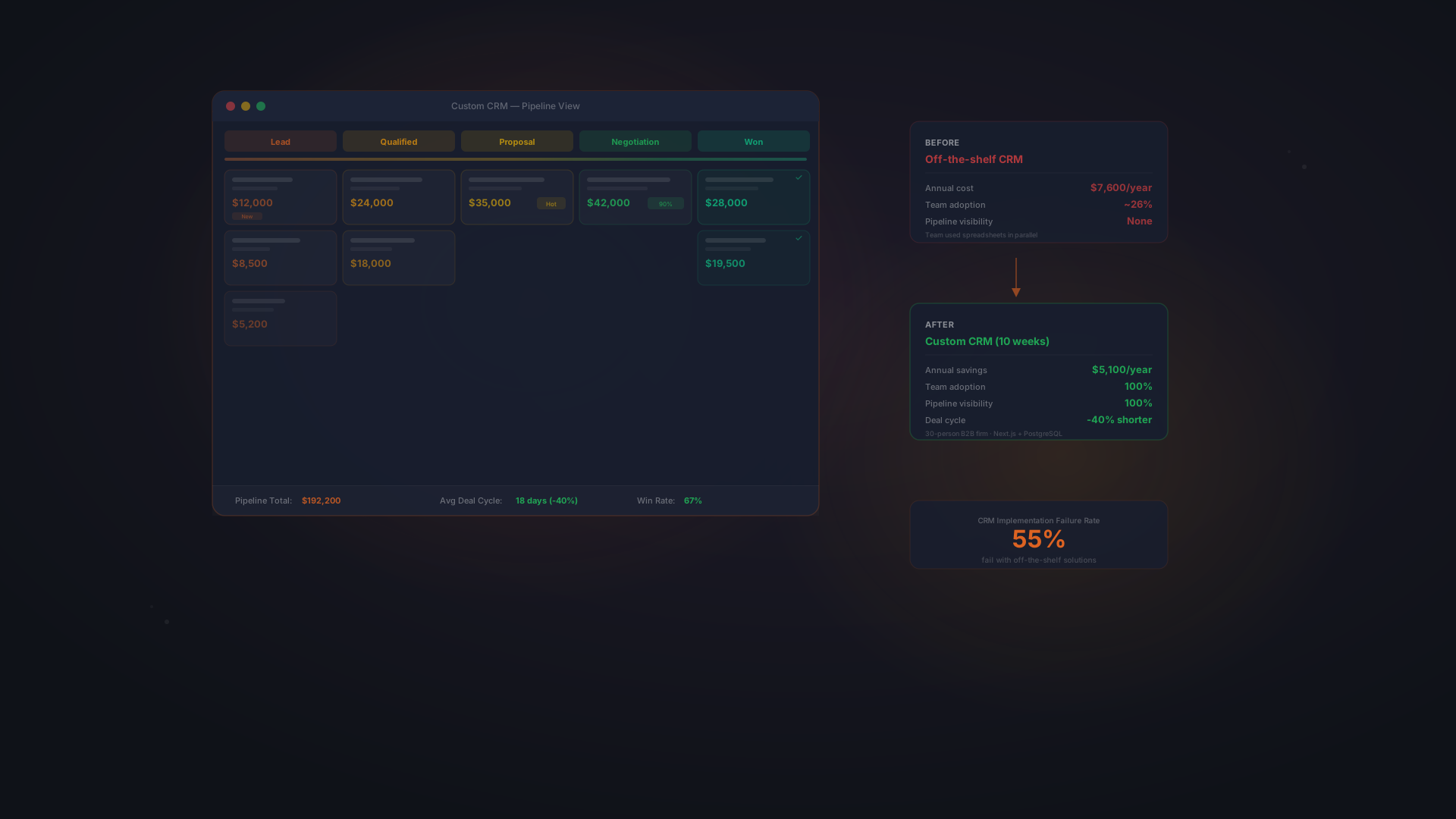
One of the clearest illustrations of what a custom CRM can do comes from a 30-person B2B sales firm. They were paying $7,600 a year for Salesforce Starter. The problem was not the cost — it was that the team barely used it.
Salespeople found the system cumbersome. Logging activities took too long. The pipeline view did not match how their deals actually progressed. So they maintained their own spreadsheets. Management had no real visibility into the pipeline. Nobody knew which deals were at risk, which needed follow-up, or how the quarter was actually trending.
They commissioned a custom CRM. The requirements were specific: a five-stage pipeline matched to their actual sales cycle, automated follow-up reminders tied to deal stage and inactivity, direct integration with their invoicing system so deals and invoices stayed in sync, and a management dashboard that surfaced pipeline health without any manual reporting.
The system was built on Next.js, React, Node.js, TypeScript, PostgreSQL, and Prisma. It took ten weeks from kickoff to live deployment. The results:
- 40% shorter deal cycle — automated follow-ups eliminated the gaps between touchpoints that had been slowing deals down
- 100% pipeline visibility — management could see every deal in real time without chasing salespeople for status updates
- $5,100 saved annually — switching from Salesforce Starter to a system they owned eliminated the recurring subscription cost
- 10-week deployment — from requirements to a live, production system used by the full team
The $5,100 annual saving is the number that is easy to point to. The 40% shorter deal cycle is the one that compounds. Faster deals mean more deals. For a B2B firm, compressing the sales cycle by that margin over a full year has a revenue impact that dwarfs the development investment.
The Build Process: What to Expect
Building a custom CRM is not a mysterious process. It follows a clear sequence, and understanding it helps you plan accurately and set the right expectations with your team.
Discovery and Requirements (2–3 Weeks)
The process starts with a structured discovery phase. This is where your actual sales process gets documented: how leads enter the pipeline, how they move through stages, who touches them at each point, what data matters, what automations would save time, and what the management view needs to show.
Good discovery is where the ROI of a custom CRM is largely determined. A development team that skips this phase and jumps to building will produce a system that fits their assumptions, not your reality. Discovery typically takes two to three weeks and produces a specification document and wireframes that both sides have signed off on.
MVP Development (6–10 Weeks)
The MVP covers the core functionality: the pipeline, data model, key automations, and any critical integrations. For most businesses, this is the system that gets deployed and used — not a prototype, but a production-ready application.
The typical technology stack for a custom CRM involves a modern JavaScript framework (Next.js or similar) for the interface, a Node.js or similar backend, a relational database (PostgreSQL is the most common choice for CRM workloads), and well-documented APIs for integrations. The stack matters for maintainability: a system built on widely-used, well-supported technologies is easier to extend and easier for any competent developer to work on.
Testing, Training, and Deployment (2–3 Weeks)
Before go-live, the system goes through user acceptance testing with actual salespeople — not just QA for bugs, but validation that the workflow makes sense in practice. This is also when data migration from the previous system happens, when integrations are tested end-to-end, and when the team receives training.
The training investment is worth taking seriously. The adoption rate problem that plagues off-the-shelf CRMs is partly a training problem. When a system is built for your process, training is simpler — but it still matters to ensure the team starts with good habits.
Ongoing Iteration
Custom CRMs are not static. After launch, you will identify improvements: a reporting view that would be useful, an automation that would save more time, a new integration as your stack evolves. Because you own the system, these changes are straightforward to implement. There is no waiting for a vendor roadmap and no paying for features you do not need.
Realistic Costs: Custom CRM vs Salesforce Over 5 Years
The most common objection to building a custom CRM is cost. It's a fair starting point, but it is the wrong comparison. The relevant question is not "what does it cost to build?" — it is "what does each option cost over the period I plan to use it?"
A custom CRM MVP typically costs between $15,000 and $40,000, depending on complexity. Development is delivered in 2–4 months. Eastern European development teams — including Czech Republic, Slovakia, and Poland — deliver at $40–80 per hour with the technical depth of Western teams and without the communication overhead of offshore development.
Now run the five-year comparison for a 30-person team:
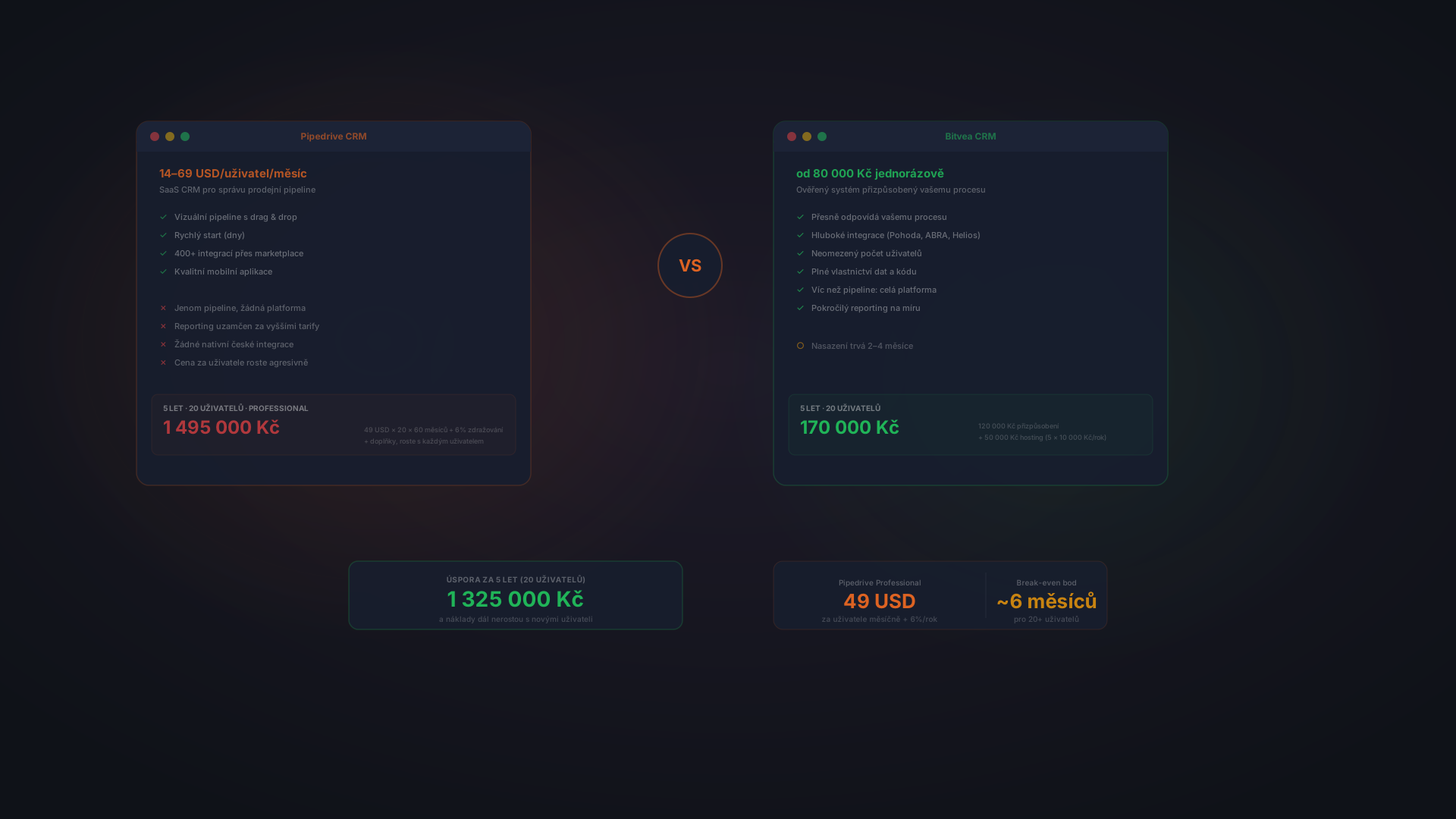
- Salesforce Pro Suite, 5 years: $100/user/month × 30 users = $36,000 in year one. With 6% annual increases: approximately $203,000 over 5 years — before add-ons, integrations, or implementation consulting
- Custom CRM, 5 years: $25,000 development (midpoint estimate) + ~$400/year for hosting and maintenance = approximately $27,000 over 5 years
- 5-year difference: ~$176,000 in favor of the custom build
- Break-even point: approximately 12–18 months for a typical mid-size team
These are directional numbers — the actual figures depend on your team size, the complexity of the system, and the scope of integrations. But the direction is consistent: beyond the 18-month mark, the custom CRM is structurally cheaper, and the gap widens every year.
The CRM market average return is $8.71 per dollar spent. A system your team actually uses captures that return. A system sitting at 26% adoption does not.
Isn't Custom Too Expensive? Addressing the #1 Objection
The "too expensive" objection almost always refers to the upfront cost. It is a real concern, especially when a SaaS subscription starts at a few hundred dollars a month and a custom build requires a five-figure investment before a single line of code is written.
But the comparison only works if you hold the time horizon constant. Comparing month-one SaaS costs to a full custom development budget is not an apples-to-apples analysis. The right comparison is total cost of ownership — and on that measure, at any reasonable team size over any period longer than 18 months, custom development is not expensive. It is cheaper.
The other dimension of cost that the objection ignores is the cost of not solving the problem. If your CRM adoption rate is 26%, you are paying for a system that does not work. The pipeline is invisible. Deals fall through gaps. Management makes decisions based on incomplete information. That has a cost — it just does not arrive as a line item on a monthly invoice.
Is a Custom CRM Right for You? A Decision Checklist
A custom CRM is not the right solution for every business. Use this checklist to assess whether you are a good candidate.
Strong signals that a custom CRM makes sense:
- Your team actively avoids the CRM you are paying for, and uses spreadsheets or email as the real system of record
- Your sales process has specific stages, approval steps, or data requirements that standard platforms cannot accommodate cleanly
- You need deep integration between your CRM and your invoicing, ERP, or operations systems — not a connector that breaks on updates
- You have 15 or more users and a time horizon of at least 2 years — the economics work strongly in your favor
- You have tried configuring an off-the-shelf platform and spent significant time and money with limited improvement in adoption
- Management lacks real pipeline visibility and relies on manual status updates or end-of-week reports
Signals that off-the-shelf is likely sufficient:
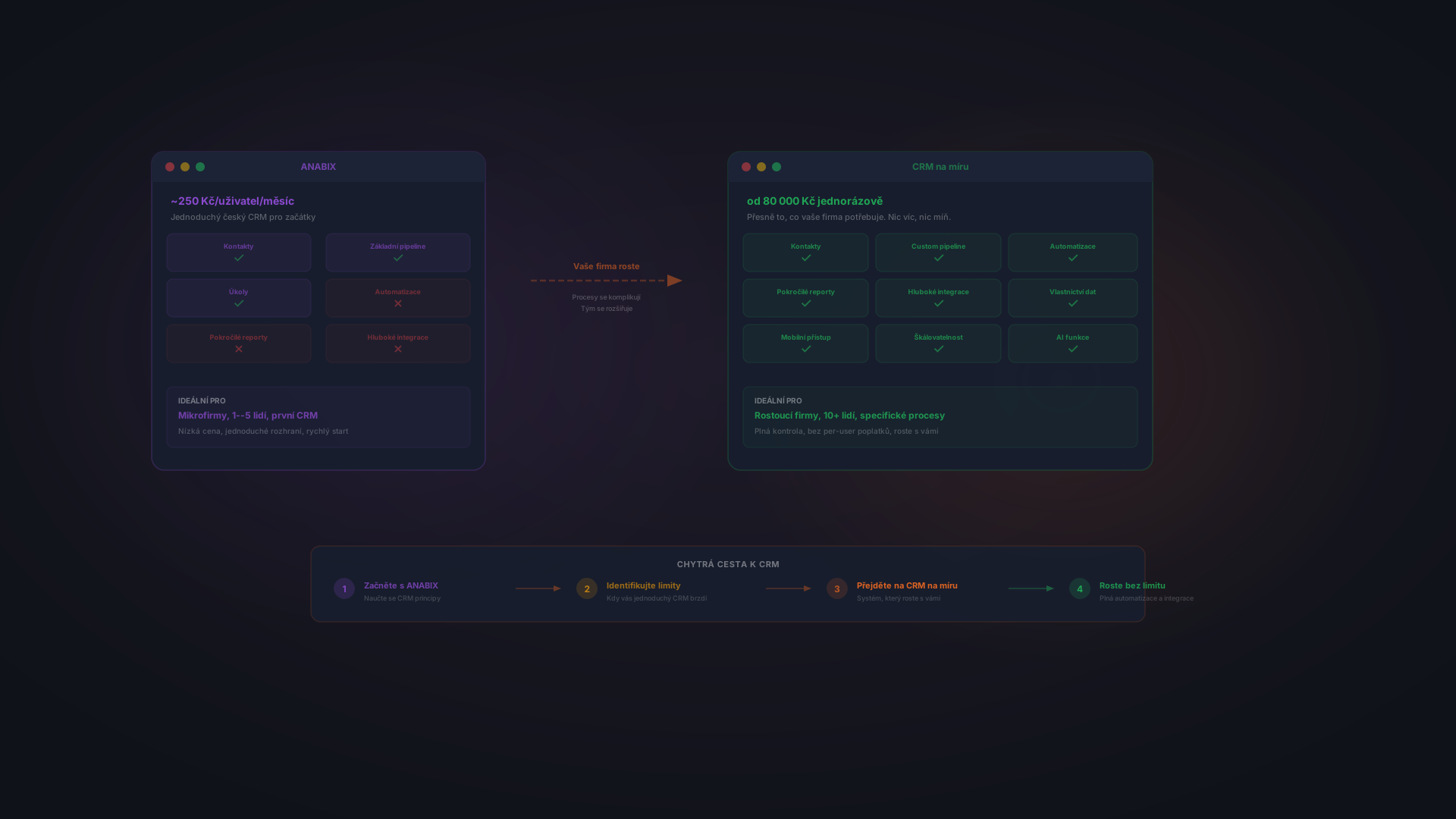
- You have fewer than 10 users and a straightforward sales process with no special integration needs
- You are in an early stage of business and your process is still evolving — it is hard to build for a moving target
- Your team is already using and adopting an existing platform effectively
- You need capabilities that are actively maintained by a vendor — compliance features, regional regulations, or integrations your team doesn't have bandwidth to build
The honest answer for most businesses with 20–100 employees and a defined sales process is that the custom path delivers better outcomes. The upfront investment is real, but it is bounded — unlike SaaS costs, which have no ceiling.
What Good CRM Development Looks Like
Not all custom development is equal. A custom CRM that is built quickly and cheaply, without proper discovery, on a fragile technology stack, will create more problems than it solves. Here is what to look for in a development partner.
- Discovery before code — a team that builds without a deep understanding of your sales process will build the wrong thing. Discovery is not a formality; it is where the system gets designed.
- Modern, maintainable technology — Next.js, React, Node.js, PostgreSQL, and similar well-supported technologies mean the system can be maintained and extended by any competent developer, not just the original team
- User acceptance testing — the system should be validated by actual salespeople before go-live, not just tested for technical bugs
- Data migration support — moving your historical data into the new system properly is critical; skipping this step means starting with an empty CRM
- Documentation — a system without documentation is a liability. You should receive clear documentation of the data model, API structure, and any non-obvious design decisions
- Post-launch support — the first weeks after go-live will surface real-world usage patterns that no testing phase fully predicts; a development partner should be available to address them
The Bottom Line
The CRM market's 55% failure rate is not a mystery. It is the predictable outcome of selling a generic platform to thousands of businesses with different processes and expecting it to fit. The businesses that break out of that failure pattern are the ones that build for their specific reality rather than trying to configure their way to something adequate.
Building a custom CRM is a meaningful investment. It requires a good development partner, a clear discovery process, and management commitment to doing the work properly. In return, you get a system your team actually uses, pipeline visibility that actually reflects reality, and a technology asset you own outright — with no subscription renewals and no vendor price increases compounding against you year after year.
For the right business, the ROI is straightforward. The 30-person firm in the case study above recouped the development cost in savings alone within two years — and the 40% reduction in deal cycle was generating revenue impact long before that.
Bitvea builds custom CRM systems for B2B companies across the Czech Republic and Europe. If your team is working around your current CRM rather than with it, let's talk — we'll assess whether a custom build makes sense for your situation and what it would realistically cost.