Martin spent three months and 400,000 CZK on a developer who delivered a React app that crashed every time more than 50 users logged in. The portfolio looked solid. The interview went great. The references checked out. But nobody on Martin's team could tell the difference between a well-architected codebase and spaghetti held together with duct tape. When the app fell apart during their first marketing push, Martin had to scrap the entire project, hire someone new, and start from scratch.
This story plays out at hundreds of growing companies every year. You need to evaluate developer candidates, but you don't have a CTO or senior engineer on staff to separate genuine talent from confident talkers. The cost of a bad technical hire can run 5x the employee's annual salary when you factor in wasted development time, missed deadlines, and the rebuild that follows.
The good news: you don't need a computer science degree to screen developers effectively. You need a framework, the right questions, and an understanding of what actually matters. If you'd rather skip the learning curve entirely, Bitvea's IT talent screening service handles the full technical evaluation for you, from code review to architecture assessment. But if you want to build your own process, here's exactly how.
Why Non-Technical Founders Struggle With Developer Screening
The core problem is asymmetric information. Developers know far more about their own skills than you can verify. A candidate can list "5 years of Python, microservices, AWS" on their resume, and unless you can probe beneath those keywords, you're taking their word for it.
This creates three specific risks.
The Confidence Gap. Articulate candidates who interview well but code poorly. They know the terminology. They can talk about system design at a high level. But when they sit down to build something, the code is fragile, untested, and hard to maintain.
The Overqualification Trap. Enterprise developers who default to over-engineering everything. They propose Kubernetes clusters and microservice architectures for an app that serves 200 users. One Hacker News commenter described a developer who pushed for "scalable micro services" that added six months to a project that should have shipped in eight weeks.
The Portfolio Illusion. GitHub profiles full of tutorial projects and half-finished side projects that never served real users. A portfolio without live, production applications tells you very little about how someone performs under real constraints.
Non-technical founders often compensate by relying on gut feeling, which is how you end up with a developer who seems great in conversation but can't ship working software.
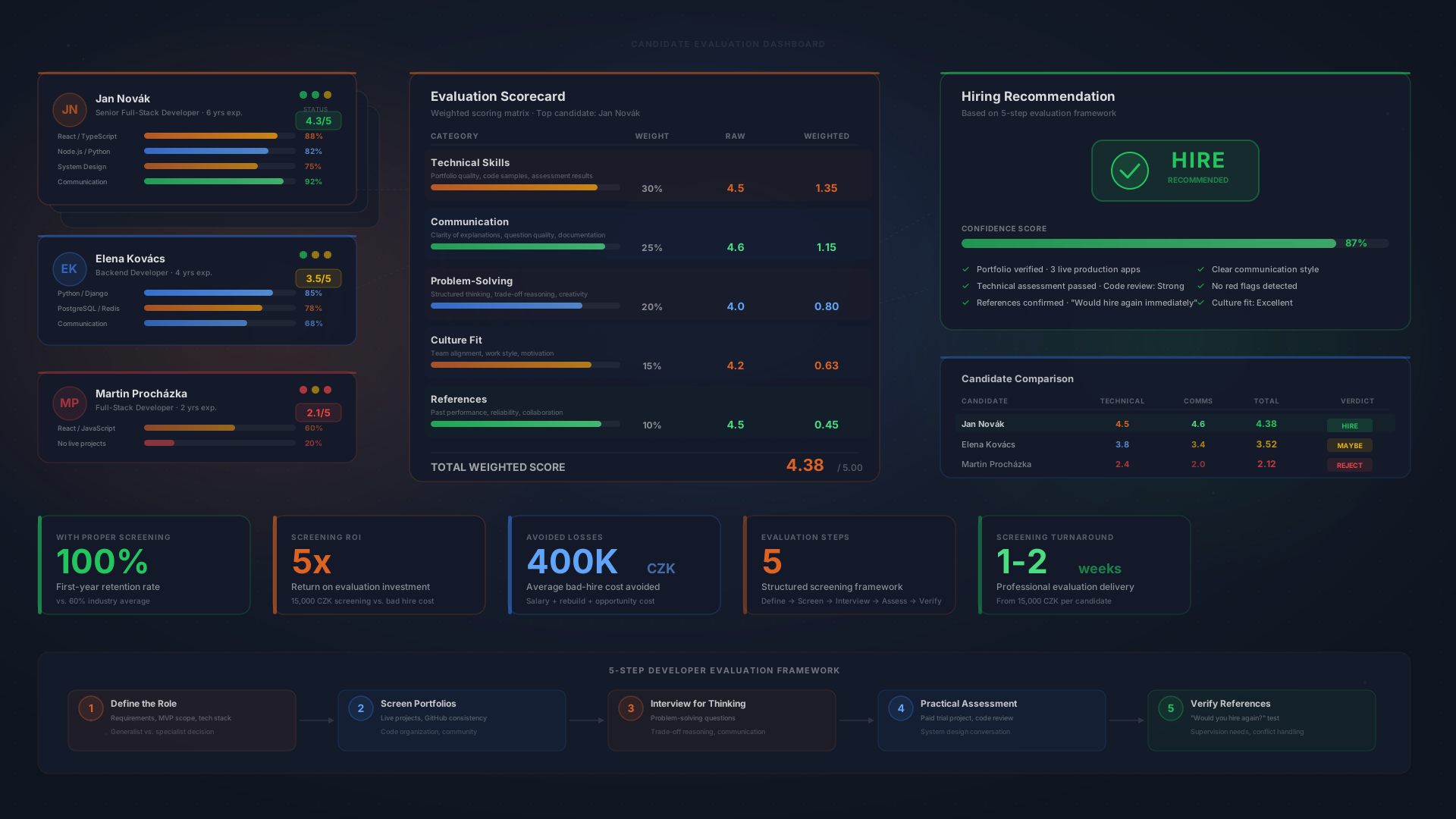
The 5-Step Framework to Evaluate Developer Candidates
You don't need to understand code to evaluate developers systematically. You need a structured process that surfaces the information you actually care about.
Step 1: Define the Role Before You Post the Job
Most hiring failures start before the first interview. If you can't describe what you need built, developers will fill in the gaps with their own assumptions, and those assumptions rarely match your business goals.
Before posting a job listing, write a one-page document that answers:
- What specific problem does this software solve?
- What does the minimum viable product look like?
- What tools and systems does this need to integrate with?
- Is this a greenfield build or work on an existing codebase?
- Do you need a generalist or a specialist?
If you're building a custom software application from scratch, you need someone with architecture experience. If you're extending an existing system, you need someone comfortable reading and modifying other people's code. These are very different skill sets.
Step 2: Screen Portfolios and GitHub Profiles
You can learn a lot from a developer's public work without understanding a single line of code. Here's what to look for:
Live Projects. Ask every candidate: "Can you show me something you built that real users are using right now?" If they can't point to a single live application, that's a red flag. It's shocking how many companies never ask this question.
Contribution Consistency. On GitHub, look at the contribution graph (the green squares on their profile). Consistent activity over months or years suggests genuine engagement. A burst of activity two weeks before applying suggests resume padding.
Code Organization. Even without reading code, you can tell if someone is organized. Do their repositories have README files? Are projects named descriptively? Is there a logical folder structure? Sloppy project organization often signals sloppy code.
Community Engagement. Do they contribute to open-source projects? Answer questions on Stack Overflow? Write technical blog posts? Active community participation often correlates with deeper expertise.
Step 3: Ask Questions That Reveal Thinking, Not Just Knowledge
You can't quiz a developer on algorithms. But you can ask questions that expose how they think, communicate, and make decisions. These work regardless of your technical background.
"Walk me through how you'd build [your product feature]." Listen for whether they ask clarifying questions before jumping to solutions. Strong developers ask about constraints, user volume, and edge cases. Weak developers start listing technologies immediately.
"Tell me about a project that went wrong and what you learned." Honest developers have failure stories. If someone claims every project went perfectly, they're either lying or haven't worked on anything challenging.
"Explain [a concept from their resume] as if I'm a business owner, not an engineer." This tests communication skills directly. If a candidate can't explain their own expertise in plain language, they'll struggle to collaborate with your non-technical team.
"Why did you choose [technology X] for your last project?" You're looking for trade-off reasoning. Good answers mention alternatives they considered and specific reasons for their choice. Bad answers are "because it's the best" or "because that's what I know."
Step 4: Use Practical Assessments, Not Puzzle Tests
Traditional LeetCode-style coding challenges, where candidates reverse binary trees or optimize sorting algorithms, are increasingly irrelevant. Research from multiple hiring platforms shows these puzzles correlate poorly with on-the-job performance.
Instead, use assessments that mirror actual work:
Paid Trial Projects. Give the candidate a small, real task from your product backlog. Pay them for 8-16 hours of work. You'll learn more from watching someone tackle a real problem than from any interview question.
Code Review Exercises. Provide a piece of code (you can ask a consultant to prepare this) and ask the candidate to review it. What bugs do they find? What improvements do they suggest? In 2026, this skill matters more than ever because developers increasingly need to validate AI-generated code for subtle bugs, race conditions, and security flaws.
System Design Conversations. Describe a business problem and ask how they'd design a solution. You won't understand every technical detail, but you can assess whether they ask smart questions and consider practical constraints like budget, timeline, and maintainability.
Step 5: Check References Properly
Most reference checks are useless because people ask generic questions. Instead, ask references:
- "Would you hire this person again for the same role?"
- "What type of supervision did they need?"
- "How did they handle disagreements about technical decisions?"
- "What's one thing they could improve?"
A pause before "yes" on that first question tells you everything.
Red Flags That Should Disqualify Developer Candidates
Some warning signs are visible even without technical knowledge. Any of these should give you serious pause.
No source control experience. If a developer doesn't use Git (or equivalent version control), they lack fundamental professional habits. This is like hiring an accountant who doesn't use spreadsheets.
No automated testing practice. Developers who don't write tests are developers who ship bugs. Ask: "How do you make sure your code works when you change something?" If the answer doesn't include automated testing, move on.
Can't show live work. Portfolios full of screenshots and descriptions but no working URLs. If nothing they've built is still running, ask why.
Zero interest in your business. Developers who only talk about technology and never ask about your users, your market, or your business model. Your first developers need to care about what they're building, not just how.
History of underestimating timelines. Ask about project estimates versus actual delivery. Every developer underestimates sometimes, but the good ones can explain why and what they learned.
Resistance to explaining decisions. If a candidate gets frustrated when you ask "why?" or tells you "it's too technical to explain," that's a communication problem you'll live with daily.
How to Assess Technical Skills Without Technical Knowledge
Even without a CTO, you can evaluate technical competence using indirect methods.
The Explanation Test
Ask candidates to explain a technical concept from their resume to you. Rate them on clarity, not correctness (you wouldn't know anyway). A strong developer makes complex ideas simple. A weak developer hides behind jargon.
The best technical communicators use analogies. If someone can relate database indexing to a book's table of contents, or explain API design using a restaurant menu metaphor, they understand the concept deeply enough to teach it.
The Problem-Solving Observation
Give the candidate a non-technical problem during the interview. Something like: "Our customer support team handles 200 tickets per day and response time is too slow. How would you approach this?" Watch for structured thinking, questions about constraints, and practical solutions.
The Reference Architecture Review
Ask your candidates to draw or describe the architecture of something they've built. Then take those descriptions to a technical advisor for a 30-minute review. You don't need a full-time CTO for this. A freelance senior developer or a technical screening service can review candidate materials and give you a calibrated assessment in days.
The Work Sample Audit
If a candidate submits code as part of your hiring process, have it reviewed by an external technical expert. This single step catches most bad hires. A 2-hour code review by a senior developer costs far less than a 6-month mistake.
When to Bring in External Technical Expertise
There's a point where doing it yourself stops making sense. If you're hiring for a senior role, building a core product, or making your first technical hire, the stakes are too high for guesswork.
External technical evaluation makes sense when:
- The role is senior or leadership-level. A bad senior hire doesn't just waste their salary. They make bad architecture decisions that cost you years.
- You're building your founding engineering team. Your first 2-3 developers set the technical direction for everything that follows. Get this wrong and you'll eventually need a complete rewrite.
- You've been burned before. If a previous hire didn't work out, repeating the same screening process will produce the same results.
- The candidate's claims are hard to verify. When someone says they've "architected systems handling millions of requests," you need someone who can probe that claim.
Bitvea's IT talent screening covers exactly this gap. The service includes structured technical interviews, code review and quality analysis, architecture evaluation, GitHub and portfolio analysis, and a detailed report with scores and recommendations. Starting at 15,000 CZK per candidate with a 1-2 week turnaround, it costs a fraction of a bad hire.
Consider it insurance. If you're about to commit 80,000 CZK or more per month to a developer's salary, spending 15,000 CZK to verify they can actually do the job is one of the smartest investments you'll make.
Building a Repeatable Developer Hiring Process
One-off hiring decisions are risky. A repeatable process reduces that risk every time you use it.
Create a Scorecard
Build a simple scoring matrix with these categories:
Category | Weight | What to Evaluate |
|---|---|---|
Technical Skills | 30% | Portfolio quality, code samples, assessment results |
Communication | 25% | Clarity of explanations, question quality, documentation |
Problem-Solving | 20% | Structured thinking, trade-off reasoning, creativity |
Culture Fit | 15% | Team alignment, work style, motivation |
References | 10% | Past performance, reliability, collaboration |
Score each candidate 1-5 in every category. Multiply by the weight. Compare candidates on total scores rather than gut feelings.
Standardize Your Interview Questions
Ask every candidate the same core questions. This eliminates the bias that comes from different conversations with different candidates. You can add role-specific questions on top, but the foundation should be consistent.
Document Everything
After each interview, write down specific observations within 30 minutes. "Seemed smart" is useless. "Explained database migration strategy using clear analogies, asked three questions about our user volume before proposing a solution" is useful. This documentation also protects you if a hiring decision is ever questioned.
Get a Second Opinion
Never make a technical hire based on one person's judgment. Even if you're the sole decision-maker, bring in a trusted advisor, a technical consultant, or a screening service to provide a second perspective. Two viewpoints catch what one misses.
What Happens After You Hire
Evaluation doesn't stop at the offer letter. The first 90 days reveal whether your screening process actually worked.
Set clear milestones for the first week, first month, and first quarter. Define what "success" looks like in concrete terms: features shipped, code reviewed, systems documented. If you don't set expectations early, you won't know whether your new hire is performing until it's too late to correct course.
Watch for early warning signs: missed deadlines without communication, resistance to code review, an inability to explain what they're working on, or code that breaks frequently after deployment. These patterns in the first month tend to persist.
If things aren't working, act quickly. The sunk cost of a hiring process doesn't justify keeping a bad hire. Every week you delay costs more than the week before.
For companies that lack in-house technical leadership, consider pairing your new developer's work with periodic external code reviews. A quarterly review of your codebase by an outside expert, through a service like Bitvea's system extension and integration assessment, can catch architectural problems before they become expensive. This also helps verify that the security practices in your codebase meet professional standards.
Your Next Step
Hiring developers without a CTO is hard, but it's not impossible. The founders who succeed at it follow a structured process, ask the right questions, and know when to bring in help.
Start with the five-step framework above. Define the role clearly. Screen portfolios for live work. Ask questions that test thinking, not trivia. Use practical assessments. Check references with pointed questions.
And if the hire is critical enough that getting it wrong would set your company back months, don't leave it to chance. Get in touch with Bitvea for a professional technical evaluation that gives you confidence in your hiring decision.
The cost of screening is always less than the cost of a bad hire.