Choosing the wrong software development partner is one of the most expensive business decisions you can make. A custom software project commonly runs from $50,000 to $300,000. Choose wrong, and you do not just lose that investment. You lose the months it took to realise the relationship was failing, plus the time and cost to restart with someone else. Switching partners mid-project routinely costs far more than the original budget, because the new team has to unpick and rebuild what the last one left behind.
The risk is not hypothetical. Dun & Bradstreet has estimated that 20-25% of outsourcing relationships fail within the first two years. Meanwhile the outsourcing market keeps growing, which means the supply of agencies claiming to be your ideal partner has never been larger. More choice does not make the choice easier.
The challenge is not finding a software development company. The challenge is finding the right one. This guide provides a systematic evaluation framework based on criteria that actually predict project success: eight evaluation criteria, a weighted scorecard you can use immediately, cost benchmarks by region, a five-question AI due diligence framework, and an honest assessment of when keeping development in-house is the smarter choice.
Why Partner Selection Is the Single Biggest Risk Factor
Most digital transformation programmes fall short of their objectives. Scope creep is routine, and a large share of failed projects trace back to requirements that were vague or wrong from the start. These are not random outcomes. They are the predictable consequences of choosing a development partner without a rigorous evaluation process.
Cultural mismatch and poor communication are two of the most common reasons offshore projects fail. Neither of these failure modes appears during a sales call or a proposal review. They emerge after the contract is signed, when the actual working relationship begins.
There is also a critical distinction that most evaluation guides miss: the difference between a partner and a vendor. A vendor executes your specification for hours and dollars. A partner shares risk, challenges your thinking when your requirements do not make sense, and aligns their incentives with your outcomes. In 2026, the best development agencies operate as partners. Outcome-based engagements, where the agency takes accountability for results and not just deliverables, are now the standard for mature development relationships. If an agency only offers to execute what you hand them, that is not a partnership. It is a staffing arrangement with a different label.
The evaluation process is not overhead. It is insurance against a costly mistake. Here is how to approach it systematically.
8 Criteria That Actually Predict Project Success
Generic guidance says "evaluate technical expertise and check references." That is necessary but not sufficient. These eight criteria separate partners who will deliver from those who will cost you time, money, and trust.
1. Relevant Technical Expertise, Not a Logo Wall
Every agency homepage displays twenty technology logos. What matters is depth, not breadth. Ask: "Show me a project where you solved a technical challenge similar to mine." Push for specifics: architecture decisions, trade-offs they considered, problems they encountered and resolved. A partner who built three CRM systems understands CRM architecture deeply. A partner who built one of everything understands nothing deeply.
2. Industry and Domain Experience
A partner who has built for your industry understands the regulatory environment, user expectations, and the common architecture pitfalls specific to your sector. For European businesses, this includes GDPR compliance, EU Data Act alignment (in force since September 2025), and familiarity with local payment and invoicing systems. Domain experience shortens discovery, reduces risk, and produces better software. The absence of it means you are paying for their learning curve.
3. Process Transparency and Delivery Methodology
Ask a candidate to walk you through their delivery model: how sprints are structured, how releases are managed, what the feedback loop looks like, and what happens when something goes wrong. Ask for a sample project timeline with milestones and deliverables. A partner with a mature process can describe it concretely. One without a mature process will give you vague answers about "staying agile." Agile projects have roughly a 9% failure rate versus 29% for waterfall, but neither methodology protects you if the team cannot describe how they apply it.
4. Team Quality and Stability
Ask to meet the actual people who will work on your project, not just the sales team or a technical lead who appears for the pitch and disappears afterward. Inquire about the senior-to-junior ratio, the split between employees and subcontractors, and the team's turnover rate. Turnover in the tech industry runs high, and high turnover means knowledge loss and re-onboarding delays mid-project. A revolving door of developers on your project is one of the most reliable predictors of failure.
5. Communication and Cultural Alignment
Agile collaboration requires real-time communication. A minimum four-hour timezone overlap per working day is not a preference. It is a functional requirement for iterative development. But timezone overlap is only one dimension. Cultural alignment, meaning shared expectations around directness, responsiveness, decision-making, and escalation, determines whether friction accumulates over time. The sales process is the partner's best communication. If they are slow to respond, vague in their answers, or difficult to reach during evaluation, that behavior does not improve after you sign.
6. References and Verified Track Record
A partner's portfolio is the first thing most buyers look at, and for good reason, but portfolio quality matters more than quantity. Ask for references from companies of similar size building similar types of software. Call those references. Ask not just whether the project was delivered, but whether it was delivered on time, whether the team communicated proactively when problems arose, and whether the client would hire them again. Check Clutch, G2, and GoodFirms for review patterns: look for recency and consistency, not just average rating.
7. Pricing Model and Cost Transparency
Three pricing models dominate custom software development: fixed-price (defined scope, fixed cost, appropriate when requirements are well-understood), time-and-materials (flexible scope, hourly or daily rates, appropriate when requirements will evolve), and dedicated team (an ongoing team embedded in your organisation, appropriate for sustained development partnerships). Get clear answers on what is included in each pricing option, how change requests are handled, and what payment milestones look like. A quote significantly below market rate should raise concern, not enthusiasm. Underquoting is how agencies win work they cannot profitably deliver.
8. Post-Launch Support and Long-Term Commitment
Software is never finished. After launch, you will need bug fixes, performance improvements, new features, and integrations with new tools. Annual maintenance typically costs 15-20% of the initial development investment. Ask specifically: "What happens when we need changes six months after launch?" and "What are your SLA terms for production issues?" A partner who has no clear post-launch support model is optimised to build and disengage, not to share accountability for your software's long-term success.
10 Red Flags That Should End the Conversation
These are not hypothetical concerns. Each represents a failure mode that plays out repeatedly in software development engagements. If you encounter three or more of these, walk away.
- They quote without understanding your requirements. No discovery call, no questions about your business, just a price. A number produced without understanding the problem is not a quote. It is a placeholder designed to win the conversation.
- The price is dramatically below market rate. Underquoting leads to scope cuts, delivery delays, or a partner who resents the engagement from week three. You do not get premium work at discount prices.
- They will not let you meet the development team. The team is the product. If you cannot evaluate the people who will build your software, you cannot evaluate the partner.
- No documented process or methodology. If they cannot describe concretely how they work, they improvise. Improvised development produces inconsistent results.
- They say yes to everything. A good partner pushes back when your requirements have gaps, contradictions, or scope that exceeds your budget. A partner who never challenges your brief is not invested in your outcome.
- No references from similar projects. Claims without evidence are marketing. Ask for references from recent projects of comparable scope and be suspicious of any reluctance to provide them.
- They resist NDAs or IP clarity. Non-negotiable legal protections should never be contentious. A partner who pushes back on standard IP assignment or confidentiality terms has a reason for doing so.
- High employee turnover or heavy subcontracting. If the team working on your project changes every few months, your project absorbs the cost of constant context re-establishment.
- Communication delays during the sales process. Slow responses, unclear answers, and missed calls during evaluation represent the partner's best effort. It does not improve after the contract is signed.
- No post-launch support plan. A partner without a maintenance offering is optimised for project completion, not project success. Avoid anyone whose engagement model ends at deployment.
Cost Benchmarks: What to Expect by Region
Cost is a real factor in partner selection, but it is not the right primary criterion. The right question is not "who is cheapest?" but "where does quality-to-cost ratio align with what this project actually requires?" Here are 2026 development rate benchmarks by region:
Region | Hourly rate | Best for |
|---|---|---|
North America | $100–$200/hr | Enterprise projects with complex compliance or proximity requirements |
Western Europe | $70–$150/hr | EU-regulated industries requiring strict regulatory alignment |
Central Europe (CZ, PL) | $40–$80/hr | Best quality-to-cost ratio for European businesses. EU law, GDPR native, CET timezone |
Eastern Europe (UA, RO, BG) | $25–$60/hr | Cost-effective option. Higher timezone and communication risk |
South Asia (IN, PK) | $20–$50/hr | Budget-constrained projects with well-defined specs. Significant timezone gap |
Latin America | $35–$65/hr | North America timezone. Less relevant for European businesses |
For total project budgets, expect these ranges in 2026:
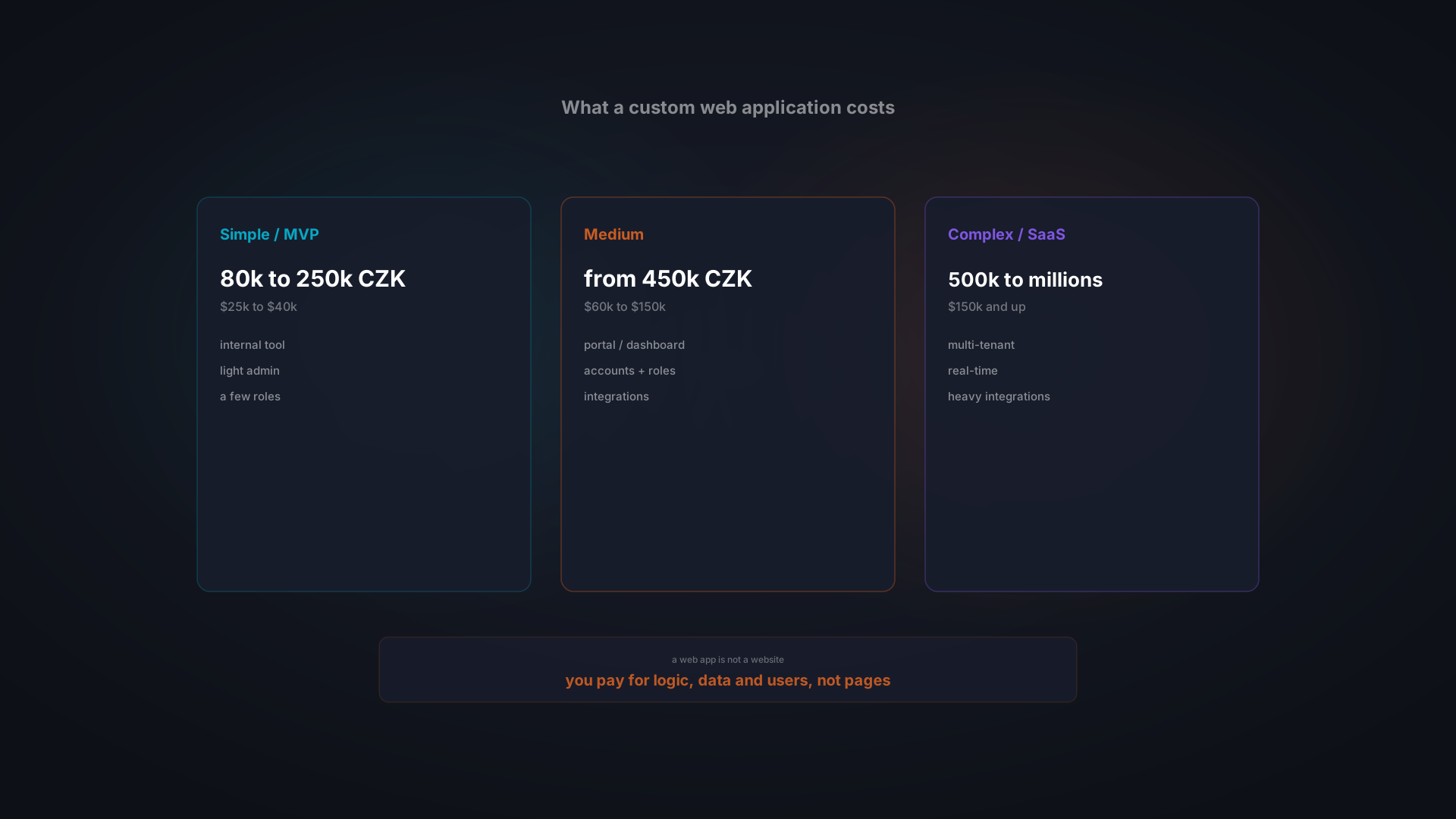
Project scope | Budget range | Timeline | Typical use cases |
|---|---|---|---|
MVP / Prototype | $15,000–$50,000 | 2–4 months | Concept validation, replacing a manual process |
Mid-Range Product | $50,000–$150,000 | 4–8 months | Custom CRM, e-commerce, internal tools |
Enterprise Application | $150,000–$500,000+ | 8–18 months | Core infrastructure, AI/ML, multi-platform |
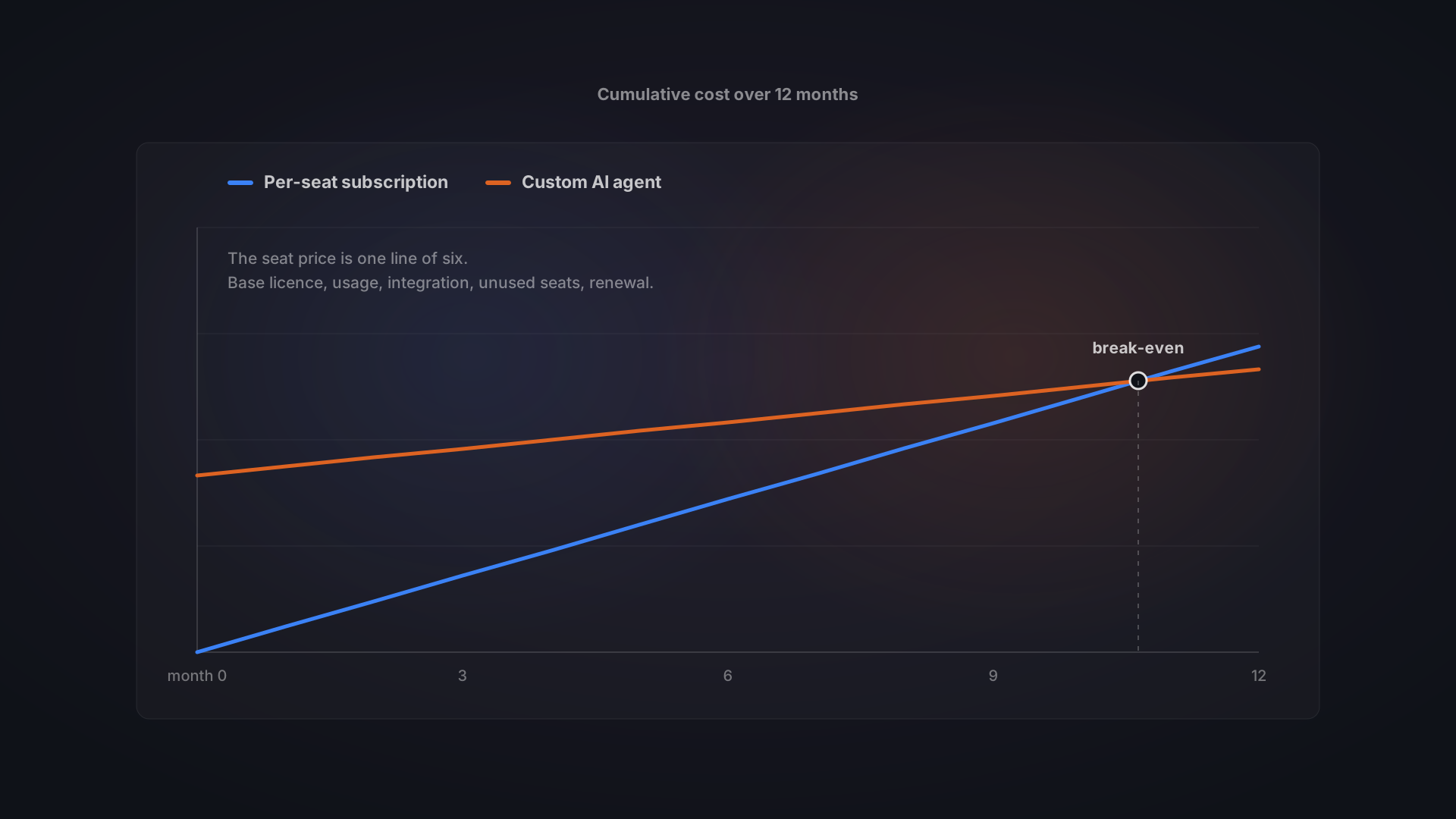
Bitvea has built a 30-person B2B CRM in 10 weeks at Central European rates. The system cut the client's deal cycle by 40% and saved $5,100 a year compared with Salesforce. For European businesses, the Central European combination of quality, timezone alignment, and EU legal framework is consistently the best value.
AI Due Diligence: Separating Capability from Marketing
In 2026, every agency claims AI expertise. Gartner expects 75% of enterprise software engineers to use AI coding assistants by 2028, up from a small fraction a few years earlier. Yet an MIT study found that 95% of enterprise generative AI pilots deliver no measurable return. The gap between AI marketing and AI reality is substantial.
Five questions will separate genuine AI capability from buzzword adoption:
- "Show me an AI feature you built that is currently in production." Not a demo. Not a proof-of-concept. A live system used by real users. Ask about the architecture, the model choices, and the operational challenges they solved.
- "How do you use AI in your own development workflow?" Partners who genuinely understand AI use it internally: for code review, test generation, documentation, and debugging. If they cannot describe their internal AI tooling, they have not integrated it into their practice.
- "What AI tools did your team adopt in the last 12 months, and what did you reject?" Thoughtful adoption, with clear reasons for rejection, signals experience. "We use everything available" signals marketing.
- "What would you recommend we NOT use AI for in this project?" A partner who can articulate AI's limitations and appropriate use cases is more trustworthy than one who responds to every problem with an AI solution.
- "How do you handle AI model costs, data privacy, and vendor lock-in?" These are operational questions that reveal whether a partner has shipped AI in production or only prototyped it. Self-hosted models, cost management strategies, and data residency requirements are real engineering problems that only experienced teams have solved.
The Partner Evaluation Scorecard
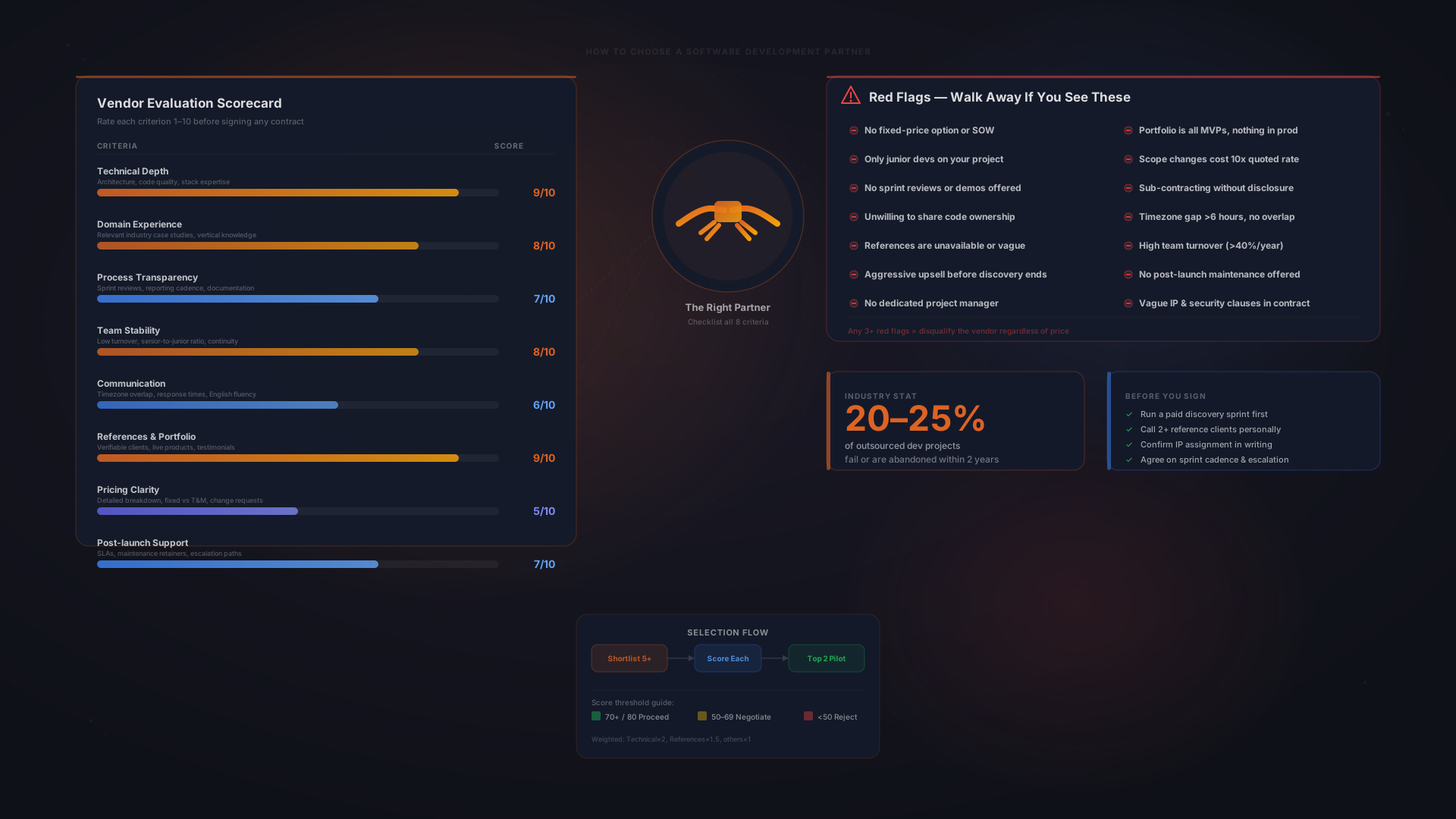
Apply this weighted scoring methodology to each candidate independently before comparing. Score each criterion on a 1–5 scale, multiply by the weight, and sum the weighted scores.
- Technical expertise match (20%): Depth in your specific technology needs, not logo count
- Relevant industry experience (15%): Demonstrated knowledge of your sector, regulatory environment, and user expectations
- Process maturity and transparency (15%): Ability to describe delivery methodology concretely, with examples
- Team quality and stability (15%): Senior-to-junior ratio, employee vs subcontractor mix, turnover rate
- Communication and cultural fit (10%): Timezone overlap, responsiveness during evaluation, directness
- References and track record (10%): Recent, verifiable references from similar-scope projects
- Pricing transparency and value (10%): Clear breakdown of costs, fair pricing model, no hidden fees
- Post-launch support commitment (5%): Documented SLA terms, maintenance model, long-term availability
How to interpret your scores: 4.0–5.0: strong candidate, proceed to contract negotiation. 3.0–3.9: promising but has gaps, request clarification on weak areas before proceeding. 2.0–2.9: significant concerns, likely not the right fit. Below 2.0: walk away.
Do not average scores across your evaluation team. Discuss and resolve disagreements. The scorecard is a decision aid, not a decision maker. It surfaces blind spots and forces structured thinking where intuition alone is unreliable.
When to Keep Development In-House
Every agency article about choosing a software development partner ends with a pitch. This one will not. The honest answer is that an external partner is not always the right choice, and recognising when to keep development in-house is as important as knowing how to evaluate external partners. If you go in-house, the same rigour applies to evaluating the developers you hire.
Keep it in-house when:
- Your software is your product, the core competitive advantage that demands full-time, dedicated ownership and continuous iteration that an external team cannot sustainably provide
- You have a strong existing team with the right skills and available capacity
- The project is a minor internal tool that your team can build in two to four weeks, since onboarding an external partner takes longer than the build
- Institutional knowledge and domain context are so deep that the external team's ramp-up cost exceeds the benefit of their technical skills
- Security and compliance requirements prohibit any external access to your systems or data
Consider an external partner when:
- You need skills your team does not have, and hiring the right person would take three to six months you do not have
- You need to move faster than your internal team's current capacity allows
- Your project is well-defined with clear outcomes, such as a custom CRM, an e-commerce platform, or an AI automation layer, where an experienced external team brings proven patterns and faster execution
- You want an outside perspective that challenges your assumptions and brings cross-industry experience your internal team lacks
- You are a growing business that needs capable software now but is not yet ready to build and manage a permanent development team
The decision is not binary. Many successful technology organisations use external partners for project-based work and new capability development while maintaining a lean internal team for operations and product ownership. The key is choosing the right model for the specific project, not a default position on outsourcing.
What Good Looks Like: Evidence Over Claims
The evaluation framework above gives you the criteria. But the most important principle is simpler: ask for evidence, not assurances. Any agency can claim they are process-driven, outcome-focused, and technically excellent. The ones who actually are can demonstrate it.
Ask to see a project retrospective, a real document from a completed project that captures what went well, what did not, and what the team would do differently. A partner confident in their work will share this without hesitation. One who cannot produce it has either not done the retrospective or does not want you to see it.
Ask about a project that went wrong. How did the team identify the problem? How did they communicate it to the client? What did they do to recover? The answer reveals more about a partner's character than any portfolio piece.
Bitvea builds custom software for growing businesses across Europe, from custom CRM systems and e-commerce platforms to AI-powered automation agents. Every engagement starts with a structured discovery process, and every project outcome is documented. If you are evaluating development partners and want to understand what that looks like in practice, let's talk.
The Bottom Line
Choosing a software development partner is a high-stakes decision, but it is a solvable problem when approached systematically. The evaluation framework in this guide, eight weighted criteria, a scoring methodology, AI due diligence questions, and a concrete red flags checklist, gives you the structure to make that decision with confidence rather than hope.
The cost of not evaluating properly is not abstract. 20-25% of outsourcing relationships fail within two years, and switching partners mid-project routinely costs far more than the original budget. The evaluation process is not a formality. It is the difference between a development partnership that delivers and one that costs you a year.
The right partner does not just build your software. They challenge your thinking, protect your interests, and share accountability for outcomes. That is the standard worth holding to.