Most companies leak more information than they realize. Forgotten subdomains. Employee credentials sitting in old breach dumps. A staging server that was never taken down. A job ad that spells out the internal tech stack. None of it is secret. It is all public, scattered across dozens of sources, waiting for someone to connect the dots. That someone is usually an attacker. It should be you first.
This is OSINT for business in practice: gathering and analyzing publicly available information to make better decisions and catch threats before they become crises. Not speculation. Not espionage. Just systematic, legal intelligence work using data that's already out there, waiting for someone to connect the dots.
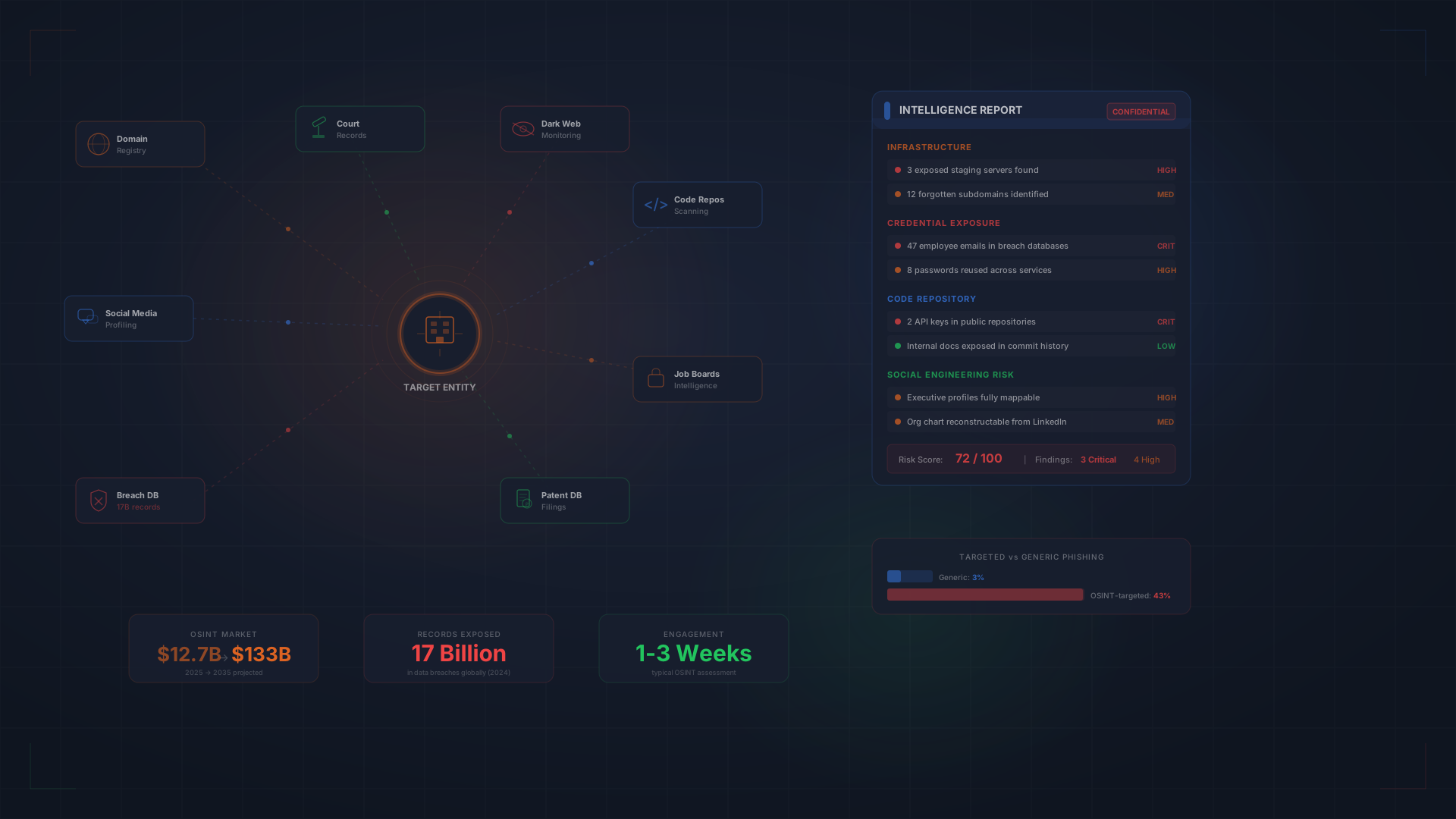
The global OSINT market hit $12.7 billion in 2025 and is projected to reach $133.6 billion by 2035, according to GM Insights, which also puts the private sector at roughly 38% of all OSINT implementations. The question is no longer whether businesses need open source intelligence. The question is whether yours is already exposed and you just don't know it yet.
Not sure what your company's digital footprint reveals? Bitvea's OSINT services give you a clear picture of your exposure, starting at 25,000 CZK.
What Is Open Source Intelligence and Why Does It Matter for Business?
Open source intelligence (OSINT) is the systematic collection and analysis of information from publicly accessible sources. These include websites, social media platforms, domain registries, corporate filings, court records, patent databases, breach databases, code repositories, and even satellite imagery.
The U.S. intelligence community's official definition, codified in Public Law 109-163, describes OSINT as information "collected, exploited, and disseminated in a timely manner to an appropriate audience for the purpose of addressing a specific intelligence requirement."
For businesses, that intelligence requirement is usually one of three things:
- Risk reduction. Understanding who you're doing business with before signing a contract.
- Threat awareness. Knowing what attackers can see about your organization from the outside.
- Competitive clarity. Tracking what competitors are doing, hiring, and building.
The distinction between OSINT and casual Googling is methodology. An analyst doesn't just search. They map connections across data sources, verify findings through multiple channels, and produce structured intelligence reports. The difference is similar to the gap between checking WebMD and getting a medical diagnosis.
Consider the scale. Billions of people and connected devices generate an enormous volume of new data every second: logs, metadata, records, posts, filings. Most organizations have no idea how much of their own data sits in plain sight, or how easily the pieces connect.
Your Company's Digital Footprint: What's Already Exposed
Every business leaves traces across the internet. Some are intentional, like your website and social media profiles. Many are not. Forgotten subdomains. Misconfigured staging servers. Employee email addresses circulating in breach databases. Old job postings that reveal your tech stack. GitHub repositories with hardcoded API keys.
A proper digital footprint assessment maps all of this.
What an OSINT Assessment Typically Uncovers
- Domain and subdomain enumeration. Companies often have dozens of subdomains they've forgotten about. Large subdomain-hijacking campaigns have taken over thousands of neglected subdomains belonging to well-known organizations and used them to send spam at scale. Every forgotten subdomain is a foothold.
- Exposed services and ports. Tools like Shodan and Censys index internet-connected devices and services. Misconfigured servers, open databases, and unprotected admin panels show up regularly.
- Credential leaks. Breach database checks reveal which employee email addresses and passwords have surfaced in known data breaches. Billions of records leak every year, and reused passwords quietly turn an old breach into a live way in.
- Code repository leaks. Developers sometimes push sensitive configuration files, API keys, or internal documentation to public repositories.
- Technology stack profiling. Analysis tools like BuiltWith and Wappalyzer reveal the exact technologies a company uses, giving attackers a roadmap of potential vulnerabilities.
Misconfiguration is the common thread in most of these stories. A single exposed server or an unsecured cloud storage bucket can leak employee records, customer data, or internal documents to anyone who knows where to look. Regulators have handed out large fines under GDPR for exactly this kind of lapse, and some of the biggest data exposures on record came not from clever hacking but from data that was simply left in the open.
These aren't sophisticated cyberattacks. They're failures of visibility. The organizations didn't know what was exposed because nobody was looking.
Your systems might have similar blind spots. A digital footprint assessment from Bitvea maps your entire external attack surface, so you can fix exposures before someone exploits them.
OSINT for Due Diligence: Seeing What References Won't Tell You
Traditional due diligence relies on what a counterparty chooses to disclose: financial statements, provided references, self-reported histories. OSINT fills the gaps with information they can't control.
Pre-Investment Due Diligence
Before committing capital, investors increasingly run OSINT checks alongside standard financial analysis. A thorough investigation covers:
- Corporate registry cross-referencing. Verifying company registration details, officer histories, and ownership structures across multiple jurisdictions.
- Sanctions and watchlist screening. Checking individuals and entities against international sanctions lists, politically exposed persons databases, and law enforcement watchlists.
- Litigation and court record searches. Uncovering lawsuits, judgments, and regulatory actions that might not appear in a standard background check.
- Media and social media analysis. Scanning news archives, social platforms, and forums for reputational signals, controversies, or inconsistencies.
- Financial footprint analysis. Cross-referencing claimed revenues, partnerships, and client relationships against publicly available data.
The pattern investors describe is consistent. Five years ago, an early-stage check leaned mostly on the pitch deck and a few reference calls. Now OSINT runs on most deals before the first meeting, and it routinely catches things a resume hides: a founder claiming a leadership role at a company that public records show was dissolved years earlier, or an exit that never appears in any filing. Traditional checks miss these because they only verify what the counterparty chooses to share.
Partner and Vendor Vetting
Supply chain attacks and vendor-related breaches now account for a significant portion of security incidents. OSINT helps you assess whether a prospective partner or vendor has:
- Adequate security practices (visible from their external infrastructure)
- A clean litigation history
- Consistent public claims (do their stated capabilities match their actual footprint?)
- Connections to high-risk entities or jurisdictions
This kind of verification is especially critical for companies operating across borders, where legal environments and transparency standards vary widely.
Competitive Intelligence: What Your Rivals Don't Want You to See
Competitive intelligence through OSINT is entirely legal and widely practiced. It focuses on publicly available signals that reveal strategic direction, operational changes, and market positioning.
What You Can Learn About Competitors
Hiring patterns reveal strategy. When a competitor posts job listings for machine learning engineers and cloud architects, they're likely building an AI product. When they suddenly hire five salespeople in a new region, expansion is coming. Job boards are one of the most reliable indicators of where a company is heading.
Technology choices signal priorities. Analyzing a competitor's tech stack, visible through their website headers, JavaScript libraries, and infrastructure choices, tells you what they're investing in. If they just migrated to a new platform or adopted specific tools, you can infer their development priorities.
Patent and trademark filings. Public patent applications reveal R&D directions months or years before product launches. Trademark filings hint at upcoming brand names and product lines.
Developer activity. Many companies contribute to open-source projects or have employees who do. Monitoring GitHub activity, conference talks, and technical blog posts provides early signals about product direction.
Public procurement records. In many jurisdictions, government contracts are public record. Tracking which contracts your competitors bid on and win reveals their revenue streams and strategic focus.
A hedge fund example illustrates the stakes: during the 2021 GameStop short squeeze, firms tracking Reddit sentiment in real time saw the r/WallStreetBets movement building days before it hit mainstream news. The ones who incorporated social media OSINT into their analysis adjusted positions early. Those who relied on traditional market data got caught flat-footed.
For mid-market businesses, competitive OSINT is less about stock prices and more about practical strategy. Knowing that your main competitor is hiring for a market you haven't entered yet gives you time to respond.
Threat Assessment and Executive Protection
The same OSINT techniques that help you gather competitive intelligence can be turned against your organization. Attackers routinely use open source intelligence during the reconnaissance phase of targeted attacks.
How Attackers Use Your Public Information
According to ESET's research on OSINT reconnaissance, attackers follow a predictable pattern:
- Harvest email addresses from breach databases, social media, and corporate websites.
- Map the organization structure using LinkedIn, press releases, and corporate filings.
- Profile key individuals by aggregating social media posts, conference appearances, and personal interests.
- Identify technical vulnerabilities through exposed infrastructure, technology stack analysis, and code repositories.
- Craft targeted attacks using all of the above.
The gap is large. Generic phishing rarely works; most people ignore it. Targeted phishing built on real digital-footprint intelligence (who reports to whom, how people write, what they are working on right now) succeeds far more often. Business Email Compromise becomes dramatically more effective once an attacker understands the internal relationships and communication patterns of a target. The reconnaissance is what turns a clumsy scam into a convincing one.
Executive Protection Through OSINT
A CEO or CFO's personal information is a high-value target. In a common pattern of attack, someone maps a finance leader's professional relationships on LinkedIn, then impersonates a trusted contact in an email requesting an urgent wire transfer. Companies have lost large sums to exactly this move, and every detail that made the message convincing came from public sources.
Proactive OSINT assessment for executives includes:
- Identifying what personal information is available through data brokers
- Mapping social media exposure and privacy gaps
- Checking for credential exposure in breach databases
- Assessing physical security risks from geotagged posts and public travel patterns
This feeds directly into penetration testing, where the same reconnaissance data is used to test whether your organization would fall for a real attack. If you are weighing how thorough that test should be, our guide to white-box versus black-box penetration testing explains the trade-offs.
What We Actually Find in a Bitvea OSINT Engagement
We can't share client specifics, and we won't. An OSINT report is confidential, and the whole point of the work is to shrink a client's exposure, not add to it. So instead of anonymized war stories dressed up as case studies, here are the categories of findings that come up again and again, generalized across engagements. If your organization has any real internet presence, you will likely recognize a few of these.
- Forgotten infrastructure. Staging servers, old subdomains, and dev environments spun up for a project and never decommissioned. They tend to run outdated software and sometimes expose internal data no one remembers publishing.
- Credentials in old breaches. Employee and shared-account logins sitting in historical breach data. Where passwords get reused, a years-old leak becomes a current route in.
- Secrets in public code. API keys, connection strings, and internal configuration pushed to public repositories, usually by accident, and surprisingly often still valid.
- Oversharing in job ads and profiles. Recruitment posts and employee profiles that map out the exact tech stack, internal tooling, and team structure, handing an attacker a reconnaissance shortcut.
- Public claims that don't hold up. Certifications, partnerships, or credentials that fail to check out against public registries, the kind of gap that matters most during due diligence and vendor vetting.
- Executive and personal exposure. Home addresses, personal accounts, and travel patterns for key people, aggregated from data brokers and social media into a profile no one intended to publish.
None of this requires breaking into anything. It is all public. The value is in finding it systematically, before someone with worse intentions does, and then telling you plainly what to shut down first.
How a Professional OSINT Engagement Works
A structured OSINT engagement follows a clear methodology. At Bitvea, engagements typically run 1-3 weeks depending on scope.
Phase 1: Scoping and Objectives (Days 1-2)
Every engagement starts with defining what you need to know and why. Common objectives include:
- Security posture assessment. "What can an attacker see about us from the outside?"
- Due diligence investigation. "Is this company/person who they claim to be?"
- Competitive analysis. "What is our competitor building and where are they expanding?"
- Incident investigation. "We've been breached. What information was already public that may have contributed?"
Phase 2: Data Collection (Days 3-10)
Analysts use a combination of custom tools, commercial platforms, and manual techniques to gather data across:
- Domain intelligence (WHOIS, DNS records, certificate transparency logs)
- Social media profiling and analysis
- Public records and corporate registries
- Breach database checks
- Dark web monitoring
- Code repository scanning
- Infrastructure fingerprinting
Phase 3: Analysis and Correlation (Days 8-12)
Raw data becomes intelligence through analysis. Analysts cross-reference findings, verify claims, identify patterns, and assess risk levels. A single data point is a fact. Multiple correlated data points become intelligence.
Phase 4: Reporting and Recommendations (Days 12-15)
The deliverable is a structured report covering:
- Executive summary with critical findings
- Detailed findings organized by risk level
- Evidence documentation
- Specific, actionable remediation recommendations
- Priority matrix for addressing identified issues
What It Costs
Bitvea's OSINT engagements start at 25,000 CZK. Pricing scales with scope: a focused assessment on a single entity costs less than a comprehensive competitive intelligence program covering multiple targets across jurisdictions.
Compare that to the cost of a breach (IBM's 2025 Cost of a Data Breach report puts the global average at $4.44 million), a failed partnership, or a bad acquisition. OSINT is among the highest-ROI security investments a company can make.
When Your Business Needs OSINT: Five Scenarios
Not every company needs ongoing intelligence operations. But there are specific moments when an OSINT engagement provides outsized value:
1. Before a major investment or acquisition. Standard financial due diligence misses reputational risks, undisclosed litigation, and fabricated credentials. OSINT catches what spreadsheets can't.
2. Before onboarding a critical vendor or partner. Especially in regulated industries where vendor breaches create direct liability.
3. After a security incident. Understanding what information was already exposed helps determine attack vectors and prevents repeat incidents. This pairs well with a penetration test to validate your defenses.
4. When entering a new market. Competitive OSINT mapping gives you a realistic picture of who you're up against, what they're doing well, and where gaps exist.
5. When hiring for senior or security-sensitive roles. Traditional background checks verify what candidates disclose. OSINT reveals what they don't. Bitvea's IT talent screening service incorporates these techniques for technical hiring.
Frequently Asked Questions About OSINT for Business
Is OSINT legal?
Yes. OSINT uses only publicly available information, gathered without breaking into systems or bypassing access controls, which keeps it firmly legal in most jurisdictions. What matters is how you collect and use it. We work within data-protection rules like GDPR, avoid deception, and never touch anything that requires authentication we are not entitled to. That line is exactly what separates professional OSINT from hacking.
How is OSINT different from a penetration test?
OSINT is passive reconnaissance: it observes what is already exposed without touching your systems. A penetration test is active, it probes your defenses to see what actually breaks. They pair naturally. OSINT tells an attacker where to aim; a pentest tells you whether the shot lands. Our white-box versus black-box guide covers how far a test should go, and a separate guide sets out how much a penetration test costs.
How long does an OSINT engagement take?
Typically one to three weeks, depending on scope. A focused assessment of a single entity moves faster; a broad competitive or multi-jurisdiction investigation takes longer because more sources have to be collected, verified, and correlated.
What does OSINT cost?
Bitvea's engagements start at 25,000 CZK, and price scales with scope. It helps to weigh that against what it protects against: the average data breach now runs into the millions of dollars, before you count a failed partnership or a bad acquisition.
What do we actually get at the end?
A structured report, not a data dump: an executive summary, findings ranked by risk, the evidence behind each one, and specific remediation steps in priority order. The goal is a document your team can act on, starting with what matters most.
Can OSINT check a person, not just a company?
Yes, and it is a core part of due diligence and of screening senior or security-sensitive hires. It verifies what someone discloses against what public records actually show. Our IT talent screening service applies the same techniques to technical hiring, and our guide to evaluating developer candidates without a CTO shows how that reasoning works in practice.
We think we are careful. Will you still find something?
Almost always. Exposure builds up quietly over years: an intern's forgotten test server, a contractor's committed API key, an old breach nobody remembers. The question is rarely whether something is out there. It is what, and how serious.
How often should we do this?
A digital footprint is not static. New employees, systems, vendors, and breaches change it constantly. Many companies run a baseline assessment, fix what it finds, then repeat annually or before major events like an acquisition, a market entry, or a key hire.
Getting Started: Your Next Steps
You don't need to build an intelligence department to benefit from OSINT. Here are three practical actions you can take this week:
Check your own exposure. Search for your company's domain on Have I Been Pwned to see if employee credentials have appeared in known breaches. Search your company name on Shodan to see what internet-facing services are visible.
Audit your public information. Review your company's social media profiles, job postings, and employee LinkedIn profiles. Ask yourself: what would an attacker learn from this?
Get a professional assessment. Self-checks are a starting point, but they miss the depth and correlation that a professional OSINT engagement provides. A trained analyst using specialized tools, data aggregation platforms, and breach database access will find things you simply can't on your own.
Bitvea's OSINT team combines custom-built intelligence tools with hands-on analysis to deliver clear, actionable reports. Engagements start at 25,000 CZK with a 1-3 week turnaround.
Get in touch to discuss your OSINT needs and find out what your digital footprint reveals before someone else does.