The average SME spends $11,200 per employee per year on SaaS subscriptions. For a 50-person company, that's $560,000 annually — and it grows every year. According to research by Zylo, SaaS vendors raise prices 7–12% without exception, meaning that same bill climbs to over $800,000 within five years if headcount stays flat.
SaaS works beautifully at the start. A two-person startup should absolutely use Stripe, Notion, and HubSpot. But for a growing business with genuine operational complexity — 30, 80, or 200 employees, established processes, and interconnected workflows — the custom software vs SaaS debate looks entirely different once you model the real numbers.
This article covers the hidden costs that SaaS vendors don't advertise, a data-driven 5-year total cost of ownership comparison, real ROI results from e-commerce automation and invoice processing, a clear decision framework for when custom software wins (and when it doesn't), and a 5-step audit you can run on your own stack today.
The SaaS Trap: Why Growing Businesses Hit a Ceiling
Subscription Costs That Scale Faster Than Your Revenue
Per-user SaaS pricing compounds ruthlessly as you grow. A CRM at $25/user/month costs $3,000/year with 10 users. With 50 users and two rounds of the standard 10% annual price increase, that same tool costs over $40,000/year — a 13x increase for a 5x headcount growth. Global SaaS spending hit approximately $300 billion in 2025 according to Gartner, driven in part by this compounding dynamic.
The breadth of the problem is equally striking: the average organization runs 112 SaaS applications. SMBs with fewer than 100 employees average around 40. Each subscription was adopted independently, often solving a real problem at the time, but the accumulated cost rarely goes through a single budget line — which is precisely why it goes unquestioned for so long.
The Workflow Compromise Problem
SaaS is built for the average business. That means you adapt your processes to the software, not the other way around. When your competitor uses the identical tool with the identical workflow, your software stack offers zero competitive differentiation.
Feature bloat compounds the problem: you pay for functionality your team never uses while lacking the specific capability your operations actually need. Integration headaches follow inevitably — connecting 5–10 SaaS tools through middleware like Zapier or Make creates fragile workflows that break silently when any vendor updates their API. A mid-size operations team typically spends 6–10 hours per week on manual data reconciliation alone as a direct consequence.
Data Ownership and Vendor Lock-In
Your business data lives on someone else's servers. When a vendor raises prices by 25% at renewal — common for deeply integrated customers — your negotiating position is weak because exit costs are high. Industry estimates put the average SaaS migration cost at $15,000–$40,000 per application when internal labor is properly accounted for. For European businesses, GDPR compliance and EU data residency requirements add another layer of complexity that generic SaaS tools often handle poorly.
The Custom Software Advantage: Building for How You Actually Work
Perfect Process Fit Instead of Workarounds
With custom software, the software adapts to your business — not the reverse. Every feature exists because your operations need it. There are no unused modules, no forced workflow compromises, and no vendor roadmap that overrides your requirements.
The financial impact of eliminating workarounds is significant. Teams of 10 or more with process misalignment between their tools and their actual workflows lose an estimated $40,000+ per year in staff time spent on manual workarounds alone. A custom CRM, for instance, mirrors your actual sales process — pipeline stages, approval logic, reporting metrics — rather than forcing your team into a generic HubSpot or Salesforce structure that requires months of configuration to approximate what you need.
True Scalability Without Per-Seat Penalties
Custom software carries no per-user licensing fees. You can add 50 or 500 users at the same infrastructure cost. The architecture is designed for your specific growth trajectory — not a vendor's tiered pricing model that penalizes you for success.
For businesses using custom ERP systems, this matters enormously as operations scale across manufacturing, logistics, or multi-location services. Tier upgrades in off-the-shelf ERP platforms like SAP or Odoo frequently carry five-figure implementation costs that dwarf the licensing fees themselves.
Competitive Advantage Through Unique Capabilities
Custom software becomes a proprietary business asset rather than a commodity tool every competitor can buy. The ability to integrate AI-powered automation, advanced analytics, and industry-specific logic into your core operations is available to businesses that own their software — not those renting it.
AI agents embedded in custom systems can automate judgment-based tasks that no off-the-shelf SaaS tool handles: complex document classification, multi-system orchestration, anomaly detection in business processes, and intelligent routing based on context that generic tools cannot understand.
The Real Cost Comparison: Custom Software vs SaaS Over 5 Years
The most common objection to custom software is the upfront investment. It's real — a well-built system requires meaningful initial capital. But the relevant comparison is not month one. It's year five. When you model the total cost of ownership (TCO) for a business scaling from 20 to 50 users, the picture changes dramatically.
Year 1: SaaS Looks Cheaper (But That's Temporary)
In year one, SaaS wins on upfront cost. Initial SaaS setup for a 20-person team typically runs around $2,500, and you're operational within days or weeks. A comparable custom development project requires a meaningful upfront investment — and 3–6 months of build time. If you need a solution this week, SaaS is the right answer.
But this is only chapter one of a five-year story. According to analysis by VrinSofts, the full cost picture over five years looks like this:
SaaS (20→50 users) | Custom software | |
|---|---|---|
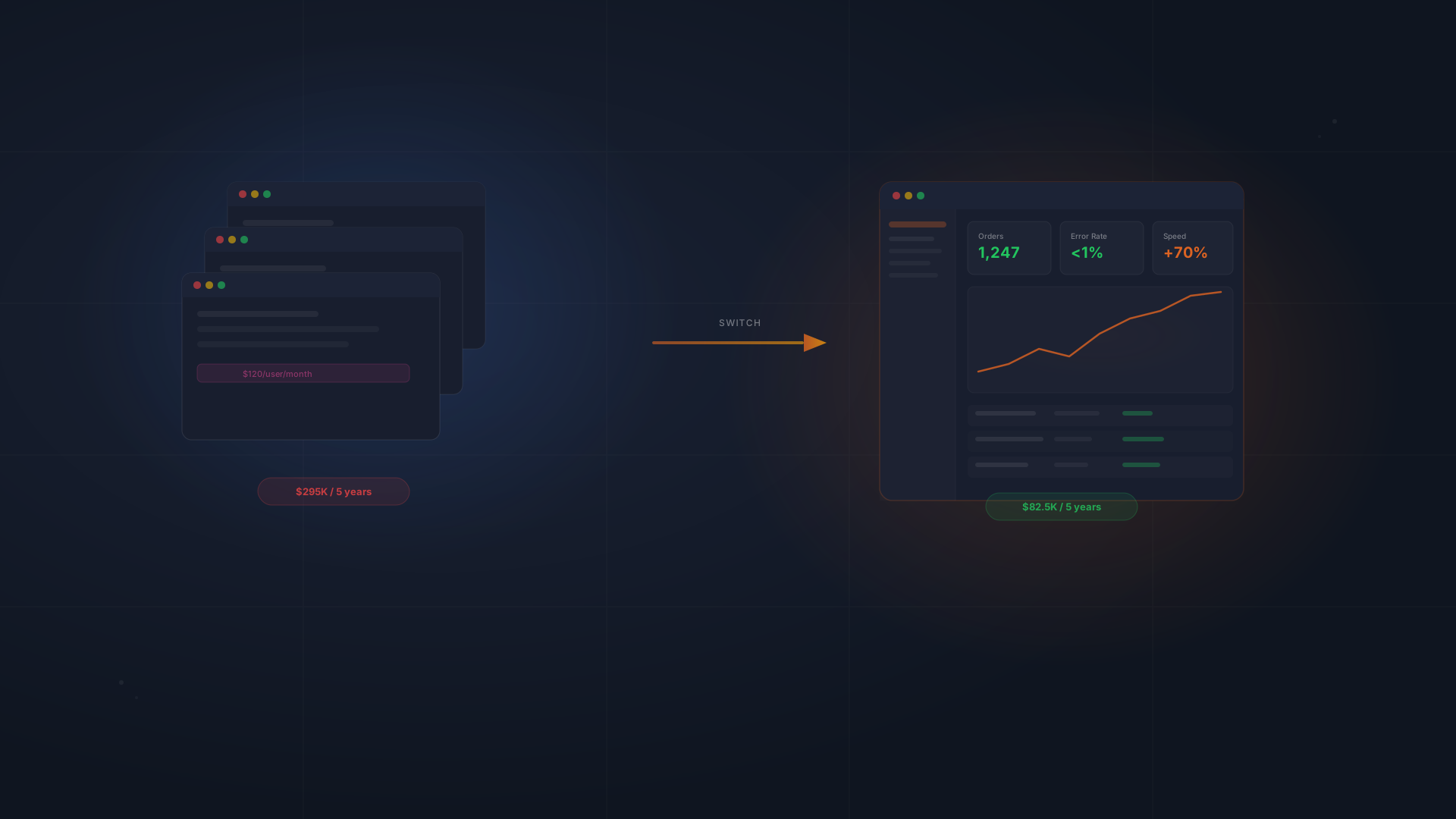
5-year TCO | ~$295,000 | ~$82,500 |
Includes | Subscriptions, price increases, add-ons, integrations, workaround labor | Development, hosting, maintenance |
Break-even point | N/A | 18–36 months |
Per-user scaling cost | Linear — every new user adds licensing cost | None — infrastructure only |
The Hidden Costs Most Businesses Miss
The subscription invoice is only the most visible component. When you account for all SaaS-related costs, the true bill is substantially higher. For a business scaling from 20 to 50 users over five years, the hidden costs alone typically include:
Hidden SaaS cost category | 5-year cost (20→50 users) |
|---|---|
User license escalation | ~$127,500 |
Premium features & add-ons | ~$45,000 |
Third-party integration tools | ~$28,000 |
Workaround labor | ~$35,000 |
Data & storage overage fees | ~$15,000 |
Exit & migration costs | ~$18,000 |
Total hidden costs | ~$268,500 |
A Swiss enterprise case study found that a custom solution delivered 33% lower TCO over 5 years compared to equivalent SaaS licensing (280,000 CHF vs. 420,000 CHF). For learning management systems at scale, the gap is even more dramatic: SaaS runs approximately $1.6 million vs. $250,000 for custom over five years at 10,000 users — according to analysis by Plume Studio.
Where Custom Software Delivers the Biggest ROI
Cost is one part of the equation. The stronger argument is what custom software enables — processes built around your actual operations, not a vendor's interpretation of best practice. Here are the four areas where the ROI case is clearest.
E-Commerce Order Automation
For e-commerce businesses, order processing speed and accuracy are directly tied to customer satisfaction and margin. Off-the-shelf OMS platforms handle the basics but cannot accommodate the specific logic of your warehouse, suppliers, and returns process without expensive customization.
The Bitvea e-commerce order automation system consolidates all sales channels into a single processing queue with automatic stock validation, intelligent routing logic, and real-time customer notification at every stage. The result: 70% reduction in processing time, error rates below 1%, and the ability to handle 40% more order volume during peak periods with the same headcount. Industry benchmarks confirm these magnitudes — businesses implementing custom order automation report 300% increases in processable order volumes and 30% reductions in fulfillment costs.
Compare this to the Shopify or WooCommerce plugin sprawl that characterizes most growing e-commerce operations: dozens of plugins that conflict with each other, break with platform updates, and require a developer to troubleshoot rather than an operations manager to configure.
Invoice Processing and Financial Workflows
Invoice processing is one of the clearest ROI stories in business automation. Manual AP teams spend significant time on data entry, exception handling, and approval chasing — work that scales linearly with volume, meaning growth makes the problem worse.
The Bitvea invoice processing system uses AI to extract, validate, and route invoices automatically — including structured data from PDFs, scanned documents, and email attachments. Processing costs drop from $15–20 per invoice to approximately $3 — an 80% reduction. For companies processing 1,000–2,000 invoices per month, this frees 200–400 staff hours monthly. The documented ROI for this type of system reaches 460% with a 6-month payback period, according to ScienceSoft research.
No SaaS invoice tool achieves these numbers for a non-standard operation. Generic tools are built for the median AP workflow. If your process has specific approval rules, multi-entity structures, or deep ERP integration requirements, you are paying staff to bend a commodity tool to your needs.
CRM That Matches Your Sales Process
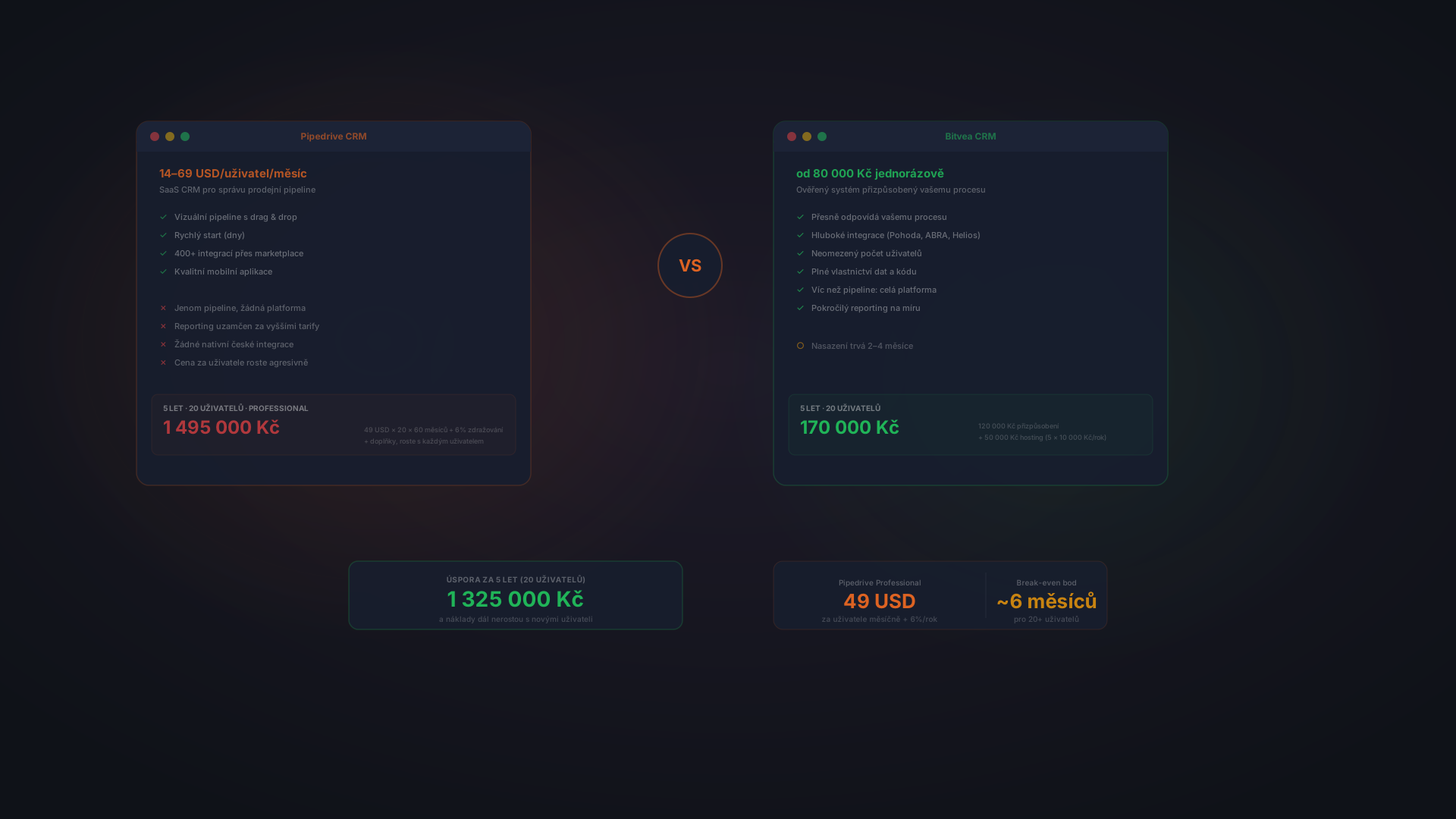
HubSpot is fast to set up but forces your pipeline into its structure. Salesforce offers deep customization but at enterprise pricing — $150+/user/month — plus consultant fees that can rival the cost of custom development. The result is either a CRM that imposes its logic on your sales team or a CRM that costs as much as a bespoke build without the ownership benefits.
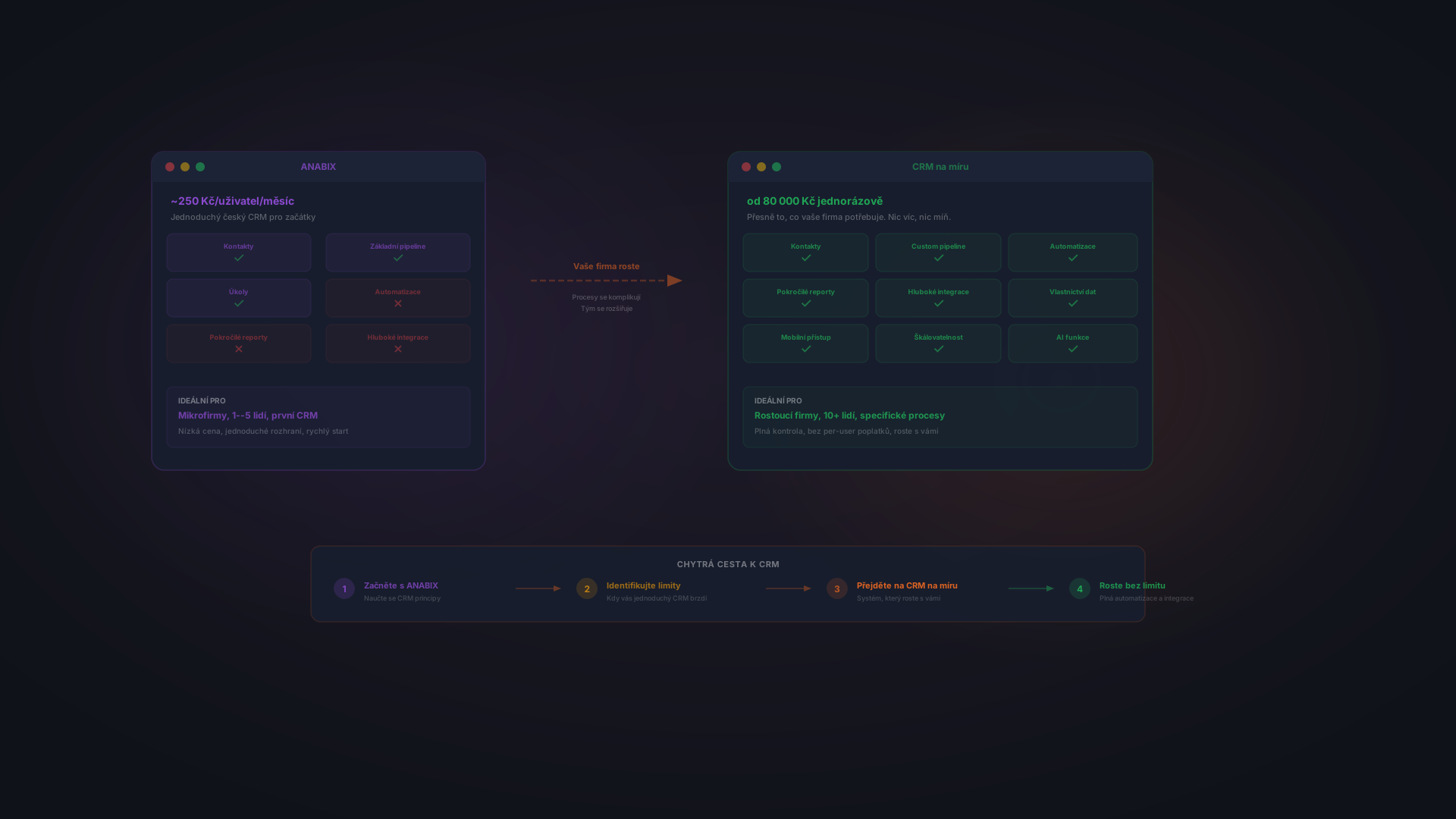
A custom CRM built by Bitvea mirrors your actual pipeline stages, approval workflows, reporting requirements, and integration landscape. One-time build cost. Zero per-seat fees. Unlimited users. Your exact workflow. When your sales process evolves, you change the system — not your process.
ERP Systems That Grow With You
Off-the-shelf ERP systems like SAP and Odoo are powerful but come with significant configuration overhead. Customization requires expensive consultants who charge per hour to approximate what your operations actually need. You end up paying for modules you don't use and waiting for vendor roadmap decisions to add capabilities your business already requires.
Purpose-built ERP connects your specific operations, finance, and logistics workflows from day one. It eliminates unused modules, integrates with your existing systems, and scales with your growth trajectory — without tier upgrade fees or consultant dependencies.
When Custom Software Is (and Is Not) the Right Choice
A credible analysis has to be honest about where SaaS is the right answer. The decision framework is not custom vs. SaaS as a philosophical preference — it's an analysis of where each approach delivers better value over your relevant time horizon.
Choose Custom Software When:
- Your workflows are proprietary and central to your competitive advantage
- You are spending $2,000–3,000+/month on SaaS subscriptions that support core operations
- You need to integrate 5 or more systems into a unified workflow
- You have 20+ users and expect to grow meaningfully
- You need GDPR compliance or industry-specific data residency requirements
- Off-the-shelf tools require workarounds that consume significant staff time
Stick With SaaS When:
- Your processes are standard and well-served by existing tools (email, calendar, basic accounting)
- Speed of deployment is critical — you need a solution within days, not months
- Your team is small (fewer than 10 people) with stable headcount
- You are still validating your business model and processes will likely change
- Your budget cannot accommodate upfront development investment
The Hybrid Approach
The most pragmatic path for many growing businesses is a hybrid: use SaaS for commodity functions (email, video conferencing, basic project management) and build custom for core differentiating processes (customer management, order fulfillment, specialized financial workflows). Connect both sides through custom integrations that you own and control.
This approach captures the speed benefits of SaaS for non-strategic functions while building owned software assets where the TCO and competitive advantage arguments are strongest.
Making the Switch: How to Evaluate Your Custom Software Needs
If the TCO case resonates, the next step is a structured self-assessment. Here is a five-step process that Bitvea uses with prospective clients to determine whether custom development makes sense and where to start.
- Audit your current SaaS spending. List every tool, its annual cost, and the core process it supports. Include integration middleware, add-on modules, and overage fees. Most businesses discover they are spending 20–30% more than their headline subscription costs.
- Identify your top three workflow pain points. Where do your tools force workarounds? Where does data not flow automatically? Where do people spend time on tasks that feel like they should be handled by the system?
- Calculate workaround labor. Count the hours your team spends on manual processes because tools don't connect. Multiply by average hourly cost. For most 30–50 person businesses, this number exceeds $30,000 per year.
- Project 3-year growth. Map how your current per-user SaaS costs will scale at your expected headcount trajectory. Include the 10% annual price increase that most vendors apply.
- Consult with a development partner who understands your industry. The goal is not to build everything custom — it's to identify the two or three systems where custom development delivers clear payback within 24 months.
Bitvea helps growing businesses in the Czech Republic and across Europe evaluate their software stack and build custom solutions where the business case is clear. If your annual SaaS spend exceeds €50,000 and a meaningful portion supports core operations, the analysis almost always produces a clear short list of high-ROI opportunities.
Custom Software vs SaaS: The Decision That Compounds Over Time
The custom software vs SaaS decision is not a one-time purchase — it's a trajectory. SaaS costs compound upward: subscriptions accumulate, headcount grows, annual price increases stack. Custom software costs compound downward: the initial investment amortizes, operational efficiency improves, and the system becomes more deeply integrated into your processes every year.
The global custom software development market is projected to grow from $53 billion in 2025 to $334 billion by 2034 at a 22.7% CAGR — according to Precedence Research. The market expansion reflects businesses completing the SaaS experiment and finding the long-term economics unfavorable. European SMBs are accelerating this shift, driven by GDPR requirements, data residency concerns, and the difficulty of adapting US-centric SaaS tools to Central European business processes.
General custom software ROI benchmarks support the decision: businesses that invest in purpose-built systems for their core operations report an average of $4 return for every $1 invested within three years, according to WheelHouse Software analysis. The 460% invoice automation ROI and 300% e-commerce order volume increases cited in this article are not outliers — they reflect what happens when software is built around actual business requirements rather than averaged across an entire market.
For businesses with genuine operational complexity, significant SaaS spend, and a time horizon beyond 24 months, the analysis consistently points in one direction. The first step is running the numbers on your own stack.
Bitvea builds custom software, CRM and ERP systems, e-commerce automation, and AI-powered invoice processing for growing businesses across the Czech Republic and Europe. Contact us for a free assessment — we'll audit your current SaaS stack and identify where custom development delivers the clearest return.