For a team of three processing 150+ orders per day across multiple channels, the morning routine looks the same: open four browser tabs, copy order details into the invoicing system, update inventory counts in a spreadsheet, create shipping labels one by one, then spend the first hour fixing yesterday's mistakes. That is ecommerce automation, or rather, the absence of it, in its most visible form.
Mid-sized retailers lose 40% of their operational time to repetitive tasks that should be automated. Over 70% of e-commerce businesses now use some form of automation, and the retail automation market is projected to grow from $31.2 billion in 2026 to $77.4 billion by 2034. The question is no longer whether to automate: it is what to automate first and how.
The right ecommerce order automation approach can save growing retailers 20+ hours per week, reduce order errors to near zero, and free staff to focus on activities that actually grow revenue. This article breaks down exactly where the time goes, what automation recovers, and when template platforms stop being the answer.
The Hidden Cost of Manual E-commerce Operations
The cost of not automating rarely appears on a single invoice. It accumulates quietly across every order, every channel, and every shift. For a retailer processing 150 orders per day across a web store and two or three marketplaces, that accumulation is substantial.
Where Your Team's Hours Actually Go
A breakdown of daily manual work for a typical 150-order/day retailer across three to four channels looks like this:
- Order entry and data transfer between channels: 2–3 hours/day
- Inventory updates across channels: 1–2 hours/day
- Invoice creation and sending: 1–1.5 hours/day
- Shipping label creation and tracking updates: 1–2 hours/day
- Error correction and customer complaints: 1+ hour/day
Total: 6–9.5 hours every single day spent on tasks that add no strategic value. McKinsey data shows that businesses can reduce operational costs by 20–25% and shorten processing times by up to 60% through order and inventory automation. The opportunity is large, and it compounds with every order.
The Error Tax on Growing Businesses
Manual data entry carries a 1–4% baseline error rate. Multi-channel operations, where order data is re-entered across four separate systems, can push this to 12% or higher. At 150 orders/day with a 12% error rate, that is roughly 18 errors per day. Each mis-shipment costs approximately $35–45 in returns, reshipping, and labor. At that rate, error costs alone run $280,000–$295,000 per year.
That figure does not include the downstream cost of negative reviews. One negative review drives away an estimated 30 potential customers. A fulfillment operation running at 12% error rate is not just an operational problem: it is a customer acquisition problem.
The Multi-Channel Complexity Multiplier
Every additional channel multiplies the manual work. Retailers selling across a web store, Heureka, Mall.cz, and a wholesale portal must maintain separate inventory counts, handle different order formats, and manage multiple shipping workflows. Each new channel adds roughly 30% more processing overhead. Without real-time inventory sync, overselling becomes constant: a product sells on one channel minutes after the last unit shipped from another.
The Five E-commerce Workflows That Eat the Most Time
Not all automation delivers equal returns. The five workflows below account for the majority of manual effort in growing e-commerce operations, and the majority of recoverable time.
1. Order Intake and Processing
Manually copying order details from each channel into an invoicing or ERP system is the single largest time drain. For 150+ orders across three to four channels, this consumes 2–3 hours per day. Automation potential: automatic import via API, normalizing order data into a unified format regardless of source channel. Time saved: approximately 12.5 hours per week.
2. Inventory Synchronization
Updating stock levels across all channels after each order, return, or stock delivery takes 1–2 hours daily. Done manually, it is always slightly out of date. Automation potential: event-driven real-time sync across all channels, with automatic alerts for discrepancies. Time saved: approximately 7.5 hours per week. Automated inventory tools also reduce stockouts by up to 30%.
3. Invoice Generation and Accounting
Creating invoices, applying correct VAT rates for B2B and B2C orders, sending them to customers, and preparing accounting exports consumes 1–1.5 hours per day. Automation potential: automatic invoice generation triggered at order confirmation, with correct formatting for each customer type and scheduled accounting exports. Time saved: approximately 5 hours per week.
4. Shipping Label Creation and Tracking
Selecting a carrier, creating labels, and manually entering tracking codes back into each sales channel takes 1–2 hours daily. Automation potential: automatic carrier selection based on package weight, destination, and predefined rules; label generation; tracking pushed to all channels simultaneously. Time saved: approximately 7.5 hours per week.
5. Error Correction and Customer Service
When the four workflows above run manually, errors are inevitable. Handling wrong shipments, missing orders, and inventory discrepancies consumes 1+ hour per day, entirely driven by upstream manual errors. Automation potential: when the first four workflows are automated with under 1% error rates, error correction drops to near zero. Time saved: approximately 5 hours per week.
Workflow | Daily manual time | Weekly time saved | Automation impact |
|---|---|---|---|
Order intake & processing | 2–3 hrs | ~12.5 hrs | API import, unified format across all channels |
Inventory synchronisation | 1–2 hrs | ~7.5 hrs | Real-time stock levels, fewer stockouts |
Invoicing & accounting | 1–1.5 hrs | ~5 hrs | Auto-generated invoices, correct VAT rates |
Shipping labels & tracking | 1–2 hrs | ~7.5 hrs | Auto carrier selection, label generation |
Error correction | 1+ hrs | ~5 hrs | Under 1% error rate eliminates rework |
Total | 7.5+ hrs | ~37.5 hrs | ~352 hours saved per year |
Total recoverable time across these five workflows: 7.5+ hours per day, or 37.5+ hours per week for a small operations team. Businesses save an average of 352 hours per year through basic retail automation, and that is before accounting for error reduction.
How E-commerce Automation Actually Works: A Real Case Study
Understanding how ecommerce workflow automation works in practice is easier with a concrete example. The following is from Bitvea's e-commerce order automation case study: a Czech consumer goods retailer selling across their own web store, Heureka, Mall.cz, and wholesale partners.
Before: Four Systems, 150 Orders, 12% Error Rate
Before automation, the retailer operated four separate systems with no integration between them. Orders arrived across all channels and were manually re-entered into their invoicing platform. Inventory was updated in a spreadsheet after each batch of orders. Shipping labels were created one by one. The error rate was 12%: roughly 18 wrong shipments every day.
Three staff members spent the majority of their time on data entry. Fulfillment averaged two days. Customer complaints about wrong orders and slow shipping were a weekly occurrence. The operations manager estimated that 70% of the team's time went to tasks they described as "pure admin."
After: Unified Automation Platform, Built in 8 Weeks
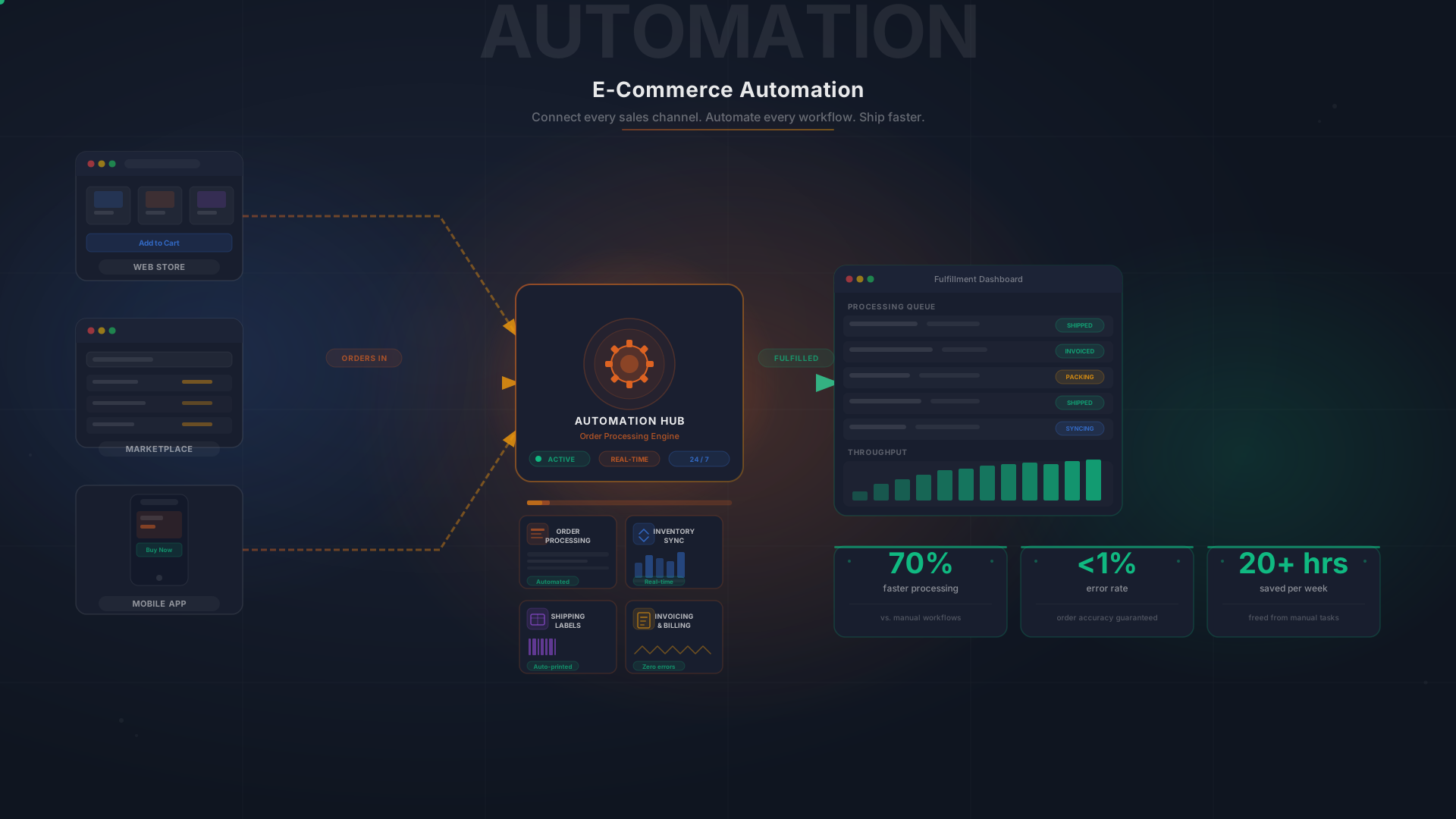
Bitvea built a unified automated order management platform integrating all four channels via API. The platform handles multi-channel order intake (web store, Heureka, Mall.cz, wholesale), real-time inventory sync using Redis pub/sub for sub-second updates, automated invoicing through Fakturoid with correct VAT handling for B2B and B2C orders, and shipping label generation for Zasilkovna and PPL with automatic carrier selection. A central dashboard handles monitoring, exception management, and manual overrides.
The results after 8 weeks from kickoff to production:
- 70% faster order processing: automated workflows eliminated the manual handoffs that had created bottlenecks
- Error rate dropped from 12% to under 1%: eliminating the $280,000+/year in annual error costs
- Same-day fulfillment for all orders: down from a two-day average
- 2 full-time employees freed from data entry to work on supplier negotiations and catalog growth
"Before the new system, our mornings started with fixing yesterday's shipping mistakes. Now orders flow through automatically and we spend that time on things that actually grow the business." The real ROI was not just time savings: it was redirecting human effort from repetitive tasks to revenue-generating activities.
When Template Automation Stops Working
Off-the-shelf platforms, Shopify, WooCommerce with plugins, BigCommerce, work well for simple retail: single-channel, standard fulfillment, limited integration requirements. But growing multi-channel retailers consistently hit a ceiling where template automation creates more problems than it solves.
The Plugin Ceiling
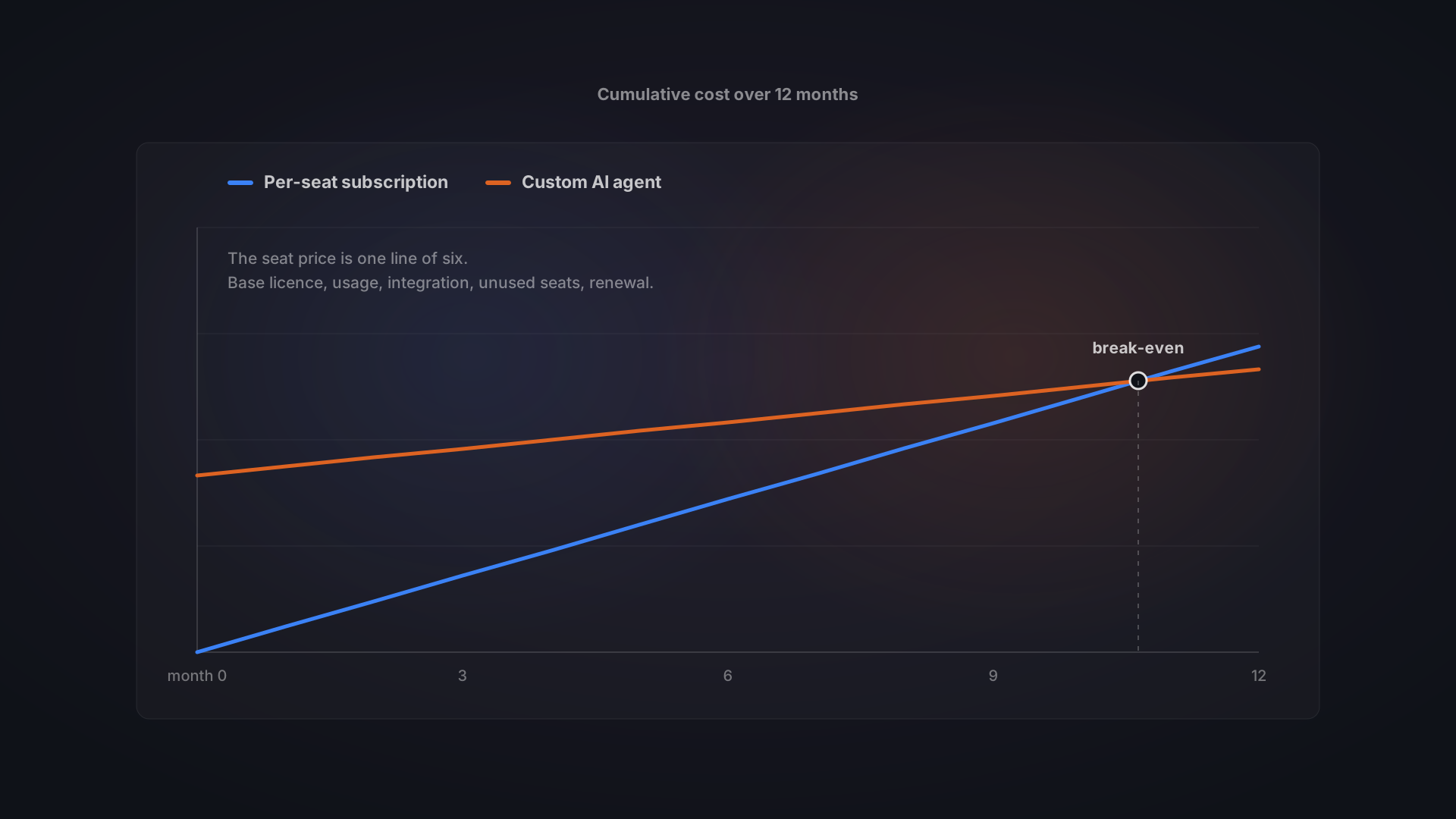
Plugin sprawl is real. Each plugin adds a new dependency, a new point of failure, and a new potential conflict with updates. A WooCommerce store running 12 automation plugins is fragile in ways that are difficult to debug and expensive to maintain. Shopify charges 0.5–2% per transaction on top of payment gateway fees, a cost that compounds as volume grows. The platform that made sense at 20 orders/day may be working against you at 200.
Signs You Have Outgrown Template Automation
The inflection point for moving from off-the-shelf to custom ecommerce automation is usually signaled by several concurrent symptoms:
- Processing 100+ orders per day across three or more channels
- Managing inventory in spreadsheets or across disconnected tools because no single plugin handles all your channels
- Spending more than 4 hours per day on manual data entry and order processing
- Error rate above 3% generating customer complaints and return costs
- Plugin costs exceeding €500/month with significant functionality gaps remaining
- Integration needs with local platforms (Heureka, Mall.cz, Zasilkovna, Fakturoid) not served by standard plugins
When these symptoms appear together, the ROI calculation shifts. Custom automation pays for itself in error reduction and labor savings within months, not years. For a deeper analysis of the build vs. buy decision with 5-year total cost of ownership data, see our guide to custom software vs. SaaS for growing businesses.
Implementing E-commerce Automation: A Practical 5-Step Roadmap
Whether you are working with off-the-shelf tools or evaluating custom development, the implementation approach matters as much as the technology. The following roadmap reduces risk and builds confidence at each stage.
Step 1: Map Your Current Workflow (Week 1)
Document every step of order processing, from order received to package shipped. Identify where manual handoffs happen, where errors occur, and where time is wasted. Calculate current time-per-task and error rates. These baseline numbers determine which workflows deliver the fastest automation ROI and give you a benchmark to measure against.
Step 2: Identify the Highest-Impact Automation Targets (Weeks 1–2)
Rank your workflows by three factors: time consumed, error frequency, and impact on customer experience. For most growing retailers, order intake and inventory sync deliver the fastest return: they are the source of both the largest time drain and the highest error rate. Fix these first.
Step 3: Choose Your Automation Approach (Week 2)
Off-the-shelf tools are the right choice for simple, single-channel operations with standard workflows. Custom e-commerce automation is the right choice for multi-channel retailers with local integrations, high order volumes, or workflows that do not fit any template. A hybrid approach, SaaS for commodity functions, custom for core differentiating workflows, often works well for businesses in transition.
Step 4: Build Incrementally, Deploy One Channel at a Time (Weeks 3–10)
Start with your highest-volume channel. Validate with real orders before connecting the next channel. This is how Bitvea approached the Czech retailer project: one channel integration at a time, with the operations manager involved in weekly reviews. The incremental approach reduces risk, builds team confidence, and catches integration issues before they affect your entire operation.
Step 5: Measure, Optimize, Expand
After each deployment phase, track time savings, error rates, fulfillment speed, and how staff are spending the recovered hours. Use real data to justify expanding automation to additional workflows or channels. The metrics from phase one typically make the case for phase two, and for the strategic reallocation of staff time that delivers the biggest long-term return.
The Strategic Benefit: Freed Staff Drive Revenue Growth
Operational efficiency is only the visible layer of what automate ecommerce operations actually delivers. The more durable benefit is what happens to the people who were doing the manual work.
In the Czech retailer case study, two staff members moved from full-time data entry to supplier negotiations and catalog expansion. Within the first quarter after deployment, they had negotiated better terms with two key suppliers and added 40 new SKUs to the catalog. Neither outcome was possible when their days were consumed by copy-paste data entry. Businesses can handle a 250% increase in order volume without proportional staff increases through automation, but the bigger gain is redirecting existing staff from repetitive work to growth work.
E-commerce companies leveraging automation see an 80% surge in lead generation and 45% improvement in ROI on average. The $5.44 return for every $1 invested in ecommerce automation reflects both the cost reduction and the revenue growth that freed capacity enables. AI-powered intelligent process automation takes this further, applying machine learning to route exceptions, predict stockouts, and optimize carrier selection automatically.
The Bottom Line on E-commerce Automation
Growing retailers processing 100+ orders per day across multiple channels lose 30–47 hours per week to manual tasks that automation eliminates. The direct cost is measurable: 6–9.5 hours of daily manual work, error rates of 12%+ costing $280,000+/year, and fulfillment delays that drive negative reviews. The indirect cost, staff time that cannot be spent on growth, is equally real.
Template platforms work for simple stores. But multi-channel retailers with local marketplace integrations, 100+ daily orders, and proprietary workflows need custom ecommerce development that matches their actual operation, not a configuration of someone else's generic platform.
The implementation path is lower-risk than it looks. An incremental approach, one channel at a time, validated with real orders, delivers measurable results within weeks, not months. The Czech retailer referenced in this article went from 12% errors and two-day fulfillment to sub-1% errors and same-day fulfillment in eight weeks. The ROI paid for itself in error reduction alone within the first quarter.
Bitvea builds custom e-commerce automation for growing retailers across the Czech Republic and Europe. If your team is processing more orders than your current setup can handle cleanly, let's assess your workflow: we will identify which automations deliver the fastest return and what implementation would realistically look like for your operation.