Your potential customers are no longer just typing keywords into Google. They are asking ChatGPT for vendor recommendations, getting answers from Perplexity, and reading Google's AI Overviews instead of clicking through to websites. The rules of being found online have changed. If your business optimizes only for traditional search, and SEO and LLM optimization has not yet entered your strategy, you are already leaving visibility on the table.
The shift shows up in the numbers. Organic click-through rates for queries that show an AI Overview have dropped from 1.76% to 0.61% in one study of more than 3,100 queries, a 61% decline (Seer Interactive). AI Overviews now appear in a large share of US searches, and ChatGPT alone reports around 800 million weekly active users and 2.5 billion messages a day (Backlinko). Fewer people click, and more of them get their answer without ever visiting a website.
This guide cuts through the acronym soup, SEO, GEO, AEO, and LEO, and gives you a clear, practical framework for modern search optimization. The good news: the foundation is still great content and strong technical fundamentals. You do not need to start over. You need to build on what you have.
Bitvea's SEO & LLM Engine Optimization service exists precisely because this shift is real and accelerating. But before we get to strategy, let us understand exactly what changed.
In short: to stay visible in 2026 you need one strategy that covers both traditional search and AI answers. Keep ranking organically, because the pages AI tools cite are overwhelmingly pages that already rank. Then make your content easy for AI to extract and cite with clear question-style headings, direct answers, structured data, and first-party expertise AI cannot copy. Track your AI citations in ChatGPT, Perplexity, and Google AI Overviews alongside your Google rankings.
How has search changed for businesses in 2026?
In 2020, search was simple: someone typed a query into Google, got a list of ten blue links, and clicked through to websites. Today, that same person is as likely to type their question into ChatGPT, ask Perplexity for a comparison, or simply read Google's AI-generated summary without ever clicking a link.
The shift is not just theory. Gartner projected that traditional search volume would fall 25% by 2026 as AI chatbots and virtual agents absorb queries that used to go to search engines (Gartner). Whether the exact figure holds or not, the direction is clear: a meaningful chunk of demand now gets answered inside an AI tool instead of on your website.
The practical implication for your business: if you only track your Google rankings, you are measuring an incomplete picture. Some of your potential customers now build their shortlist inside an AI assistant before they ever see a search results page.
What do SEO, GEO, AEO, and LEO actually mean?
Let us settle the alphabet soup once and for all. These terms all describe facets of the same problem: being found where your customers are looking. Here is what each one means in plain language.
SEO (Search Engine Optimization)
SEO is the practice of optimizing your website and content to rank in traditional search engine results pages, primarily Google and Bing. It covers technical website health, content quality, keyword targeting, and earning links from other websites. It has been the foundation of digital visibility for 25 years and remains essential.
GEO (Generative Engine Optimization)
GEO is the practice of optimizing your content and brand to be cited in AI-generated answers from ChatGPT, Perplexity, Google AI Overviews, Claude, and Microsoft Copilot. The goal is not just to rank. It is to become the source that AI platforms reference and recommend.
AEO (Answer Engine Optimization)
AEO specifically targets zero-click answer formats: featured snippets, voice search results, People Also Ask boxes, and AI answer cards. It overlaps significantly with GEO but focuses on the format of answers rather than the platform delivering them.
LEO (LLM Engine Optimization)
LEO is the broadest term: optimizing your brand, content, and digital footprint specifically for large language model platforms. In 2026, "share of voice" in your industry is being replaced by "LLM visibility", how often your brand is cited versus competitors when AI models answer questions in your category.
What Business Owners Actually Need to Know
Stop worrying about which acronym is correct. Think of it as "Search & AI Optimization", a unified strategy that ensures your business is visible both in traditional search results and in AI-generated answers. The goal is the same: be found when your customers are looking for what you offer.
Why is traditional SEO still the foundation for AI visibility?
Before you shift your whole budget toward AI optimization, understand one thing: the pages AI tools cite are overwhelmingly pages that already rank. Ahrefs found that in 2025 about 76% of AI Overview citations came from URLs ranking in Google's top 10 for the query (Ahrefs). SEO is not the enemy of AI visibility. It is the prerequisite.
That overlap may loosen over time as AI platforms pull from a wider range of sources, but organic authority is still the entry ticket. A page that ranks well is far more likely to be cited by AI platforms than one that does not.
The pages AI tools cite are mostly pages that already rank organically. The message for business owners is clear: do not abandon your SEO investment. Build AI optimization on top of it.
How do AI search engines decide what to cite?
Understanding how AI platforms choose their sources is the key to being chosen. It is fundamentally different from how traditional search engines rank pages.
What Makes Content "Citeable" by AI
AI platforms cross-check many sources before citing a brand. Consistent brand mentions across the web appear to matter more for AI visibility than raw backlink counts, a real shift from traditional SEO, where links were king. LLMs do not match keywords; they interpret meaning, seeking the clearest, most complete explanation of a topic.
Content with specific data points, expert insight, and original research earns citations. Vague, generic content gets ignored.
The E-E-A-T Factor Is More Important Than Ever
Google's E-E-A-T framework (Experience, Expertise, Authoritativeness, Trustworthiness) has been amplified dramatically in the AI era. As AI-generated content proliferates, demonstrating genuine human expertise becomes the differentiator. AI models surface content with real user stories, named expert opinions, proprietary data, and first-hand case studies.
Content that AI cannot replicate, such as original data, genuine expert insight, proprietary frameworks, and real client outcomes, earns the most citations. Our AI customer support case study is an example of the kind of first-party content that earns persistent AI citations.
Multi-Platform Brand Consistency
If your brand description differs across your website, LinkedIn, Google Business Profile, industry directories, and review platforms, AI models become confused and less likely to cite you accurately. Consistent messaging, naming, and positioning across all channels creates a clear "semantic footprint" that AI can map and trust.
This matters especially for B2B companies. A growing share of B2B buyers now use generative AI somewhere in their purchasing journey, and many start their research in ChatGPT rather than Google. Consistent brand information is what makes you easy for those tools to cite accurately.
What are the 7 steps to get found in SEO and AI answers?
Here is the concrete framework. These seven steps work across all the major AI platforms (Google AI Overviews, ChatGPT, Perplexity, Claude, and Copilot), so you need one strategy, not five.
Step 1: Audit Your Current Search Visibility Across All Platforms
Start by understanding where you currently stand. Check your traditional Google rankings, then test AI platforms directly: ask ChatGPT, Perplexity, and Claude the questions your customers ask. Does your brand appear? Are competitors mentioned instead? This establishes your baseline and shows exactly where the gaps are.
Step 2: Make Your Website AI-Readable
Check your robots.txt file immediately. Many businesses, particularly those using Cloudflare, are unknowingly blocking AI crawlers. You need to allow: OAI-SearchBot, ChatGPT-User, PerplexityBot, ClaudeBot, Google-Extended, and Applebot-Extended.
Consider implementing an LLMS.txt file, a Markdown-formatted map of your most important content, placed at the root of your domain. It signals to AI crawlers what pages matter most, similar to how a sitemap works for traditional search engines. Adoption is growing steadily and supported by major documentation platforms.
The technical foundation matters too: clean HTML, proper heading hierarchy (H1 to H2 to H3), fast loading times, and mobile-friendly design. Our custom software development team can address any technical barriers preventing AI crawlers from properly indexing your content.
Step 3: Structure Content for AI Extraction
AI platforms extract answers from well-structured content. Use clear H2/H3 headings that match the questions your audience asks. After each heading, provide a direct 2-3 sentence answer, then elaborate. This "answer first" structure dramatically increases your citeability.
Use formats AI can easily extract: comparison tables, numbered step-by-step processes, bulleted feature lists, and definition-style paragraphs. Add FAQ sections with structured data (FAQ schema in JSON-LD) to tell AI systems exactly what each question-answer pair means.
Step 4: Build Your Brand's Semantic Footprint
Ensure consistent brand information across every platform: your website, LinkedIn, Google Business Profile, industry directories, and review platforms. Get your brand mentioned on authoritative third-party sites, industry publications, and relevant forums, especially Reddit, which AI platforms heavily reference.
Publish original research, data, and expert perspectives that other sources will cite. Every citation your content earns is a signal to AI models that your brand is authoritative in your domain.
Step 5: Create Content AI Cannot Replicate
The content that earns the most AI citations is the content that AI cannot generate itself. That means: original case studies with real metrics and client outcomes, proprietary data and research findings, expert opinions from named authors with credentials, and first-hand experience that only your team has.
One practical tactic: if you produce podcast episodes or webinars, always publish the transcript. Text that AI can read and quote tends to earn far more citations than audio or video-only equivalents.
Step 6: Implement Structured Data and Schema Markup
Use JSON-LD schema markup to tell AI systems exactly what each page means. The most valuable schema types for AI visibility: Organization (your business details), Article (content type and author), FAQ (question-answer pairs), HowTo (step-by-step processes), and LocalBusiness (if you serve a geographic area).
Well-structured schema turns your page into a ready-made answer that LLMs can trust and cite. Validate all schema with Google's Rich Results Test before publishing.
Step 7: Monitor, Measure, and Iterate
Track both traditional SEO metrics and AI visibility metrics. Monitor brand citations in ChatGPT, Perplexity, and Google AI Overviews using emerging tools like Siftly, Sight AI, and Otterly. In Google Analytics, look for perplexity.ai and chatgpt.com as referral traffic sources.
AI search optimization shows results faster than traditional SEO. Well-optimized content can appear in Perplexity citations within hours or days. Our SEO & LEO service focuses on exactly this kind of AI-citation optimization.
What are the most common AI search optimization mistakes?
Avoid these pitfalls that undermine AI visibility efforts:
- Abandoning traditional SEO. SEO is the foundation that AI optimization builds upon. Both are needed.
- Blocking AI crawlers in robots.txt. This is especially common for businesses using Cloudflare's default settings. Check this today.
- Applying keyword stuffing tactics. LLMs interpret meaning, not keyword frequency. Stuffing actively hurts citeability.
- Ignoring brand consistency. Inconsistent descriptions across platforms confuse AI models and reduce citation accuracy.
- Waiting for the "right time" to start. Search behavior is already shifting toward AI answers, and the cost of waiting compounds while competitors get cited first.
- Treating it as a one-time project. AI optimization requires ongoing monitoring and iteration, not a single pass.
- Focusing only on Google. ChatGPT, Perplexity, and Claude collectively handle billions of queries. All require attention.
What does this mean for your business in 2026 and beyond?
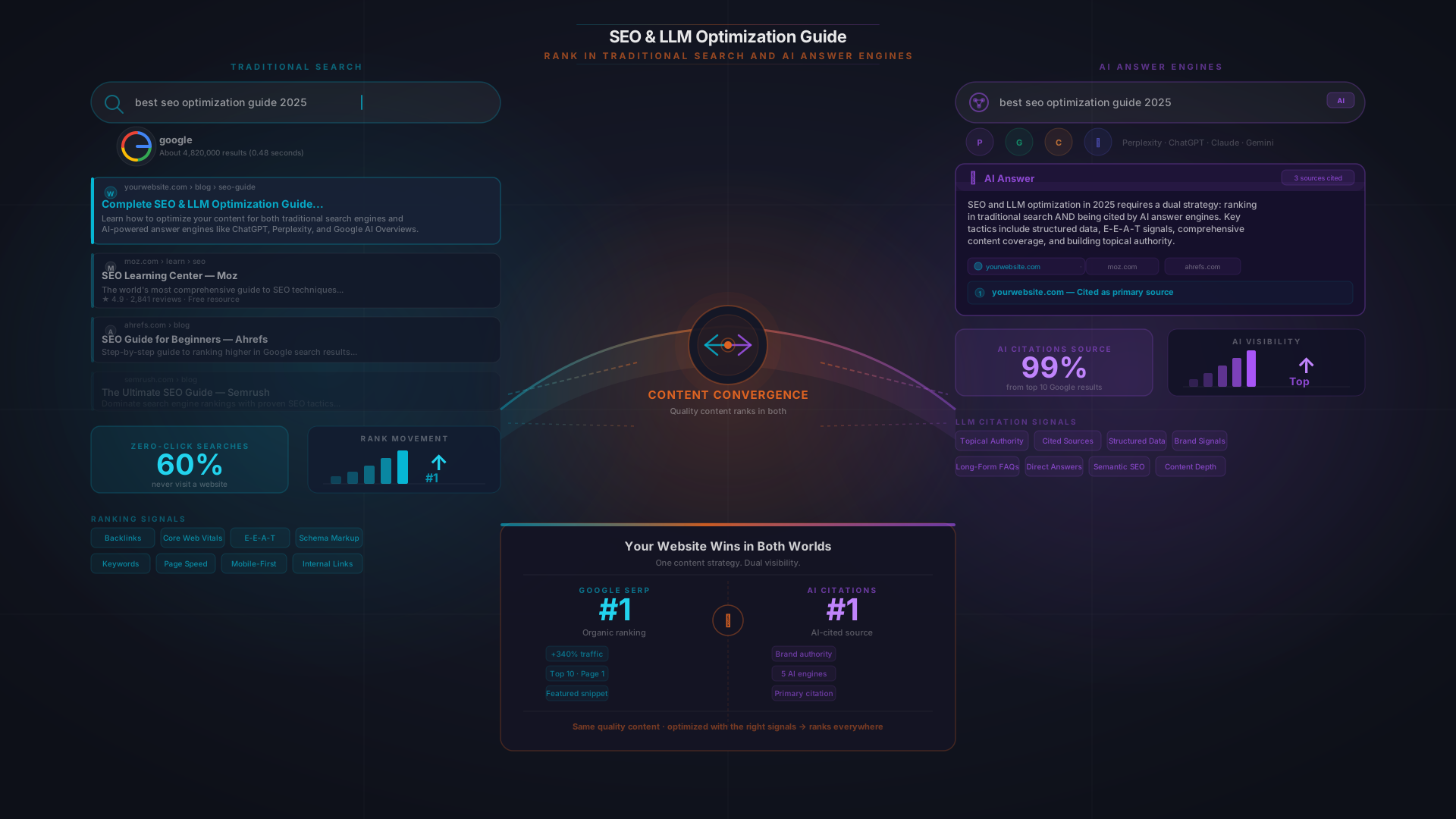
Search has split into two worlds: traditional SERP rankings and AI-generated answers. The businesses winning in 2026 are not choosing between them; they are integrating both into one cohesive strategy. Traditional SEO stays foundational, because the pages AI cites are mostly pages that rank, but on its own it is no longer sufficient.
The direction of travel is clear. Organic CTR on queries with AI Overviews has already dropped 61% in one large study (Seer Interactive), and the gap between ranking and getting clicks will keep widening.
For European businesses, there is an added dimension. GDPR considerations affect how AI models can use your data, multilingual optimization matters when your customers search in multiple languages, and ensuring AI models cite your business accurately across German, Czech, French, and other European languages requires specific attention. These are not obstacles. They are opportunities for differentiation that US-focused competitors are not addressing.
The framework is clear: audit your current visibility across all platforms, fix the technical barriers blocking AI crawlers, restructure your content for AI extraction, build your semantic footprint, create content that AI cannot replicate, implement structured data, and measure your AI citation rates alongside your traditional rankings.
Frequently asked questions about SEO and AI optimization
What is the difference between SEO and GEO?
SEO gets your pages to rank in traditional search results like Google and Bing. GEO (generative engine optimization) gets your content cited inside AI-generated answers from tools like ChatGPT, Perplexity, and Google AI Overviews. You need both, and they share the same foundation: clear, credible, well-structured content.
Do I still need traditional SEO if I optimize for AI?
Yes. The pages AI tools cite are overwhelmingly pages that already rank organically. Strong SEO is the entry ticket to AI visibility, not something you replace.
How do I know if AI tools are citing my business?
Ask the questions your customers ask directly in ChatGPT, Perplexity, and Claude, and see whether your brand appears. Then watch for chatgpt.com and perplexity.ai as referral sources in Google Analytics, and use monitoring tools built for AI citations.
How long does AI search optimization take to show results?
Faster than traditional SEO. Well-structured content can appear in Perplexity citations within days, though building consistent citation authority takes longer.
Which AI crawlers should I allow in robots.txt?
At a minimum: OAI-SearchBot and ChatGPT-User (OpenAI), PerplexityBot, ClaudeBot, Google-Extended, and Applebot-Extended. Many sites block these by accident, especially on default Cloudflare settings.
Bitvea helps businesses across Europe navigate this shift with integrated SEO and LLM Engine Optimization. Whether you need a full strategy audit or want to understand where you currently stand in AI-generated answers, we will show you exactly where your customers are finding information, and make sure your business is in those answers.