Most Czech online stores run on Shoptet, and for good reason. It is cheap to start, quick to launch, and good enough for the majority of merchants. But growing stores keep hitting the same wall: custom fields they cannot add, integrations that break or run manually, and add-on costs that creep upward every quarter.
This is not a "SaaS bad, custom good" article. Shoptet is the right choice for most stores. The real question is narrower: at what point does investing in a custom e-shop actually justify itself? This guide gives you the limits that signal it, an honest cost comparison, and a checklist to decide.
Shoptet Pricing in 2026
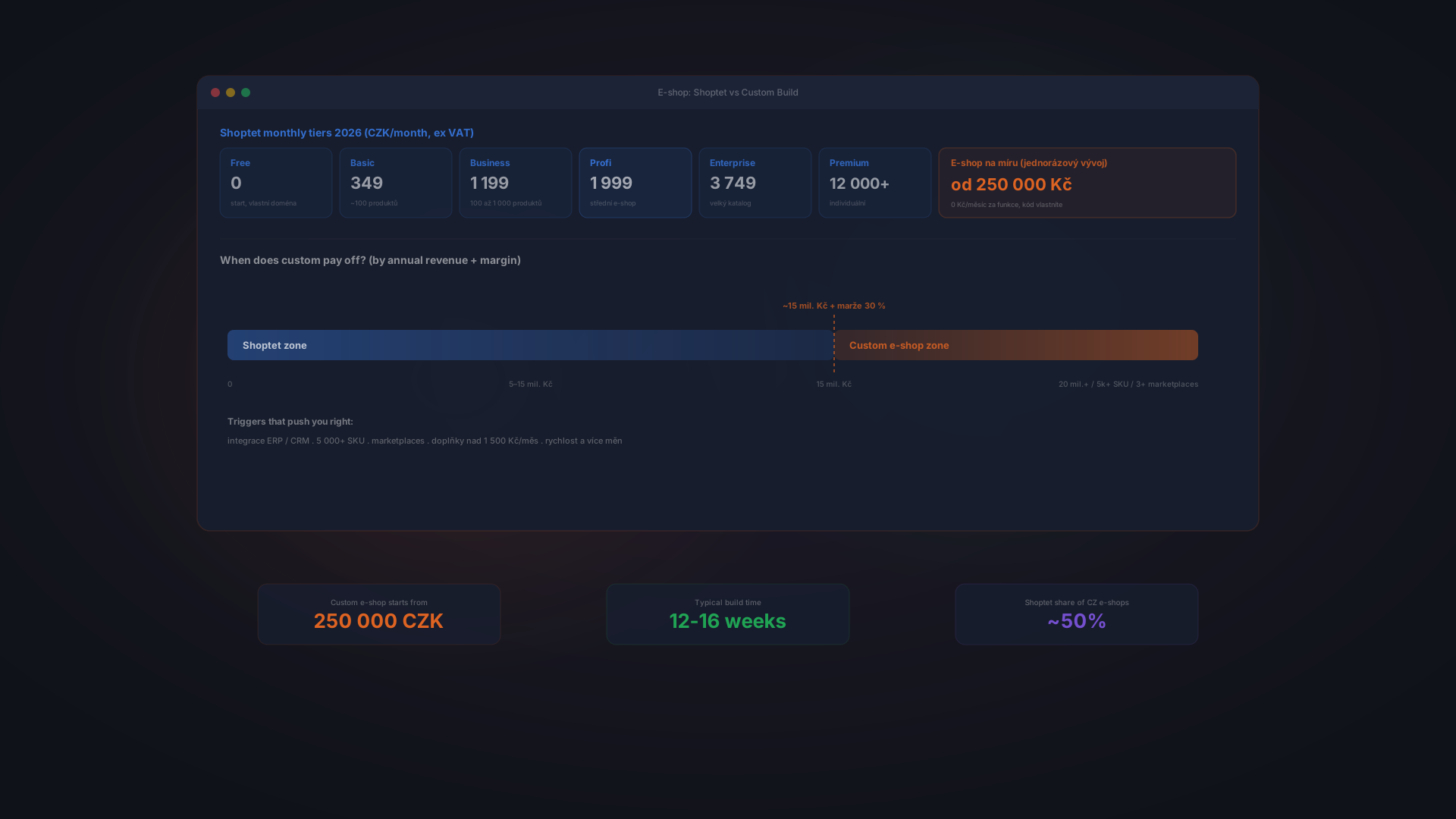
Shoptet serves roughly half of all active Czech e-shops. The entry price is low, but the real monthly bill climbs with tier and add-ons. List prices (excl. VAT):
Tarif | Price/month | Best fit |
|---|---|---|
Free | 0 CZK | Start, own domain |
Basic | 349 CZK | ~100 products, 50 orders/month |
Business | 1 199 CZK | 100-1,000 products, first "grown-up" tier |
Profi | 1 999 CZK | Mid store, multiple warehouses, external integrations |
Enterprise | 3 749 CZK | Large catalog, multiple brands |
Premium | from 12 000 CZK | Individual, custom scope |
Annual payment gives 10 percent off, two years gives 20 percent. Add-ons (advanced shipping, marketplace feeds, accounting connectors) push the effective cost higher, and at scale they often reach 3,000 CZK or more per month on top of the tier.
What Shoptet Does Well
- Low barrier: live in days, no dev team needed
- Ecosystem: designers, agencies, and apps because of its market share
- Maintenance-free: updates, security, and hosting are handled
- Built-in payments and shipping: GoPay, ComGate, Packeta, DPD out of the box
- Good enough for most: standard products and 1-15M CZK revenue rarely need more
When Shoptet Hits the Wall
The triggers that expose the platform limits are usually about complexity and connection, not traffic:
- Catalog complexity: thousands of SKUs with variants and product rules that templates cannot express
- Integrations: real-time sync with an ERP (stock, orders), a CRM (customer data), or your accounting system
- Marketplaces: selling on Mall, Allegro, or Amazon EU needs custom fulfillment logic
- Speed: template stores load slower, and every second of mobile load time costs conversions
- Branding and UX: template-based design limits differentiation in crowded categories
- International: multi-currency, localization, and regional shipping rules
The integration pain is the most common one we see, and it is the most expensive to live with. If your team re-keys orders between the e-shop and the warehouse, or your stock is wrong because sync runs overnight, that is revenue leaking every day. Our guide to API integration covers how that layer is built.
The Honest Cost Comparison
Let us be straight: in raw numbers a custom e-shop is more expensive than Shoptet. A mid-range custom build runs 400,000 to 700,000 CZK with 40,000 to 120,000 CZK a year for hosting and maintenance. Shoptet on the Profi tier with add-ons is a few thousand CZK a month. So custom does not win on subscription savings. It wins when fit, integrations, and speed move revenue more than the difference costs. That threshold is what the table below is really about.
Store profile | Annual revenue | Recommendation | Why |
|---|---|---|---|
Starting or small | up to 5M CZK | Shoptet | Margin cannot carry a custom investment |
Growing, standard catalog | 5-15M CZK | Shoptet (Profi) + optimize | Limits are manageable with add-ons |
High margin, complex integrations | over 15M CZK | Custom e-shop | Saved leakage + integrations + speed pay back |
Multi-market, 5k+ SKUs | over 20M CZK | Custom e-shop | Shoptet hits structural ceilings |
A Quick Decision Checklist
Count how many of these are true for you:
- Annual revenue above 15M CZK
- Gross margin above 30 percent
- You need integrations beyond Shoptet API (ERP, advanced CRM, custom accounting)
- SKU count above 5,000 or growing more than 30 percent a year
- You sell on three or more marketplaces plus your own store
- You already pay Shoptet add-ons above 1,500 CZK a month
Three or more "yes" answers means a custom build very likely has a return. One or two means stay on Shoptet and optimize, you are not leaving money on the table yet.
What a Custom E-shop Looks Like
A custom store for a Czech SMB is usually a fast frontend (Next.js or React) over a backend that handles orders, stock, and integrations, with a database built for reliable transactions. It connects directly to your ERP (ABRA, SAP), CRM (Pipedrive), payment gateway (GoPay, Stripe), and carriers (Packeta, DPD), with an admin panel shaped around how you actually work.
- Initial build: 400,000-700,000 CZK for a mid-range store
- Timeline: 12-16 weeks from kickoff to live
- Hosting and maintenance: 40,000-120,000 CZK/year
- Ownership: you own the code, no per-feature fees, no lock-in
If your main pain is automation rather than the whole platform, you may not need a full rebuild at all. See how e-commerce automation saves time, and if you also run an ERP, our ERP pricing guide covers the e-shop to ERP connection.
Frequently Asked Questions
How much does a custom e-shop cost?
A mid-range custom e-shop runs 400,000 to 700,000 CZK to build, with simpler stores starting from around 250,000 CZK and enterprise builds reaching 1 to 2.5 million CZK. There is no per-feature subscription, so the cost does not climb as you add products or orders.
How long does development take?
Typically 12 to 16 weeks for a small to mid-range store, delivered in phases so the core goes live early. Complex integrations and marketplace logic add time.
What does maintenance cost after launch?
Plan for roughly 40,000 to 120,000 CZK a year for hosting, updates, and support, depending on traffic and how many integrations you run.
Can I move from Shoptet to a custom e-shop later?
Yes. Products, customers, and order history can be migrated, and you can keep your domain and URL structure to protect SEO. The usual approach is to build and test in parallel, then switch over once the new store matches the old one feature for feature.
What happens if development stops?
You own the full source code, so you can hire any developer to continue. That is the core difference from a rented platform: there is no vendor who can switch you off or keep raising the price.
The Bottom Line
Shoptet is the right call for most Czech stores, and it stays the right call until specific limits start costing you real revenue. When integrations, catalog complexity, or marketplace ambitions push past what the platform can do, a custom e-shop stops being a luxury and becomes the cheaper option, because the leak it closes is bigger than the build.
Not Sure Which Side You Are On?
We will look at your numbers honestly. If Shoptet still fits, we will tell you. If a custom build would pay for itself, we will show you the math.
Book a free consultation and we will walk through where your store is and what makes sense next.