Seventy percent of digital transformations fail. That statistic comes from McKinsey, and it has been cited so many times it has almost lost its power to alarm. But here is the number that gets far less attention: companies with fewer than 100 employees are 2.7x more likely to succeed at digital transformation than large enterprises. The advantage is not technology: it is agility.
European SMBs are at a pivotal moment. The EU has set a target of 90% of SMEs reaching basic digital intensity by 2030. Today, the figure stands at 58%. That 32-percentage-point gap represents a window of competitive opportunity for the businesses that act now, and a structural threat for those that do not. If your systems are holding you back, you already know the cost of inaction.
This guide provides a digital transformation roadmap for SMBs that is grounded in European realities: GDPR compliance, EU funding programmes, and the specific challenges of growing businesses operating across the single market. It is not a theoretical framework: it is the structured approach that separates the 30% that succeed from the 70% that do not.
What Digital Transformation Really Means for SMBs
Digital transformation is not buying a new tool. It is not launching a website or moving files to the cloud. It is the process of redesigning how your business operates: your processes, your customer experiences, and your business model, using technology as the enabler.
The distinction matters because it explains why so many transformations fail. Companies spend on technology without changing the processes the technology is supposed to support. They add software to broken workflows instead of fixing the workflows. The tool gets blamed; the underlying problem remains.
Genuine digital transformation operates across four dimensions simultaneously:
- Technology: the systems and platforms your business runs on
- Data: how you capture, store, access, and act on information
- Processes: the workflows and operations that technology should support and automate
- People: the skills, culture, and change management that make transformation stick
As Dreher Consulting noted in their 2026 report, digital transformation is now a management task, not an IT project. That shift in ownership is what separates the businesses that succeed from those that treat transformation as something the technology department handles.
SMBs have structural advantages here that enterprises do not. Faster decision-making. Less legacy technical debt. Closer relationships with customers. A culture that can actually change when leadership decides it should. The global digital transformation market is growing at 23.73% CAGR, reaching $12.53 trillion by 2035, and the SME segment is growing fastest, at 28.4% annually. The businesses investing now are building advantages that compound.
The State of Digital Transformation in European SMBs
The data on European SMB digitalisation tells a story of enormous potential and significant gap. Only 52.7% of EU companies used cloud services in 2025. Just 20% use AI, up from 13.5% in 2024, but still far behind the 30% that plan to adopt within the next two years. Only 37.9% of small EU enterprises use ERP systems, compared to 86.3% of large enterprises.
The opportunity in that gap is substantial. Digitally mature firms earn 26% higher profitability and 9% greater revenue than their less-digitalised peers. Among SMBs that have gone through transformation: 60% report efficiency gains, and 43% report increased profitability. Those numbers are not aspirational: they are the average outcomes from businesses that have already done it.
The barriers are real, but they are not insurmountable. The OTRS 2026 SMB survey found that 29% of IT specialists cite budget constraints as the main obstacle, 17% cite lack of qualified personnel, and 16% cite integration difficulties. Employee resistance is a factor for 70% of businesses attempting transformation. These are change management challenges as much as technology challenges, and they are exactly what a phased roadmap is designed to address.
The digital divide across EU member states is also worth acknowledging. Denmark and Finland operate at over 90% digital intensity. Southern and eastern member states are catching up, with significant EU support accelerating that process. Wherever your business operates in Europe, the competitive landscape is shifting.
The 5-Phase Digital Transformation Roadmap
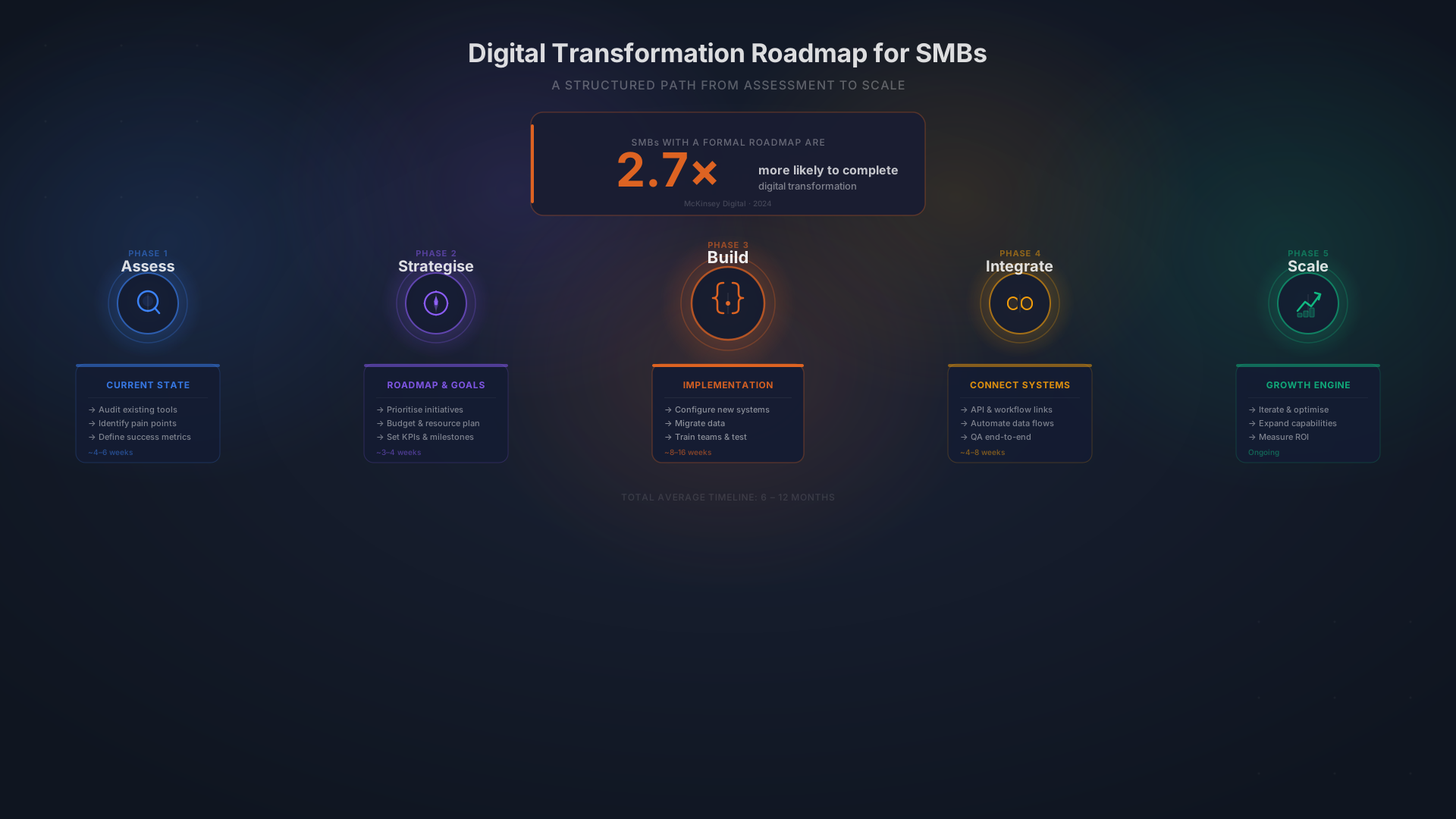
The following framework maps the full transformation journey: from assessing where you stand today to scaling what works across your organisation. Each phase builds on the previous one. Skipping phases is one of the most reliable ways to join the 70% that fail.
Phase 1: Assess Your Digital Maturity
You cannot plan a transformation without knowing your starting point. A digital maturity assessment does not require a consultant: it requires honest answers across five dimensions.
- Technology: What systems do you actually run? Spreadsheets and email, disconnected SaaS tools, legacy on-premise software, or integrated platforms?
- Data: Can you access real-time information for decisions? Where is data trapped in silos or heads?
- Processes: Which workflows are manual, repetitive, or error-prone? Where do things fall through the gaps?
- People: What digital skills does your team have? Where are the capability gaps that will limit transformation?
- Customer experience: How do customers interact with your business across every touchpoint? Where is the friction?
Most European SMBs sit at one of two maturity levels. Level 1 (Manual/Fragmented): spreadsheets, email, disconnected tools, manual invoicing: the business runs on individual knowledge rather than systems. Level 2 (Partially Digital): some SaaS tools in use but not integrated, data silos everywhere, partial automation that creates as many handoff problems as it solves.
The assessment phase should also include a technology audit: what you pay for, what your team actually uses, what integrates with what, and where the technical debt sits. The EU's Digital Intensity Index (DII) and European Digital Innovation Hubs (EDIHs) offer free assessment tools that benchmark your business against your sector. Use them.
Phase 2: Define Strategy and Prioritise
Digital strategy follows business strategy, not the other way around. The question is not "what technology should we adopt?": it is "what business outcomes do we need, and what technology enables them?"
The 80/20 rule applies here: in almost every SMB, 20% of processes are consuming 80% of the time, cost, or errors. Find those processes first. They are where transformation delivers the fastest, most visible return, and where early wins build the internal momentum that sustains longer-term change.
Use an impact vs. effort matrix to prioritise:
- Quick wins (high impact, low effort): automate invoicing, implement CRM, digitise customer onboarding. Do these first to build momentum and prove ROI
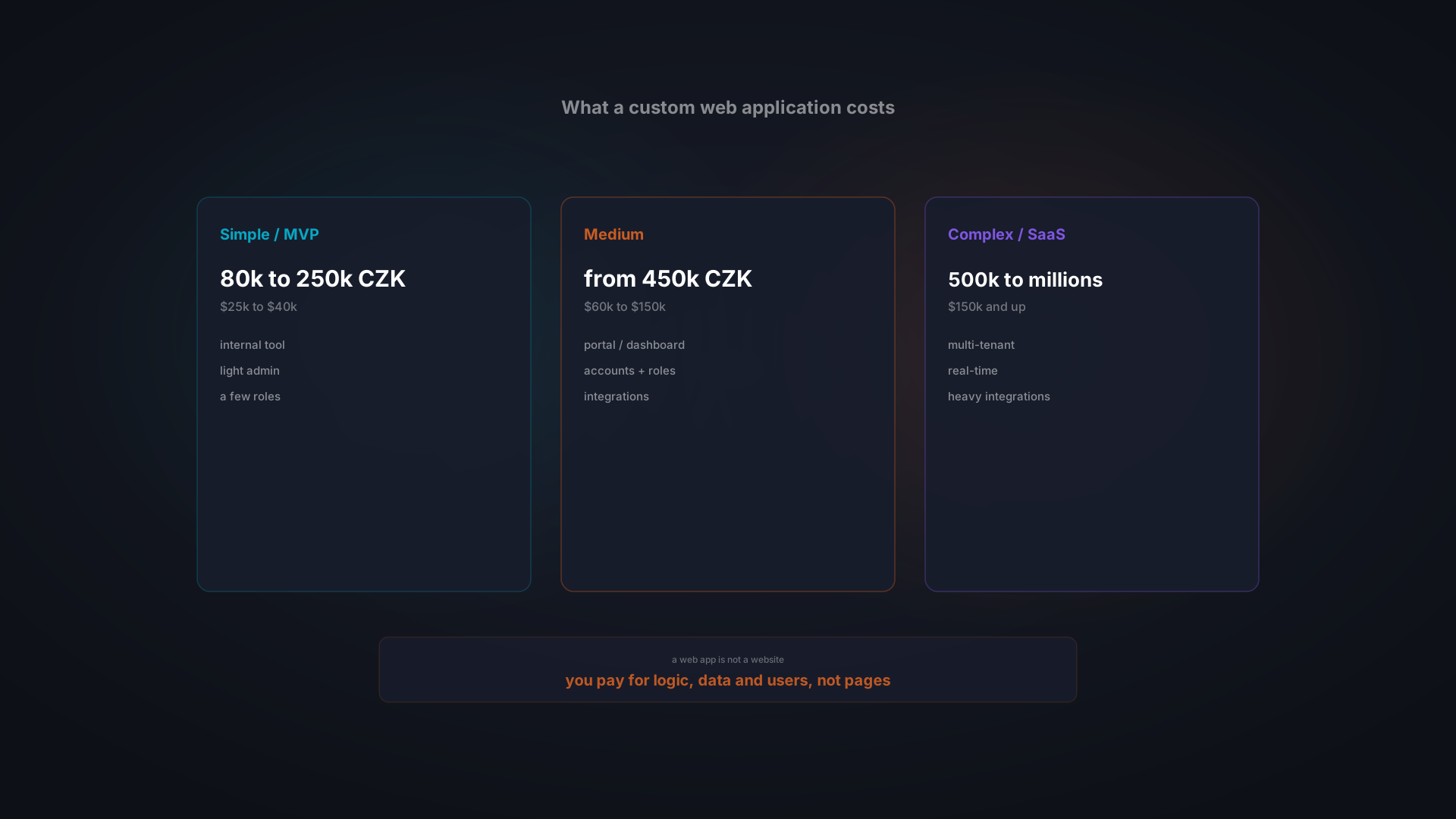
- Strategic bets (high impact, high effort): custom ERP, AI agents, full e-commerce platform. Plan these carefully, fund them properly, and execute with a partner who has done it before
- Optimisations (low impact, low effort): tool consolidation, process documentation. Do these alongside quick wins
- Avoid (low impact, high effort): bespoke tools for non-differentiating functions. Buy SaaS for these
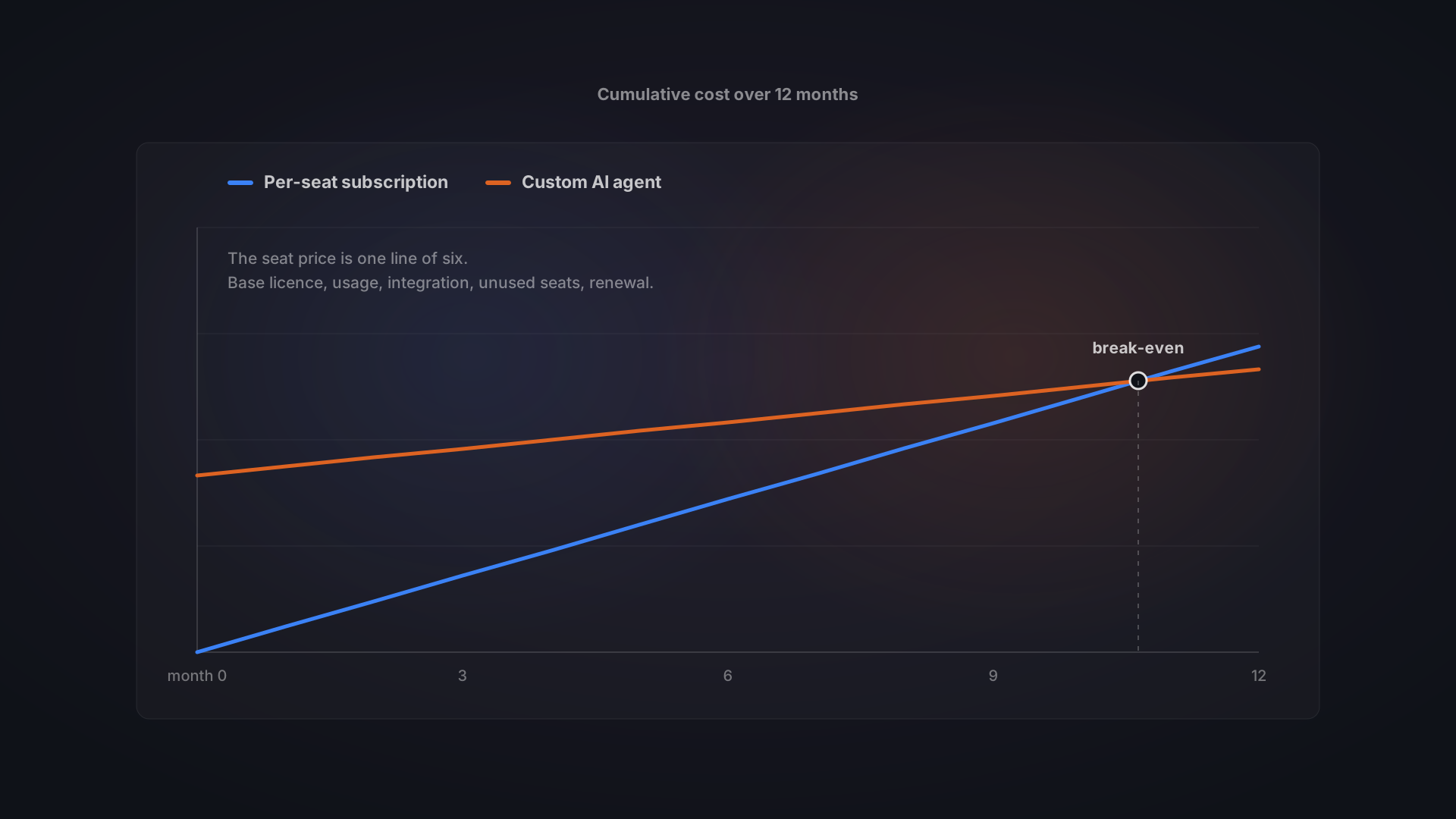
The build-vs-buy decision deserves its own analysis. Buy SaaS when the function is commodity, the workflow is standard, and there is no competitive differentiation in how you do it. Build custom when the process is a competitive differentiator, the workflow is complex and multi-system, the data is sensitive, or the long-term cost of SaaS subscriptions outweighs development investment. According to Retool's 2026 Build vs. Buy Report, 35% of enterprises have already replaced at least one SaaS tool with a custom build, and 78% expect to build more custom internal tools in 2026. SaaS subscriptions exceed custom development costs by 72% over five years. Read more on why custom software beats SaaS for a detailed framework.
Phase 3: Build Your Digital Foundation
This is where strategy becomes systems. The digital foundation for most European SMBs spans four technology domains, and the sequence in which you build them matters.
Customer Relationship Management (CRM)
Your customer data is your most valuable business asset. A CRM centralises it, makes it actionable, and creates the visibility that drives sales performance. CRM delivers an average of $8.71 ROI for every $1 invested, with an average 29% increase in sales and 34% improvement in productivity. Only 25.8% of EU enterprises currently use CRM software, which means the competitive advantage is still available to those who act.
For businesses with complex sales processes, industry-specific workflows, or deep integration requirements, a custom CRM outperforms off-the-shelf platforms at any reasonable time horizon. Read the full guide to building a custom CRM to understand the process, costs, and decision criteria.
Enterprise Resource Planning (ERP)
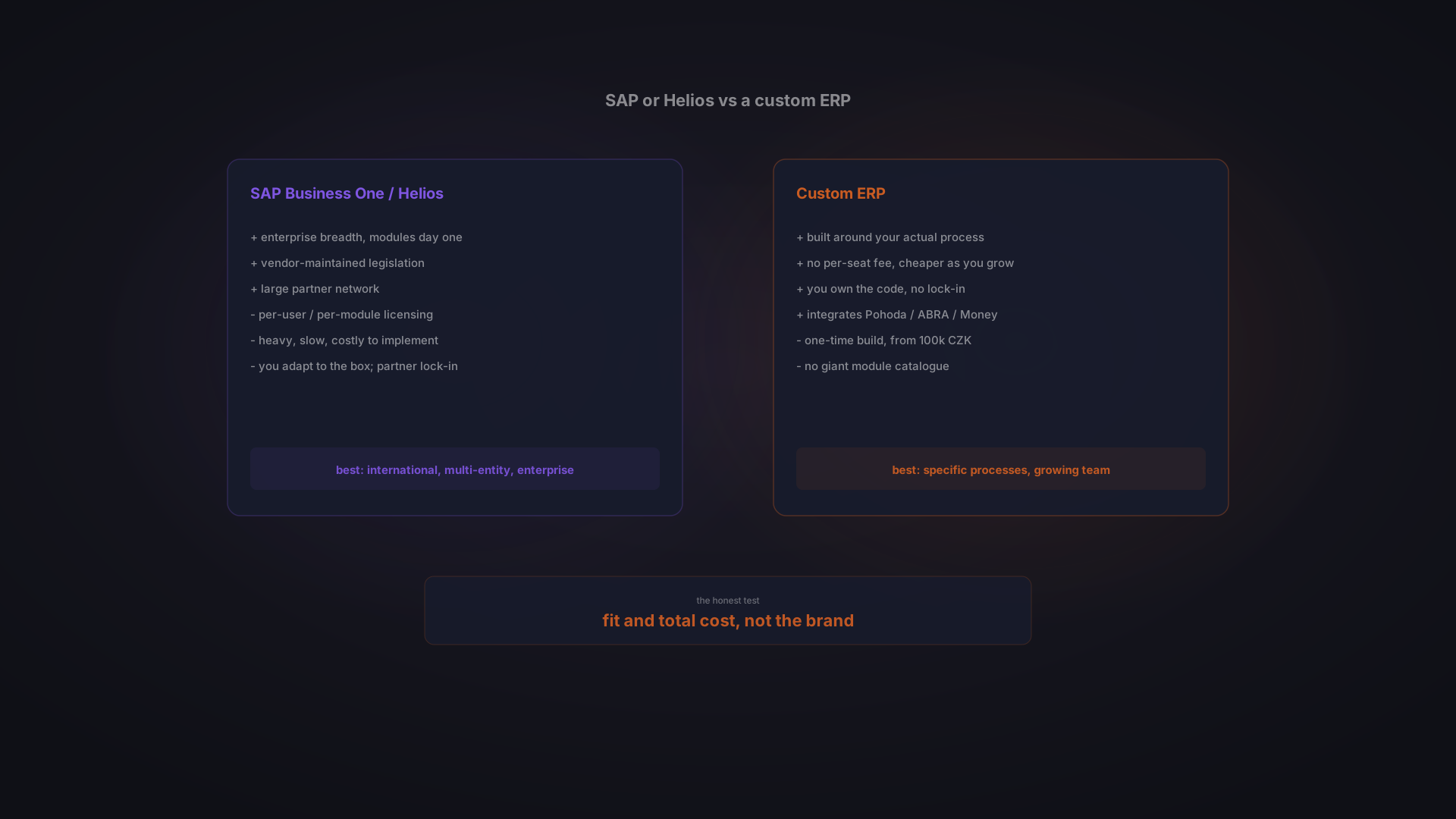
ERP unifies finance, inventory, HR, and procurement into a single system of record. The average ERP ROI is 52%, with 82% of implementations achieving ROI within the expected timeframe and an average payback period of 2.5 years. Yet only 37.9% of small EU enterprises use ERP, compared to 86.3% of large enterprises. That adoption gap is a competitive opportunity. ERP solutions built for your specific operations outperform generic platforms for growing businesses with complex requirements.
E-Commerce and Mobile
Digital sales channels are no longer optional for European SMBs competing in the single market. 78% of retail traffic comes from mobile devices. Mobile e-commerce is projected to exceed $7 trillion globally by 2027. For businesses that have outgrown template platforms, where customisation limits are slowing growth, performance is suffering, or multi-country expansion is constrained, a custom e-commerce platform and mobile app built to your specific requirements delivers the flexibility that generic platforms cannot.
Process Automation and AI
Start with the highest-volume repetitive tasks: the processes your team does manually every day that consume time without adding judgement. AI delivers the most immediate ROI here. Two Bitvea case studies illustrate the range:
- AI Invoice Processing: GPT vision AI processing 800+ invoices per month, achieving 87% cost reduction and 95%+ accuracy, eliminating a manual process that was consuming multiple hours of staff time daily
- AI Customer Support: 60% auto-resolution rate, response time reduced from 4 hours to under 2 minutes, CSAT improved from 3.2 to 4.6, transforming support from a cost centre into a competitive advantage
91% of AI-adopting SMBs report revenue growth. The businesses that implement AI agents and automated invoice processing are not replacing human judgement: they are freeing it for the work that actually requires it. For more on the opportunity, read how AI agents are transforming small business operations.
Phase 4: Integrate and Connect
Individual tools are only as powerful as their connections. The most common reason digital investments fail to deliver ROI is not that the tools are poor: it is that they do not talk to each other. Data silos persist. Manual handoffs remain. The automation you paid for only automates half the process.
Integration architecture (APIs, middleware, custom connectors, a unified data layer) is the infrastructure that transforms a collection of tools into a genuinely integrated operation. Two examples from Bitvea's work illustrate what integration delivers in practice:
- E-commerce order automation: connecting the e-commerce platform, inventory system, fulfilment operations, and accounting in a single automated flow, eliminating the manual steps between order and delivery that were creating errors and delays
- Custom sales CRM: integrating email, calendar, invoicing, and reporting into a single sales workflow, giving management real-time pipeline visibility without requiring salespeople to maintain separate records
GDPR data governance is a specific integration concern for European SMBs. Cross-system data flows require data mapping, consent management, and clear data residency policies. Building this into integration architecture from the start is far less expensive than retrofitting compliance later.
Phase 5: Scale and Optimise
Once your foundations are working and producing measurable results, the question becomes: what do you do more of? Use data and analytics to identify the next bottlenecks: the processes still constraining growth, the customer experiences still generating friction, the manual workflows still consuming disproportionate time.
Common scaling paths for European SMBs: from single-market e-commerce to multi-country platforms; from CRM to full customer lifecycle automation; from invoice processing to complete financial operations automation; from reactive customer support to proactive AI-driven engagement. Each of these is a natural extension of foundations built in Phase 3.
Build internal digital capabilities alongside your technology investment. 75% of SMBs feel underprepared in digital skills. Training your team to use, maintain, and extend your digital systems is not optional: it is what determines whether transformation is sustainable or whether it depends permanently on external support.
European-Specific Considerations for Digital Transformation
GDPR and Data Protection
GDPR is not a constraint to work around: it is a framework to build into your transformation from Phase 1. Data protection by design means making compliance architectural rather than an afterthought. The practical implications for digital transformation: data mapping before any new system is implemented, privacy impact assessments for processes involving personal data, consent management built into every customer touchpoint.
The May 2025 EU simplification proposal introduced targeted GDPR relief for companies with fewer than 750 employees, reducing administrative burden without changing the fundamental data protection obligations. This is useful context, but it does not change the strategic imperative: build GDPR compliance into your architecture from the start.
The custom software advantage here is significant. When compliance is baked into the architecture of systems built for your specific data flows, it is structurally more reliable than relying on a SaaS vendor's compliance framework, which may not cover your specific use case, jurisdiction, or cross-border data requirements.
EU Funding and Support Programmes
European SMBs have access to funding support that businesses in other regions do not. The EU's Digital Europe Programme carries a EUR 8.1 billion budget, with SMEs receiving a 75% funding rate compared to 50% for larger organisations. This is a meaningful offset to transformation investment costs.
European Digital Innovation Hubs (EDIHs) are perhaps the most underused resource available to European SMBs. Each hub carries EUR 2.6-4M per project and provides free digital maturity assessments, test-before-invest access to advanced technologies, training programmes, and connections to funding. Before committing to any significant technology investment, contact your nearest EDIH for a free assessment.
Most EU member states also operate national digitalisation voucher and grant programmes specifically targeting SMEs. The combination of EU-level and national support means that European SMBs have meaningful funding options that can significantly reduce the effective cost of transformation, particularly for businesses in Phase 2-3 of the roadmap.
The European Competitive Landscape
The European business software market stands at $75.78 billion in 2026, growing at 8.21% CAGR to reach $112.41 billion by 2031. Digital platforms are enabling European SMBs to sell across the single market at scale: the competitive moat of established enterprises is narrowing for businesses that invest in the right digital infrastructure.
Data sovereignty is a specific European consideration. Working with development partners who build and host within EU jurisdiction ensures your data stays within European regulatory frameworks, a procurement requirement for many European enterprise customers and a competitive signal of trustworthiness for consumers.
Why 70% of Digital Transformations Fail (and How SMBs Beat the Odds)
The 70% failure rate is well documented. What is less discussed is why, because understanding the failure modes is what allows you to avoid them.
The #1 reason is culture, not technology. McKinsey's research attributes 62% of digital transformation failures to cultural resistance. The technology worked. The people did not change how they worked. If you cannot get your team to change alongside the technology, you have an expensive proof of concept, not a transformation.
The other consistent failure patterns:
- Treating transformation as a technology project rather than a business initiative: buying tools without changing processes
- Trying to transform everything simultaneously instead of phasing initiatives by impact and readiness
- No executive sponsorship or change management investment: transformation without leadership commitment fails at the culture layer
- Choosing wrong technology or wrong partner: 54% of SMBs cite lack of expertise as a key barrier
- No measurement from day one: if you cannot show ROI on early phases, later phases lose funding and momentum
The businesses in the successful 30% share six characteristics: they start with business outcomes, not technology; they use a phased approach; they measure everything from day one; they invest in people alongside technology; they choose partners with implementation experience; and they start small, prove ROI, then scale.
Companies with fewer than 100 employees are 2.7x more likely to succeed at digital transformation than large enterprises. Faster decisions. Less bureaucracy. Shorter feedback loops. Closer to customers. The agility advantage is real, but only if you use it.
If you are recognising the warning signs that your technology is already constraining growth, read 5 signs you have outgrown your tech stack: it provides a diagnostic for where the pressure points are most likely to be.
Getting Started: Your Digital Transformation Roadmap Next Steps
Digital transformation is a phased journey, not a one-time purchase. The 5-phase roadmap (Assess, Strategise, Build, Integrate, Scale) provides the structure that separates sustainable transformation from expensive failure.
The numbers from businesses that have completed the journey are consistent: 60% efficiency gains, 43% profitability increase, $8.71 CRM ROI per dollar invested, 87% cost reduction on AI invoice processing, CSAT improvements from sub-3 to above 4.5. These are not projections: they are results from real implementations.
European SMBs have advantages that businesses elsewhere do not: genuine agility, EU funding support that covers up to 75% of transformation project costs, and regulatory frameworks that, when built into your architecture, become a competitive differentiator rather than a compliance burden. The businesses that act on those advantages now are building positions that compound.
The most important step is the first one: assess where you stand today across technology, data, processes, people, and customer experience. Everything else follows from that honest starting point.
Bitvea builds the custom software, CRM, ERP, e-commerce, mobile apps, and AI agents that power digital transformation for European SMBs, with measurable results and no vendor lock-in. Tell us where you are starting from. We will assess where technology can make the biggest impact in your business.